This report analyzes how technological advances and scientific research are enabling the commercialization of space, which is already presented as a business opportunity on Earth.
Space industry
The Space Age
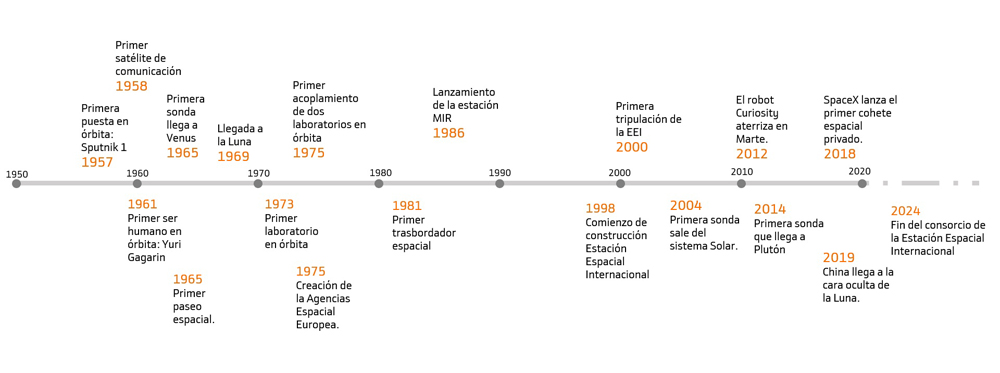
In the mid-twentieth century, the great powers of the time (the United States and the Soviet Union) began with the first activities in Space, beginning the Space Age.
The development of the space industry is allowing a new scenario for the commercialization of space, where the different actors involved develop their activities:
Investors must provide stability to the market.
Governments can incentivize private investment by trying to ensure regulatory stability.
Companies must direct their efforts to optimize processes and reduce production cycles.
The most promising fields of new commercialization of space, identified by the experts of the Future Trends Forum are: LEO market, manufacturing in space, satellite connectivity, democratization of access to space and the exploitation of space exploration data.
The commercialization of space is not without risks. Our experts highlight: the lack of legislation, the risks of business for those organizations that want to approach this industry and cybersecurity.
The arrival of the so-called Space 4.0 poses a series of challenges, as well as a change in the paradigms associated with space. For those who want to work in the commercialization of space:
– They should try to create a space-related value chain and try to make access cheaper and work on developing a broader and more accessible infrastructure that allows them to build space businesses. The goal is to create the products and services that will build the space industry.
– To do this, it is necessary to be disruptive and promote innovation, trying to influence traditional companies to adapt to a new way of doing things.
– But without losing sight of the fact that there has to be a viable business model, even if it is in the long term.
The main challenges to work on for the future of space commercialization selected by the experts of the Future Trends Forum are:
The space industry is currently developing in various fields, but the experts of the Future Trends Forum have highlighted that new business opportunities will move to a sustainable market in low Earth orbit; manufacturing and fabrication in space; global connectivity via satellite; democratization of access to space; exploitation of data obtained by satellites.
What will be the business models that exploit these new business areas?
Until now it was governments and government space agencies that have led the space industry, but with new business opportunities, it must now be companies that take the lead.
How should governments facilitate access to space for private companies? What is the new role of space agencies?
There are still many things to be clarified in the commercialization of space, especially from the point of view of the global risks of its development from a legal and regulatory point of view; business; organizational and cybersecurity.
What will the global regulations governing activity in space be like? Who should be the regulator? Who should organize this activity? How do we ensure that this activity is safe?
Space-related activities are around 260,000 million dollars per year. But according to estimates by Bank of America Merrill Lynch, by 2045 investment in space will increase eightfold, reaching about $2.7 trillion. In addition, it is estimated that from June 2017 to June 2018 the private initiative invested 3,400 million dollars in the space and that this investment will continue to grow.
How should the new commercialization of space be financed? How should governments promote and ensure private investment in space?