
AI-generated summary
The Akademia 2020-2021 program has launched its first session focused on fostering innovation among Spanish university students nearing graduation or recently graduated. Sixty students from diverse disciplines, selected in partnership with several universities, participate in a practical journey that immerses them in the innovation process—from predicting future trends to developing AI-based algorithms. Guided by leading professionals, students gain hands-on experience and insights to help them create groundbreaking products and services for the future.
In the inaugural session titled “How to innovate by putting your knowledge into practice,” experts Javier Foncillas and Fernando Alfaro emphasized that innovation arises from applying existing knowledge in novel ways, particularly leveraging telecommunications and energy—two fundamental human domains. They highlighted that innovation is a learnable skill, requiring a methodology to analyze problems and transform solutions into impactful, market-relevant innovations. Health was identified as the largest current innovation field due to its vast demand and limited supply. Key elements for innovation include deep expertise in any discipline, leveraging energy and telecommunications as transformative vectors, and amplifying knowledge through artificial intelligence. The experts also advised surrounding oneself with diverse, talented people to enhance innovative potential.
Since 2008, the Bankinter Innovation Foundation’s Akademia program has empowered over 1,600 students with critical innovation skills that have significantly shaped their careers.
Akademia experts, Javier Foncillas, VP. Commercial Partnerships Europe at Dolby and Fernando Alfaro, Co-founder of Madiva Solutions, provide the keys for you to become an innovator.
The first session of the Akademia 2020-2021 program has already taken place and has dealt with how to innovate.
The mission of the program is to awaken the innovative attitude of Spanish university students with high potential, who are about to finish university or have just finished it. Among all the candidates who have applied, we have selected 60 university students from multiple disciplines, in collaboration with universities such as the Polytechnic University of Valencia, Pompeu Fabra, Loyola University and the University of Santiago de Compostela.
Students take a practical journey that allows them to experience a real innovation process: from learning to predict future trends to developing an algorithm based on Artificial Intelligence. To this end, we have a network of professionals who stand out in their respective fields and who accompany students by contributing their experiences and practical cases, with the sole purpose of helping new generations to generate innovative products and services for our future.
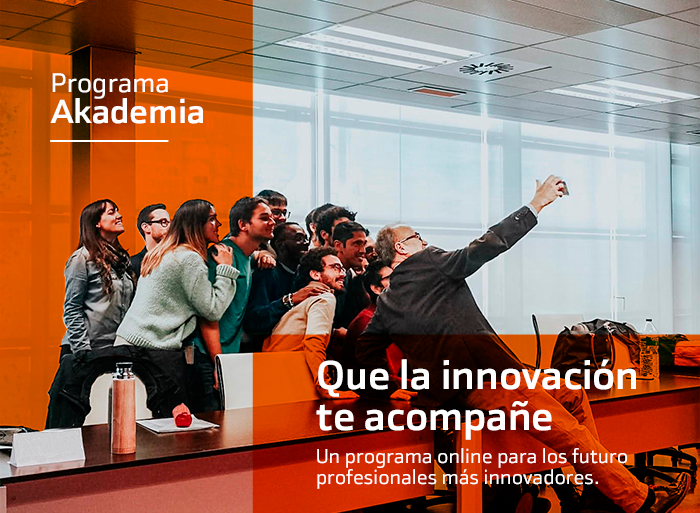
In the first session, under the title “How to innovate by putting your knowledge into practice”, the experts of the Spanish innovation scene Javier Foncillas and Fernando Alfaro, have broken down the keys to being innovative based on our current knowledge.
With the common thread of telecommunications and energy, we can distill the following ideas:
- Every time there are changes in telecommunications and, or energy, there is a wave of innovation. This is because both areas are intrinsic to the human being: Communication and work.
- Innovation is applying the knowledge you have to solve challenges in a different, groundbreaking way that provides differential value.
- You learn to innovate. To innovate, you have to apply a methodology and a way of thinking: analyze common problems and see how we are able to turn solutions into innovative products. Think about what you know and apply telecommunications. A very simple way to innovate is to take everyday problems, large markets and apply new forms of energy and new forms of telecommunications to them.
- The only sustainable competitive advantage is learning before everyone else.
- The largest field of innovation currently is in Health, where demand is “infinite” and supply is limited.
- In essence, you need three things to innovate:
- Have a deep functional knowledge of a subject (it can be economics, marketing, medicine, engineering or journalism, any field of knowledge).
- Use energy and telecommunications as a vector of change in your field of knowledge.
- See how that knowledge can become exponential: Thanks to Artificial Intelligence, an expert’s knowledge is not constrained by time or space.
And one final piece of advice: surround yourself with people better than you, smarter than you, and different from you. This way you will become an innovator in everything you tackle.
The Bankinter Innovation Foundation’s Akademia programme has been successfully held since 2008, having helped more than 1,600 students acquire essential skills and abilities that have made a difference in their professional careers.