
AI-generated summary
The Bankinter Innovation Foundation continues advancing societal and professional understanding of innovation through its outreach initiatives, recently hosting a webinar focused on intelligent robotics. This event followed the Future Trends Forum (FTF), which explored the rise of embodied AI—artificial intelligence that physically interacts with the world—and produced a comprehensive report available online. In the webinar, Sonia Chernova, a researcher from Georgia Tech and FTF participant, discussed how AI integrated with sensors and robots is reshaping human-machine collaboration. She traced robotics evolution from large, industrial robots of the 1980s and 90s, which were fast but inflexible and hazardous, to the emergence of collaborative robots (cobots) around 2000. Cobots are smaller, safer, and designed to work alongside humans, revolutionizing manufacturing and logistics. Autonomous mobile robots (AMRs) have also transformed warehouses by efficiently transporting goods without human intervention, with companies like Starship Technologies and Fox Robotics leading innovations. Chernova emphasized that successful robotic integration depends on structured environments and highlighted how mobile manipulation—combining navigation and object handling—is a key yet challenging frontier.
Addressing current trends, Chernova examined the hype around humanoid robots and foundational AI models, noting that while these technologies promise multifunctional capabilities, they face substantial technical and practical hurdles. She cited Agility Robotics’ Digit as a rare example of a functional humanoid robot focused on real-world applications, contrasting it with many prototypes still far from market readiness. The webinar concluded with a Q&A covering robotics’ impact on employment, the long horizon for domestic robots, maintenance challenges, and ethical concerns about autonomous weapons. Chernova advocated for critical, ethical, and responsible adoption of robotics and AI, encouraging focus on mature sectors like last-mile delivery, and emphasizing education and retraining to navigate the evolving landscape.
Discover the real impact of physical AI and intelligent robotics on our lives with Sonia Chernova, expert in human-robot interaction
The Bankinter Innovation Foundation continues to be committed to bringing the innovation that will mark the future closer to society and professionals. As part of this mission, we have organized a new webinar dedicated to one of the most transformative fields: intelligent robotics.
This event is part of our outreach cycle after the celebration of the last Future Trends Forum (FTF), where more than 40 international experts analysed the rise of physical AI (Embodied AI) – artificial intelligence that already interacts directly with the physical world. The FTF’s conclusions have been reflected in our “Embodied AI” report, now available on the web.
To delve into this technological revolution, a webinar has been organized by Marce Cancho, director of the Future Trends Forum, in which we have Sonia Chernova, researcher and professor at the Georgia Institute of Technology, who also participated in the FTF.
During the session, Sonia Chernova shares her vision on how artificial intelligence is driving modern robotics and its concrete impact on people’s lives. It discusses how the combination of AI, sensors, and robots is revolutionizing our coexistence with technology and redefining human-machine collaboration. In addition, it explores the growing global commitment to humanoid robots: what this trend means, what the real expectations are and what advances are still to come.
Don’t miss the webinar The Future of Intelligent Robotics with Sonia Chernova, which illustrates the capabilities of robots with numerous impactful videos:
The first robots: giants of industry
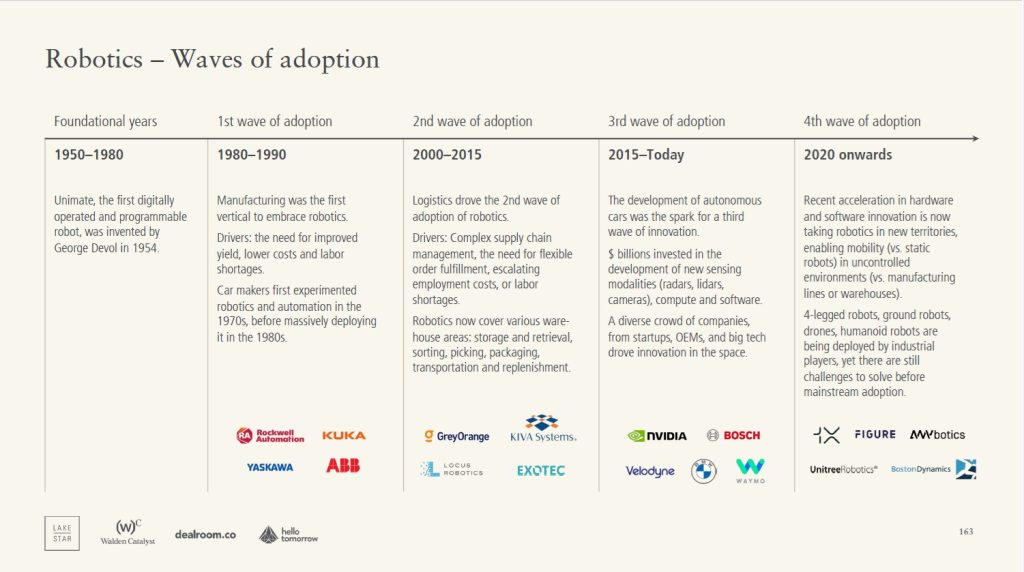
Sonia Chernova begins her speech by reviewing the first generation of industrial robots that burst into factories during the 80s and 90s: large, heavy and with high power and voltages. These extremely fast and precise robots drove decisive innovations in the automotive and other industrial sectors.
However, they also had significant limitations: they were dangerous for operators, who could not share space with them, and required specially designed work environments. In addition, its use depended on software and highly specialized training, which made its integration complex and expensive. These robust systems are still in operation in many factories, but their lack of flexibility and siloed nature have been overcome by new generations of more accessible and collaborative robots.
Source: https://dealroom.co/uploaded/2025/03/2025_Dealroom-Deeptech-Report.pdf
Cobots and the Collaboration Revolution: A New Paradigm in Manufacturing
After describing the panorama of large industrial robots in past decades, Sonia Chernova explains how, from the year 2000, a new type of robot began to emerge that would completely change the relationship between humans and machines: cobots, or collaborative robots. These robotic arms are smaller and more versatile than industrial giants, and are designed to share space and tasks with workers. Unlike traditional robots, cobots do not need physical barriers: they can be touched, moved and programmed manually by operators.
Chernova details how European, Asian and American companies, such as Universal Robots, have democratised this technology, offering solutions that allow assembly, welding or adhesive application processes to be automated in a safer and more flexible way. While cobots are no substitute for large robots when it comes to handling heavy or large parts, their range – around one and a half metres – and their ability to carry up to 15 kilos are more than enough for many logistics and manufacturing tasks.
Mobile robots and the logistics of the future
At the same time that cobots were taking hold in factories, other key innovations were emerging: autonomous mobile robots (AMRs ). Chernova explains how these smart vehicles are transforming warehouses and distribution centers, as they allow packages or even entire shelves to be transported without human intervention. These platforms integrate into existing environments and can move around operators and vehicles, increasing efficiency and reducing time and costs.
He exemplifies this trend with cases such as Starship Technologies – founded by the creators of Skype – whose delivery robots are now operating on university campuses and streets in Europe and the United States. He also talks about the autonomous robots of the company Fox Robotics, capable of moving entire pallets in large-scale warehouses.
The researcher also addresses applications beyond warehouses, mentioning the case of Diligent Robotics. This company develops robots for hospitals, capable of transporting medical supplies and improving efficiency in healthcare environments.
Another prominent example is AutoStore, founded in 1996 in Norway. This company has developed a cube-based system that maximizes storage capacity by using robots that lower and raise boxes in vertical structures. Although limited to small objects, this system allows you to triple or quadruple the capacity of a warehouse without the need to increase physical space.
Sonia Chernova also presents Ocado, a British company that has been using robots to automate the preparation and delivery of supermarket orders since 2000. These systems employ a network of robots to pick and pack fresh and dry produce, integrating with e-commerce and home delivery.
Another fascinating case is that of Symbotic, founded in 2007 in the US, which is automating the distribution centers of Walmart, the largest retailer in the country. Unlike other, more rigid systems, Symbotic uses robots that can handle boxes and products of all sizes, without the need for special packaging or containers. These intelligent systems pick up orders from stores and build entire pallets ready to be loaded onto trucks, employing robotic arms that – as Chernova says – “play Tetris” to organize packages optimally and safely.
Overall, Chernova paints a clear picture: robotic technology has moved from isolated, dangerous machines to systems that work in harmony with people, redefining factories, warehouses, and hospitals. Companies such as Universal Robots, Starship Technologies, Fox Robotics, Diligent Robotics, AutoStore, Ocado , and Symbotic are leading this transformation, driven by the combination of AI, sensors, and new forms of automation.
The role of structure
After reviewing how logistics has become the main driver of robotics success in the last 20 years, Sonia Chernova takes stock of the level of integration and the challenges posed by this technology. He highlights that the most advanced systems – such as fully automated warehouses – offer very high productivity, but require a profound restructuring of spaces and business processes. On the contrary, technologies such as AMRs (autonomous mobile robots) and collaborative robotic arms bring significant improvements with less impact on the facility, making them easier to adopt in existing environments.
Chernova stresses that the success of robotics ultimately depends on the structure: from the physical layout of the warehouses to the homogeneity of the products handled. For autonomy to work, the environment must be structured: either by simplifying navigation (as in a well-ordered warehouse), or by standardizing the sizes and shapes of objects to facilitate their handling.
Throughout her speech, Chernova explains that current solutions tend to specialize in navigation (moving things) or manipulation (grabbing things), but rarely in both at the same time. The success of combining these functions – known as mobile manipulation – remains exceptional. Only when the environment is highly structured is it possible to achieve this successfully.
To illustrate this point, Sonia talks about the case of Diligent Robotics, an American company founded in 2015. Diligent Robotics designed a robot for hospitals with an arm and wheels, initially thinking that it could pick up supplies from warehouses and place them on shelves. However, after years of testing, they found that such an application was not practical or necessary for healthcare workers, who were not satisfied with the performance. What did prove very useful was the ability of these robots to transport samples, medicines, and other materials through the long hospital corridors. Diligent Robotics’ robot remains the only one that, in addition to moving, maintains a functional arm for simple but critical tasks, such as pressing elevator buttons or opening doors thanks to its ID card. Currently, these robots perform more than 10,000 interactions per month, demonstrating the importance of finding concrete and useful applications for mobile manipulation.
Other sectors: household and large-scale distribution
Sonia briefly mentions robotics in the home and in supermarkets. In the domestic sphere, except for robot vacuum cleaners – which are already part of daily life – companion robots such as ElliQ, aimed at the elderly, are still very rare. And although during the pandemic robots were experimented with to inventory products in supermarkets, the technology has not been as successful as expected and has not yet been consolidated in these environments.
Humanoid robots and foundational models: the next frontier… or a bubble?
After analysing the successes of robotics in logistics and manufacturing, Sonia Chernova addresses in the webinar one of the hottest topics of recent years: humanoid robots and foundational models for robotic systems.
Chernova explains that, if we follow the news of the sector or networks such as LinkedIn, it seems that the only trend that matters right now is humanoid robots. Companies like Figure are attracting large venture capital investments to develop vision, language, and action (VLA) models, such as their Helix project: a system that integrates visual perception, language understanding, and even motor control into a single AI model. It’s an impressive leap – beyond traditional automation – that seeks a “universal brain” for all kinds of robots.
The researcher illustrates how this approach aspires to create a foundational model capable of controlling very different robots (simulated, real, underwater, logistic) and of processing multiple data sources (cameras, sensors, touch, etc.) to generate movement in the physical world. However, he acknowledges that this challenge is immense: while generative text and image models are trained on billions of examples, there is still no “internet of robotic movements” to serve as a database for learning.
Although there are projects that try to collect data – such as the RT-X project, which combines data from 25 research groups – the quantity and quality of information are still insufficient to achieve real generalist AI. In addition, the data generated in simulation has a major obstacle: the “gap” between what is simulated and reality, which means that training a robot in a virtual environment does not guarantee that it will perform as well in a real environment.
The challenge of manipulation and physical reality
Chernova emphasizes that the difference between a prototype and a marketable product is still huge. The development of humanoids involves overcoming complex technical challenges: mobile manipulation (moving and manipulating at the same time) is still difficult, and unstructured environments – such as homes or public spaces – multiply the difficulty.
In fact, while there are many impressive video demonstrations, she stresses that most of these humanoids aren’t ready for real-world applications. As an example, he mentions how the articulated fingers of today’s humanoid robots remain an unsolved challenge: the dexterity needed to manipulate small objects has not been reliably achieved, and these components often break easily.
Separating the Bubble from Reality: The Case of Agility Robotics
In a sea of promise and hype, Chernova highlights one exception: Agility Robotics and its humanoid robot Digit. Unlike other projects that are limited to eye-catching videos, Agility Robotics has demonstrated hours of continuous operation of its robot in real-world environments, such as warehouses and logistics centers. The secret to its success lies in prioritizing functionality over appearance: instead of trying to replicate human anatomy with complex fingers, Digit uses simple but effective tweezers. This decision allows your robot to be more reliable and ready for specific tasks such as moving boxes and collaborating with human workers.
Sonia Chernova concludes this analysis by stressing that, although media attention and investment are focused on humanoids and foundational models, most of these projects are still more of a dream than a reality. He recalls the example of autonomous cars, which a few years ago generated great enthusiasm until expectations clashed with technical complexity and the lack of practical results.
The case of Agility Robotics shows that it is possible to find viable applications and turn mobile manipulation into a real product, but the road is full of challenges. And, for now, much of the current fervor around humanoids is still – in Chernova’s words – a bubble of expectations that is difficult to sustain.
Current trends and resources for further analysis
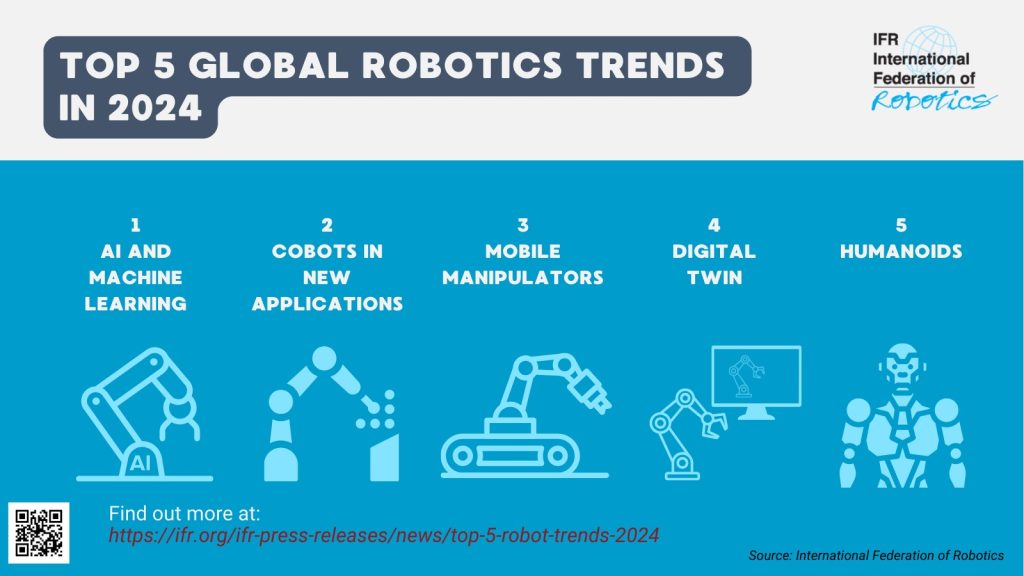
To close her speech, Sonia Chernova summarises the major trends that are marking the present of robotics. In addition to humanoids and foundational models, the growing attention to mobile manipulation, which combines navigation and manipulation in the same system, and which remains one of the most complex and promising challenges of the discipline, stands out.
Other hot topics include the rise of cobots as flexible allies for manufacturing tasks and the popularization of digital twins, which allow physical environments to be simulated and optimized before making actual investments.
Source: https://ifr.org/ifr-press-releases/news/top-5-robot-trends-2024
For those who wish to delve deeper, he recommends sources such as The Robot Report and the International Federation of Robotics, which publish global analysis and trends on a regular basis. He also mentions major events such as RoboBusiness, the largest international meeting in the sector, which every year brings together experts and professionals to share experiences and discover the latest developments.
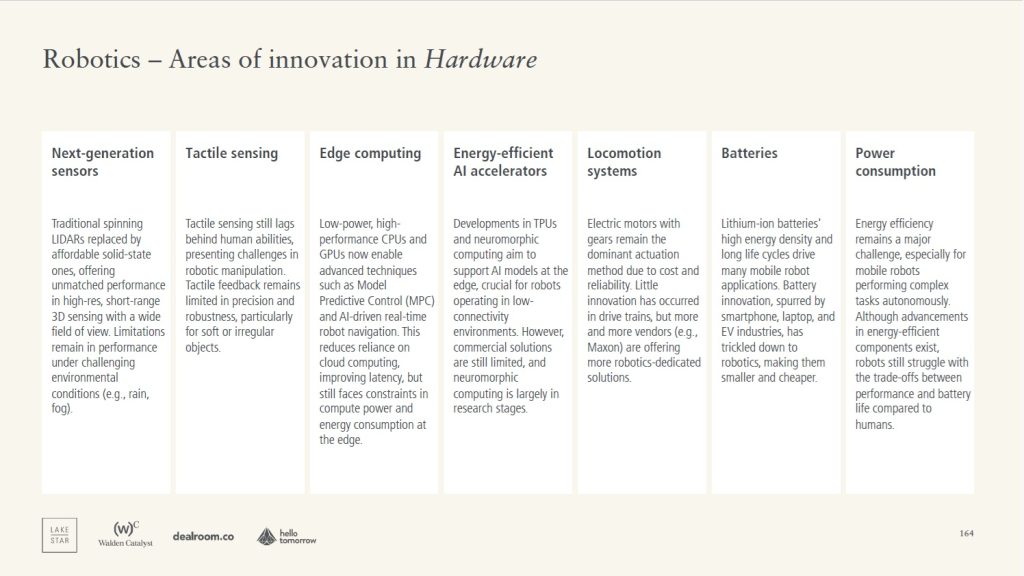
Regarding the latest innovations in Hardware and Software, Sonia refers us to the document THE 2025 EUROPEAN DEEP TECH REPORT:
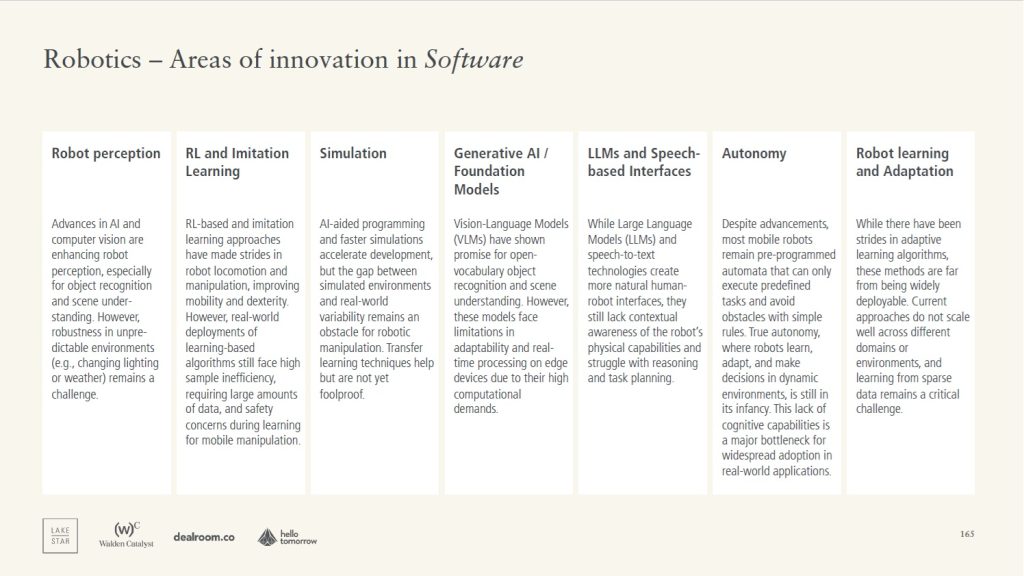
With these references, Chernova concludes her presentation and opens the Q session.
Q Job, Household and Future Outlook
The round of questions and answers has been extensive and addresses essential issues to understand the challenges and opportunities of robotics in our society.
How will robotics affect employment?
Sonia Chernova explains that robots and generative AI will change the world of work, but not suddenly. While there will be job losses, especially in repetitive jobs, opportunities will also arise in the development, maintenance, and monitoring of these technologies. In addition, companies are already facing difficulties in finding workers for certain tasks, which makes robots allies rather than immediate threats.
How far are we from having domestic robots?
Very far away, says Chernova. Homes are highly unstructured and variable environments, which greatly complicates the adoption of robots that can multitask. Although there are projects and research centers dedicated to robotics in the home, the reality is that there is still a long way to go.
What about robot maintenance?
Robot maintenance, especially in industrial environments, is quite advanced. However, robots continue to fail, especially in large logistics centers where frequent breakdowns are recorded. Companies deal with this with redundancy and quick repairs. In the case of cobots, they are very robust machines that can operate for years without significant problems, as long as too early versions of the products are avoided.
What role does education and training play?
Chernova stresses the need to train the next generations not only in robot engineering, but also in its application in companies and in business. In addition, it underlines the importance of continuing education programmes for adult workers, a field that is still underdeveloped but crucial for the future.
Is there a relationship between the jobs that are lost and those that are created?
While there is no precise figure, Chernova tells how some companies are choosing to retrain their employees to become robot operators, rather than firing them. In this way, robotization can open the door to safer and more specialized jobs, provided that investment is made in training and retraining.
Why did you choose robotics?
Sonia shares her personal journey: she started in AI thanks to her teacher, Manuela Veloso, and soon became fascinated with the possibility of developing programs that could help people. For her, human-robot interaction is key, as humans are the most unpredictable and challenging environments.
What type of robotics to invest in in the short term?
His recommendation is clear: focus on last-mile delivery. Although humanoid robots capture a lot of media attention, last-mile delivery – the final connection between transport and the consumer – is a more mature area with high potential for growth in the coming years.
What do you think about the use of robots as weapons?
Chernova’s response is blunt: he is very concerned about this trend. While acknowledging the power of autonomous technologies in war situations, he fears that they could create even greater imbalances and that their use as autonomous weapons poses a very serious ethical and political risk.
This is how the webinar concludes: with a realistic tone, full of data, examples and reflections. A reminder that, although robotics and AI are transforming our industries and our lives, their adoption and evolution must be approached critically, ethically and responsibly.

Profesora Asociada en el Instituto de Tecnología de Georgia (Georgia Tech)