AI-generated summary
Geothermal energy, derived from the Earth’s subsoil heat, is a clean, virtually infinite energy source available almost anywhere on the planet. It is harnessed by drilling into the ground and circulating a liquid to absorb heat, which can be used for district heating or to generate electricity if sufficiently hot. With urgent global decarbonization needs underscored by rising temperatures and climate reports, geothermal energy offers a crucial alternative to carbon-based power. It stands out for its high availability, with over 80% of human settlements suitable for its use, surpassing wind and solar power coverage. The technology is evolving, with shallow drilling common for heating and deeper drilling being explored to produce electricity, especially in less populated regions like Utah and Nevada. Notably, the geothermal sector could benefit from a workforce transition as skills from the oil industry, which is investing in geothermal, become transferable.
A significant advancement is the development of geothermal batteries, which store heat underground for extended periods, addressing renewable energy storage challenges without the environmental drawbacks of traditional batteries. Globally, geothermal projects are expanding: Iceland leads with decades of pioneering work; Spain has launched a €180 million Deep Geothermal program; France’s Elysée Palace uses geothermal heating; and the UK and the Netherlands are advancing their geothermal infrastructure. These initiatives highlight geothermal energy’s growing role in the clean energy transition.
If sustainability is pursued through decarbonisation, having geothermal energy is essential
Clean, virtually infinite, and ubiquitously available virtually anywhere on the planet, geothermal energy is emerging as an essential energy for the The decarbonization of human activities and yet their mass development and adoption will still require a few years, perhaps decades. Why is geothermal energy needed? What advantages does it have over other clean sources? What is the state of development?
What is geothermal energy, in a nutshell
Thermal energy extracted from the earth’s subsoil. In a plot, the soil is drilled and two connected vertical conduits are introduced: through one of the conduits, a liquid will travel to the subsoil and be heated, and the other conduit (communicating with the first) will serve to extract the hot liquid from the subsoil. This can be used for district heating (domestic heating, public swimming pools, spas…) and, if it is hot enough, to heat a gas, turbine and obtain clean electrical energy.
Why geothermal energy is urgently needed
In April 2024, the European Union’s Copernicus Climate Change Service (C3S) confirmed in its report for the year 2023 that “almost half of the days [of 2023] we were more than 1.5 °C above pre-industrial values and, for the first time, more than 2 °C” at some times. These are negative figures that urge urgent decarbonisation and spur any alternative energy generation solution.
In a global environment of high energy demand (and growth as many countries move out of poverty), it is necessary not only to have an extra source, but also a substitute for carbon. As mentioned in the Megatrends 2024 report, “sustainability affects everything”, and any solution that brings us closer to Net Zero will be welcome.
The state of the art of geothermal energy
The current photo. Geothermal energy is an energy of the future that is being studied in the present. Most viable locations and applications still they are in a dormant state and require both investment in infrastructure and local training to exploit that energy.
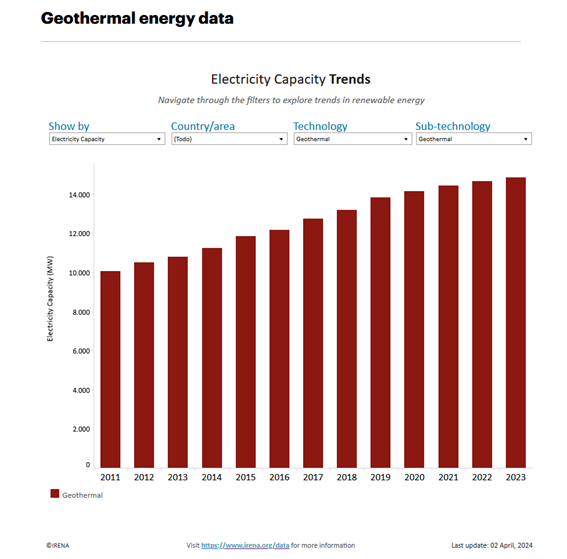
The (positive) trend. In 2009, there were about 10,000 megawatts of geothermal installed worldwide. By the end of 2023, the IRENA’s figure reached 14,800 megawatts.
A potential. While ‘only’ 40% of human settlements can make use of wind power and 65% of the photovoltaic, More than 80% can use geothermal energy. It is the most abundant type of energy with our technological level.
Technology (of the upper layers). Every year, about 70,000 are opened for oil and gas, and only 1,500 for geothermal. However, the trend is one of growth for the latter, and stagnation for the former. Drilling wells is no secret and we have the technology to reach the first hot layers, using heat from the planet as domestic heat.
Technology (of the lower layers). But if you want to transform heat from the subsoil into electrical energy, the drilling has to reach deeper levels. Something that is already being investigated at the moment with regions with almost no populations such as Utah and Nevada in the lead.
Job transition. One of the advantages of geothermal energy is that it requires a similar talent (with their differences, which there are) to the one that exists in oil drilling, a sector that he hopes to cannibalize resources. In fact, oil companies are the first to invest in geothermal energy, knowing that the time of their main business is running out.
Geothermal batteries, solving the problem of storing clean energy
One of the challenges of renewable energies, and of renewable energies in general, green and clean energies (they are not exactly the same), is that they have problems with storage. A photovoltaic or wind power plant can use electric batteries, but their cost, environmental impact and energy density limitations make it complicated. The solution?
Right now a way to store heat underground for hours or days is being tested in Nevada, as if it were a huge lithium-ion battery, but without the problems associated with its environmental impact. If geothermal energy is already clean, reliable, virtually unlimited and multifunctional (heat and electricity), storage technology would make it even more versatile.
Some current uses of geothermal energy
There are more and more geothermal projects globally. No wonder: it is a source of energy available practically anywhere, very profitable, inexhaustible thousands of years in sight and clean.
- In Iceland, they have been drilling into the earth’s crust for decades to obtain thermal and electrical energy. They are the pioneer country of this technology. Projects such as the IDDP seek to reach new drilling limits.
- In Spain, the Deep Geothermal program seeks to promote innovative geothermal projects by injecting aid worth 180 million euros. The grants have just been approved.
- The Elysée Palace in Paris, home to the Presidency of the French Republic, has opted for geothermal energy for heating.
- In the United Kingdom, a geothermal project with the longest well in the country has been activated (finally, it had been on stand-by for years).
- In the Netherlands, the Geothermie Nederland project has been driving the development of the technology in the nation for years.