

AI-generated summary
The webinar “Alternative Proteins: Towards a Sustainable Food Future,” featuring Mark Post, co-founder of Mosa Meat and pioneer of cultured meat, explored the urgent challenges and innovative solutions for sustainable food production amid a growing global population expected to reach 10 billion by 2050. Post highlighted the inefficiency and environmental harm of traditional animal protein production, which consumes vast agricultural land and water, contributes significantly to greenhouse gas emissions, and wastes large amounts of food. He emphasized that plant-based and alternative proteins, including cultured meat grown from animal cells without slaughter, offer promising paths to meet rising protein demands sustainably. Cultured meat, especially when produced with renewable energy, can reduce environmental impacts close to those of plant proteins, while also addressing consumers’ preference for meat taste and texture.
Post acknowledged the challenges in consumer acceptance of alternative proteins but remains optimistic, citing increasing familiarity and regulatory progress in several countries. He noted the evolving industry with over 160 companies and emphasized the potential integration of cultured meat production with traditional farming to support farmers’ transition. Projecting that alternative proteins could replace up to half of meat consumption within 15 to 25 years, Post stressed the necessity of these innovations as there is no viable plan to continue current unsustainable animal protein production. The webinar underscored the importance of international collaboration, regulatory support, and consumer education to accelerate the adoption of sustainable food alternatives.
Exploring the Science, Challenges, and Potential of Alternative Proteins for Sustainable Global Food, with Mark Post
Following the presentation of the report Smart Agriculture: The Sustainable Food Challenge, the result of the 41st edition of our think tank Future Trends Forum, we continue to present some of the most interesting topics discussed by the participating experts.
After the webinar Challenges and Solutions of Sustainable Nutrition, where we had Gabriel Torres, CEO of Pascual Innoventures, and Juan Gabriel Aguiriano, Group Head of Sustainability, Technology Ventures at The Kerry Group, LLC, we held the webinar Alternative Proteins: Towards a Sustainable Food Future , with the presence of expert Mark Post, known worldwide as the “father of cultured meat” and co-founder and Scientific Director of Mosa Meat, a spin-off of Maastricht University, which in 2013 produced the world’s first hamburger grown from cultured cells. In addition to his work on cultured meat, Mark Post has also conducted research on alternative sources of protein, such as insects, vegetables, and microorganisms.
In this webinar, Mark Post offers an in-depth look at the future of sustainable food production, exploring the crucial challenges and innovative solutions needed to feed a global population projected to reach 10 billion by 2050. Throughout the webinar, Mark Post talks about vital topics such as environmental sustainability, resource efficiency, and equitable food distribution. Alternative proteins, whether plant-based, insect-based or using cell culture techniques, are promising solutions. All of them face significant challenges, both in terms of production and acceptance, with international collaboration and the involvement of regulators being of vital importance.
If you want to watch the webinar, you can do so here:
Alternative Proteins: Towards a Sustainable Food Future with Mark Post
Below, we summarize the ideas discussed in the webinar:
Challenges and Solutions in Sustainable Food Production: The Inefficiency of Animal Proteins
Feeding the world is a complex problem and is becoming increasingly complicated as our current population heads towards ten billion, with increasing demands, such as for animal protein. The current protein production system will not be able to meet the expected demand.
At the Smart Agriculture: The Sustainable Food Challenge, experts identified several critical issues with the food system. One of them is clearly unequal distribution: a large part of the population does not have enough food while another part has excess food. On the other hand, during production and consumption, approximately 40% of all the food we produce is wasted.
There are several inefficiencies in the food system, and one of the most important is in the production of animal proteins. Despite being an attractive method, it is a very inefficient way to feed the population. In addition, there is the environmental impact of animal protein production, which contributes to the unsustainability of our food production system.
There is a growing demand for animal proteins. Although in parts of the Western world such as Europe and the United States meat consumption is relatively stable, this is not the case in other regions such as China, India and Africa. Animal protein consumption has been increasing for the past 30 years and is expected to continue to increase for at least the next 25 years. According to the FAO, by 2050 we will need almost double the current production of animal proteins.
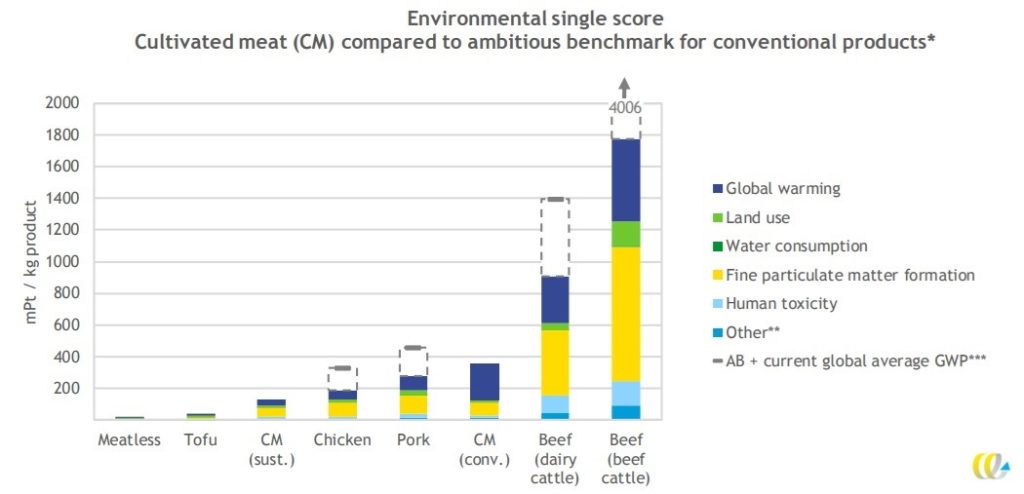
Animal proteins consume 80% of all our agricultural land and 20% of freshwater use, contributing to greenhouse gas emissions of between 14 and 15%. This is mainly because animals act as intermediaries between the plant proteins in their diet, such as grass for cows, and the animal proteins in our diet, losing a large number of calories in the process. For example,
Source: LCA of cultivated meat
As can be seen in the figure, there are two approaches to producing cultured meat (MC): one conventional and one sustainable. The main difference between these approaches lies in the type of energy used for their production. If based on fossil fuels, the environmental impact of cultured meat (CM-conv) is between that of pork and beef. If, on the other hand, renewable energy (CM-subst) is used, the impact is comparable to that of chicken proteins and is close to, but not equal to, that of vegetable proteins.
Post argues that, from an environmental and health perspective, the most prudent thing to do would be to adopt a vegetarian diet. He tells us that the myth that animal proteins are essential for human health is false, highlighting that there are two billion vegetarians in the world who lead healthy and fulfilling lives. In addition, he cites studies showing that plant-based diets can reduce the risk of cardiovascular disease.
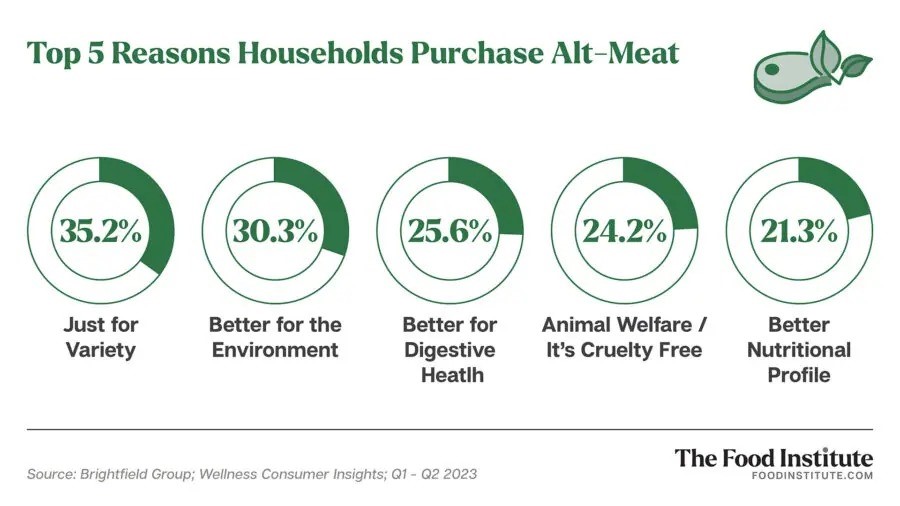
It also mentions that, although the inclusion of a very limited amount of animal protein could be beneficial from a global perspective, especially in places where access to a wide variety of plants is not possible, the transition to more plant-based diets is clearly favorable. However, he acknowledges that changing established eating habits is not easy, as evidenced by the experiences of companies such as Beyond Meat and Impossible Foods, which have had initial success in offering plant-based alternatives to meat consumers, but now find that their growth forecasts are far from being achieved. Major vegetarian food producers, such as Tattooed Chef, even went bankrupt. This pullback has generated a feeling of disillusionment in the U.S. market towards plant-based meat substitutes, considering them a lost cause, which has negatively influenced investments towards these companies. Post mentions that this sentiment has not been replicated in Europe and he is skeptical about it happening. In addition, a study that analyzes the reasons why households would opt for alternative meats reveals that the main motivation is the search for variety in the diet.
Source: The Food Institute
The possibilities of lab-grown meat
However, Post stresses that most people like meat and don’t have the discipline to become vegetarians, underscoring the need for choices that don’t compromise taste or environmental impact. Faced with this challenge, cultured meat has the greatest potential, a technology that makes it possible to produce meat from animal cells without the need to slaughter animals. This process is based on tissue engineering and is achieved by adapting pre-existing medical technologies to grow muscle and fat tissue in the laboratory. Since their first cultured burger in 2013, they have improved the efficiency of the process, increasing the proportion of cells that effectively produce muscle tissue from 50% to 95%, and eliminating animal components in the culture medium to create a product that is ethical, sustainable, and efficient.
However, in order for cultured meat to replicate the taste and texture of traditional meat, not only animal muscle cells have to be cultured, but also fat cells. Post explains how they have managed to grow adipose tissue. Today, the composition of cultured fat is very close to that of natural fat, with a higher proportion of unsaturated fatty acids.
Post notes that meat farming requires considerable fermentation capacity, similar to the process used to produce single-cell proteins from fungi. This process is intensive but feasible and necessary if you want to replace traditional meat production on a large scale. In addition, it discusses the economic and technical challenges of making cultured meat economically viable, highlighting the significant reduction in production costs thanks to technological advances and the substitution of pharmaceutical-grade ingredients for cheaper food-grade ones.
The future of cultured meat
In the closing of his presentation, Mark Post addresses the acceptance of cultured meat, stressing that its adoption is not immediate due to its origin in the laboratory, which some criticize as “Frankenstein’s food”. However, Post is optimistic that, with enough explanation and education, these products will gain market acceptance. He highlights that familiarity with these products has been increasing since 2011 and believes that, over time, people will become accustomed to consuming foods that might initially seem strange, similar to how many consume sausages without fully knowing their composition or production method.
In addition, Post mentions the rapid growth of the cultured meat industry, which already has 160 companies globally, and how some are starting to scale production, facing technical challenges and high ingredient costs. Despite the difficulties, significant progress has been made in regulation, with approvals in markets such as Singapore, the United States, Israel, and Australia.
Post also discusses the potential impact of these technologies on traditional agriculture, highlighting efforts to integrate farmers into this new paradigm through initiatives such as Respect Farms, which seeks to design farms of the future where cultured meat can be produced on a small scale alongside traditional farming. This approach seeks to innovate in food production by offering sustainable alternatives that could ease the pressure on farmers in places like the Netherlands.
Finally, it projects a significant change in the next 15 to 25 years, where up to 50% of meat consumption could be replaced by alternative proteins. This change, according to Post, is inevitable given that there is “no viable plan B” to continue with current methods of producing and consuming animal proteins. Thus, Post emphasizes the need to develop and present these alternatives to the consumer, offering options that can mitigate the problems associated with conventional meat production.
Q with Mark Post
During the webinar’s Q, Mark Post addresses a variety of audience concerns about cultured meat and alternative proteins. One of the points discussed was the initial impetus that led Post to found Mosa Meat, highlighting his motivation for environmental impact.
On the increase in meat consumption, he explains that while in the West it seems to be stagnating, in developing countries such as China and India it is increasing significantly due to the improvement in the standard of living.
Another issue discussed was the ability of vegetable proteins to mimic flavors and textures of meat, where he points out that, although flavors can be easily replicated, replicating structures such as those of meat cuts is much more complicated. Post also explains how blended products of plant proteins and cultured meat are being created to improve taste and texture, which will likely dominate the initial market.
In terms of nutritional queries, Post comments on the composition of cultured meats, especially in fatty acids and amino acids, highlighting that, although these products contain a similar nutrient profile to conventional meat, they still need optimization, as in the case of myoglobin and vitamin B12 content.
The issue of acceptance of insect proteins is also discussed, indicating that, despite being nutritionally viable, their acceptance is low due to cultural prejudices and specific tastes.
On regulation, Post laments the bans in some places, such as Florida (USA) and Italy, considering them counterproductive for advances in alternative proteins.
Finally, the future of cultured meat in catering businesses and its disruptive potential in traditional agriculture is discussed, as well as the need for regulations and approvals to ensure its safety and efficacy.
Post concludes by expressing optimism about the future of alternative proteins, anticipating that they could make up to 50% of meat consumption in the next 15 to 25 years, reflecting the inevitable need to shift towards more plant-based diets and sustainable alternatives.
If you’re interested in the future of food, be sure to read our report Smart Agriculture: The Sustainable Food Challenge.
If you want to see Mark Post’s presentation at the Future Trends Forum, you can do so here:
Mark Post: Biotech, farmed meat – #TechToTableForum

CSO en Mosa Meat