AI-generated summary
For the past fifty years, space has symbolized geopolitical competition, but today it represents a vital extension of Earth’s infrastructure, particularly in low-Earth orbit where satellites, space stations, and manned vehicles operate. Space exploration has shifted from symbolic acts to driving innovations critical to sectors like energy, medicine, telecommunications, and digital security. This evolving ecosystem includes public agencies, tech corporations, startups, and universities, with Europe aiming to lead in this domain. Veteran astronaut Michael López-Alegría highlights the transition from government-led exploration to commercialization by private companies, a shift that is now accelerating rapidly.
The International Space Station (ISS) has been central to scientific research in orbit, but its operational lifespan is nearing its end, prompting private enterprises like Axiom Space to develop autonomous commercial space stations. Europe supports this transition by advancing its launch capabilities with Ariane 6 and Vega C, ensuring strategic autonomy and access to space. Beyond research, satellites play a crucial role in Earth observation, communication, and cybersecurity, with initiatives like the EU’s IRIS² and EuroQCI aiming to secure digital communications against future threats. Microgravity research on new materials and biotech therapies exemplifies space’s unique contribution to innovation. Looking forward, the rise of commercial stations and reusable vehicles will foster a global entrepreneurial space ecosystem. Unlike past space races, today’s efforts focus on sustainable capabilities that enhance life on Earth, making space exploration a quiet but powerful driver of terrestrial innovation.
The space frontier is accelerating progress in a multitude of industrial domains, as Europe prepares to lead a more autonomous and sustainable orbital economy.
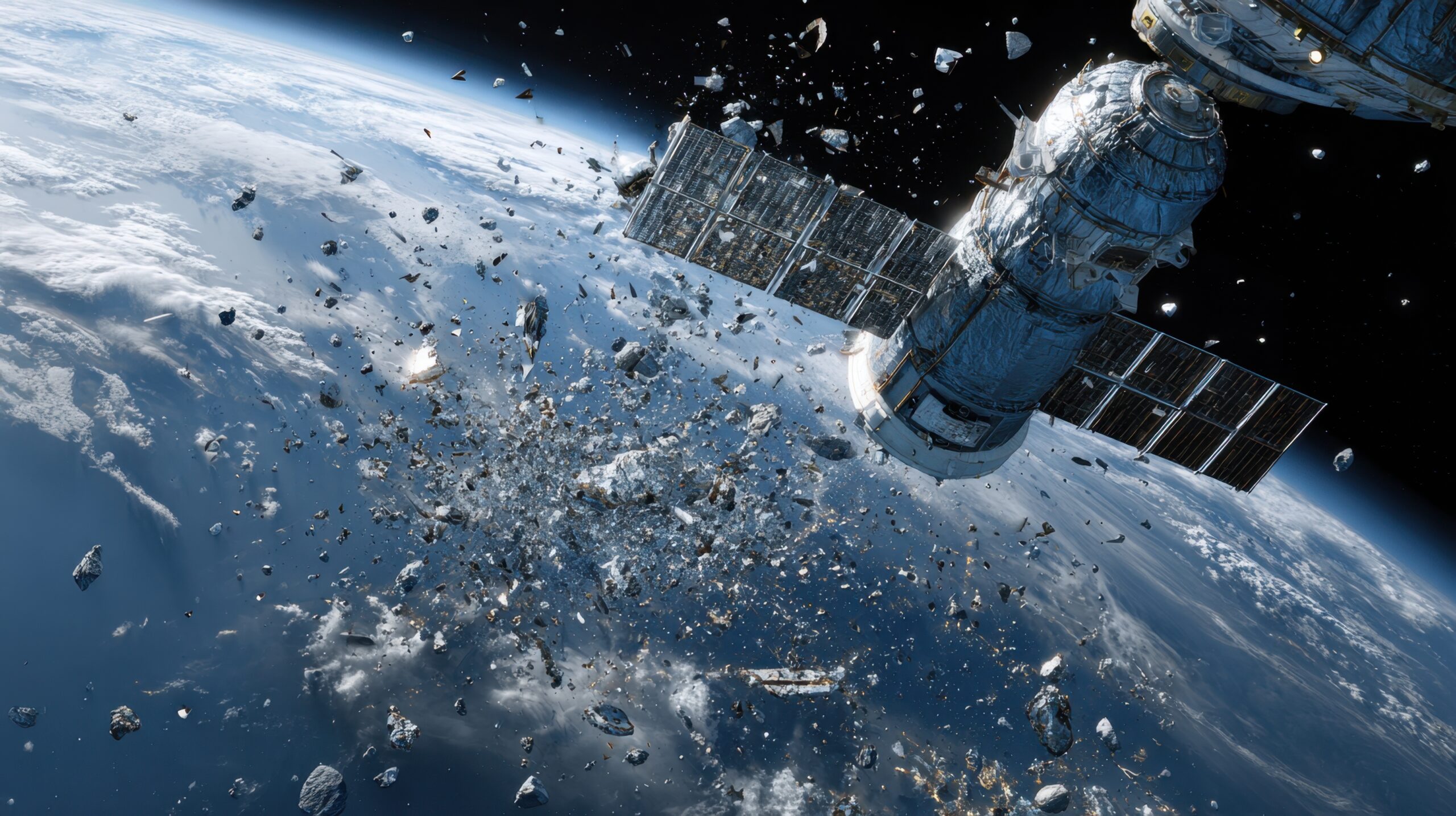
For half a century, the Space was the scene of a competition that was as symbolic as it was geopolitical. Today, the competition has become more concrete and low-Earth orbit, the region where satellites, stations and manned vehicles gravitate, has become an essential piece of contemporary infrastructure. Exploration is no longer about planting flags, but about promoting innovations that transform sectors as essential as energy, medicine, telecommunications or digital security.
In this new ecosystem, where public agencies, large technology corporations, startups, research centers and universities coexist, Europe wants to take a leading role and voices such as that of Michael López-Alegría – veteran astronaut, commercial mission commander and expert at the Bankinter Innovation Foundation’s Future Trends Forum – help us understand why orbit is today a natural extension of terrestrial innovation. As he explains: “it has always been the responsibility of governments to lead exploration (…) and then allow the companies commercialize”. This transition, historically slow, has accelerated irreversibly.
A new frontier: from the state epic to the orbital industrial fabric
The International Space Station has been the hub of scientific activity in low orbit for decades. A laboratory with no equivalent on Earth has been established there, to study material behaviors, chemical reactions, fluid dynamics, combustion, cell biology and physiological effects of prolonged stays in weightlessness. However, this infrastructure is not eternal. The technical horizon of the ISS points to the end of this decade, which makes it necessary to ensure its replacement, mainly by the hand of the private sector.
Axiom Space, a company in which López-Alegría plays a leading role, will build habitable modules that will initially dock with the ISS to operate taking advantage of its resources, and which will later be undocked to form the first fully autonomous commercial space station. The strategy avoids operational discontinuity and allows research, infrastructure and accumulated experience to be transferred to a next-generation platform.
Europe is accompanying this transition with a profound renewal of its space capabilities. The new Ariane 6 and Vega C launchers – decisive reinforcements of European strategic autonomy – are designed to compete in a market dominated by private suppliers and to ensure that European countries can carry their own payload into space without relying on third parties and to ensure access for the continent’s scientific, institutional and business ecosystem.
The Earth’s Orbit: Communications, Security, and Digital Sovereignty
In fact, the expansion of the Activity in low orbit is not only for scientific reasons. The Earth depends more and more on what happens up there. Observation satellites make it possible to manage crops, optimise maritime routes, anticipate extreme weather events or monitor large forest fires. On the other hand, increasingly dense and efficient communications constellations connect remote areas and support entire sectors.
In addition, Europe is building its own orbital digital shield. With the IRIS² system and the infrastructure EuroQCI, the EU wants to ensure quantum-secure communications for governments, financial institutions, hospitals, power grids and data centres. The integration of terrestrial fiber optics, quantum nodes and a satellite segment will allow a key distribution resistant to even future attacks quantum computers. In a world where cybersecurity is a strategic imperative, maintaining control over these networks is equivalent to ensuring the continuity of economic and social life.
This movement is not isolated. The Future Trends Forum already pointed out that the combination of deep tech, artificial intelligence, new materials and quantum capabilities is part of the same transformation vector. And most of that vector literally passes through space.
The Laboratory Without Gravity: New Materials, New Therapies, New Possibilities
Space is a constant source of technology transfer. CMOS sensors, advanced filters, air purifiers, protective materials, navigation systems, technical textiles and machine vision technologies have arrived on the civilian market after being born in space projects. At the same time, European companies are applying their know-how in sectors such as automotive, energy or design to develop specific components for orbital missions. This dual circulation – from Earth to space and from space to Earth – has become one of the continent’s most powerful engines of innovation.
Microgravity also allows to observe physical and biological phenomena that are impossible to fully replicate on Earth. Many of the industrial and medical advances that we now consider routine were born in a context where weight disappears. Among the most frequently cited examples is ZBLAN fiber, whose structure solidifies in orbit with fewer imperfections. López-Alegría recalls that a turbine melted and recrystallized in microgravity turned out to be “twice as resistant” as its terrestrial equivalent, an advance with potential in aviation and energy.
In the same way, the Biotechnological research finds in microgravity an accelerated model of cellular aging. Changes in bone mass, immune response or oxidative stress allow degenerative diseases to be studied with a clarity unattainable in the terrestrial laboratory. Recent experiments on stem cells exposed to simulated microgravity have shown that certain bioelectrical treatments can restore the expression of key genes for regeneration and protect cell integrity. These findings open up new avenues in regenerative medicine, advanced cosmetics and anti-aging therapies.
Towards commercial stations and a global entrepreneurial ecosystem
The next decade will see the coexistence of commercial stations, reusable vehicles, new manned capsulesand more versatile constellations. In his public speeches, López-Alegría stresses that demand is growing both in research and in private activity and tourism: “there is an unmet tourist demand” and now that companies have commercial vehicles “I think demand will be very positive”. The arrival of private astronauts, scientists from technology companies and even crews specialized in biotechnology or manufacturing in orbit will transform the traditional model.
Europe sees this change by strengthening its value chain: companies such as GMV in control and navigation systems, Sateliot in satellite IoT communications, PLD Space in reusable launchers, Thales Alenia Space in pressurized modules, or Open Cosmos in “turnkey” constellations, show how the European space sector is diversifying and becoming more sophisticated. It is no longer just about sending cargo or astronauts, but about creating services, economy and knowledge.
The new space race does not imitate that of the twentieth century. It does not seek isolated milestones, but to develop lasting capabilities; it does not aspire to conquer a territory, but to expand the possibilities of life on Earth. In a world facing energy, climate, health and technological challenges, orbit is a place where it is possible to test solutions that will later return to us. That is ultimately what makes the Space exploration in a silent engine that drives terrestrial innovation. A reminder that every advance beyond the atmosphere makes sense only when life down here improves.