

AI-generated summary
Artificial intelligence is evolving beyond invisible algorithms to embodied AI, where robots interact physically with humans in real environments. Carme Torras, a leading researcher in social robotics, highlights the challenge of ensuring these robots are useful, ethical, and socially accepted. Through projects in healthcare robotics, such as an assisted feeding robot in a Barcelona hospital and a cognitive stimulation robot for Alzheimer’s patients, Torras demonstrates AI’s potential to enhance quality of life while emphasizing the need for ethical design. These robots adapt to individual needs, use friendly cues to improve acceptance, and support both patients and caregivers.
Torras stresses the importance of addressing ethical concerns in social robotics, including avoiding dehumanization, protecting user privacy, and promoting autonomy. His team adopts a co-creation approach involving healthcare professionals, patients, and families to ensure robots complement rather than replace human care. He advocates for clear regulations on data use and integrates ethics into education through literature and university courses. Looking ahead, social robots could free caregivers from repetitive tasks, allowing focus on emotional support, and future AI advances may enable more intuitive, empathetic interactions. Ultimately, Torras argues that trust, ethical design, and collaborative development are key to harnessing social robotics for a beneficial human-robot coexistence.
Social robots are already helping in hospitals and nursing homes, but how do we ensure that their development is ethical and accepted by society?
Artificial intelligence is no longer just invisible code and algorithms operating in the cloud. The
In his presentation at the Bankinter Innovation Foundation’s Future Trends Forum, Torras presents some of his most innovative projects in the field of healthcare robotics, focusing on their deployment in hospitals and care centres. Their work shows the potential of AI in improving people’s quality of life, and also highlights the ethical challenges that need to be addressed in order for these technologies to be truly inclusive and beneficial for all.
Robots that help: from laboratories to hospitals
One of the key challenges of social robotics is its real-world implementation. “What works in the laboratory is not always adapted to a hospital or a home,” warns Torras. To overcome this gap, his team has worked on co-creating solutions together with doctors, nurses, caregivers and patients.
A prominent example is an assistance robot for feeding patients at the Pere Virgili Health Park in Barcelona. This device detects the moment when a person opens their mouth to offer food and avoids forcing feeding if it detects that the patient is not ready. Its development responded to a specific need: 50% of the hospital’s patients needed assistance with eating, but caregivers did not always have enough time to do so in a leisurely and personalized way.
The initial reaction was mixed. While health professionals valued its usefulness, some patient associations were skeptical. “The fear was that the robots would dehumanise the experience,” explains Torras. To improve acceptance, his team added an animated face to the robot, which offered friendly visual and auditory cues. The results were positive: patients responded better and the general perception changed from rejection to enthusiasm.
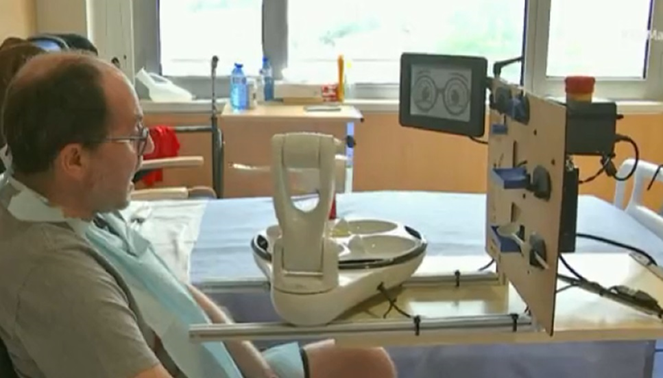
Feeding assistant robot. Source: Presentation by Carme Torras
The robot has an advanced system of cameras and force sensors that allows it to:
- Detect human movements: The robot identifies the exact moment when the patient opens their mouth, adjusting their arm to avoid common mistakes, such as bumps on the teeth or food spills.
- Adapt to personal preferences: Through learning algorithms, the system is able to adjust the feeding speed and angle according to the patient’s needs. In this way, it improves the user experience, increasing the acceptance of the system.
Another success story has been a robot designed to cognitively stimulate people with Alzheimer’s in collaboration with the Ace Alzheimer Center Barcelona foundation. Equipped with a manipulative arm, cameras and speech ability, the robot interacts with patients through cognitive stimulation games, adapting its behavior according to each individual’s responses. In addition to supporting patients, the robot provides accurate data to caregivers and doctors, facilitating more detailed monitoring of users’ cognitive status.
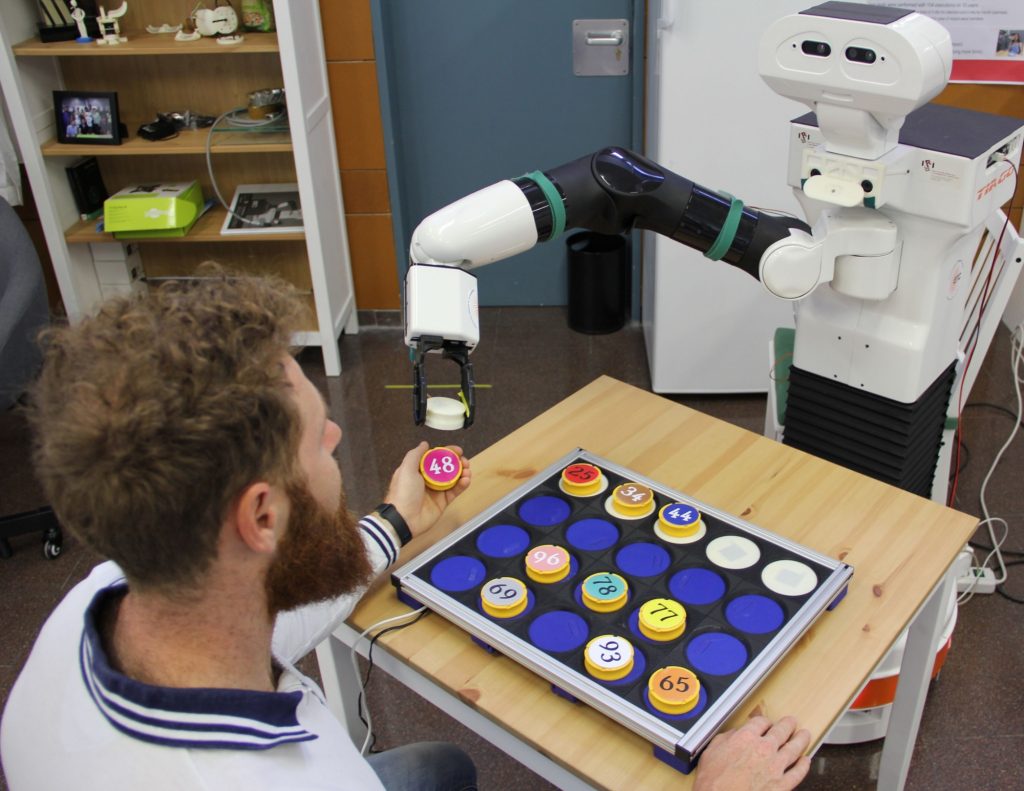
Source: ACE Foundation
Interaction with AI improves the patient experience, demonstrating that social robots can strengthen autonomy and quality of life in vulnerable people.
Ethics in Social AI: Beyond Technology
The development of social robots, in addition to posing technical challenges, also presents ethical dilemmas that require deep reflection before their deployment in society. Carme Torras points out that, unlike other AI applications, social robotics allows for a more leisurely process, which offers a unique opportunity to integrate ethical considerations from design to implementation.
One of the key risks of social robots is the potential for dehumanization in caring for vulnerable people. As
Another crucial aspect is the privacy and autonomy of users. A robot that moves around and interacts with people can collect sensitive data without users being fully aware. The mobility of these systems also amplifies risks such as inadvertent surveillance or the collection of information without explicit consent. To mitigate these risks, Torras proposes the development of specific regulations that set clear limits on how social bots can collect, store, and use user information.
In addition, the researcher points out that human dignity must be at the center of the design of social robots. One of the problems he has identified in his research is the possible
This focus on ethics does not remain only in theory. Torras has taken these reflections beyond the academic field through literature and university education. His novel The Sentimental Mutation poses futuristic scenarios where the coexistence between humans and machines generates complex moral dilemmas. Based on this work, he has developed a course on ethics in robotics, with a guide for teachers and a presentation of more than one hundred slides that is used in universities in Europe and the United States.
This material, available for free, seeks to generate debate about the implications of robotics in society, training future engineers and designers on the importance of integrating ethical principles in the development of AI. For Torras, the objective is clear: it is not just about advancing technology, but about ensuring that these advances are beneficial, safe and aligned with human values.
The Future of Social Robotics: Autonomy and New Opportunities
The impact of social robotics will be measured in how it redefines work and people’s autonomy. Torras argues that the introduction of assistive robots should not be seen as a replacement for the human factor, but as a tool that frees up time for more meaningful tasks.
For example, in healthcare, robots can take care of repetitive tasks such as feeding, mobility, or medication reminders, allowing caregivers to focus on patients’ emotional interaction and overall well-being. In turn, this could transform the role of care professionals, elevating their specialization and training in technology applied to health.
In addition, the evolution of AI will allow robots to better adapt to their users. Developments in
Conclusion: Trust is the key
Carme Torras‘ presentation leaves a clear lesson: technology alone is not enough, it needs to be designed with an ethical and human purpose. Social robots have the potential to improve the lives of many people, but their success will depend on how they are integrated into society.
For this technological revolution to be accepted and beneficial, it will be essential to:
- Design ethically: consider human impact from the beginning of technological development.
- Promote co-creation: involve users and professionals in the design of solutions.
- Ensure transparency and security: regulate the use of data and the autonomy of robots to prevent abuses.
The future of social robotics is in our hands. The question is not whether we will coexist with robots, but how we want that coexistence to be.

Profesora de Investigación en el Consejo Superior de Investigaciones Científicas (CSIC)