
AI-generated summary
The regulation of artificial intelligence (AI) and its ethical implications are critical to shaping the future of technology and society. AI is rapidly transforming diverse sectors such as healthcare and business, raising important questions about effective and ethical governance. Isabelle Hupont and María López, in their webinar “AI Regulation and its Ethical Implications,” explore the balance needed between fostering innovation and protecting fundamental rights. Hupont, a researcher focused on trustworthy AI, highlights AI’s pervasive role—from virtual assistants to facial recognition—and stresses the challenges posed by biases in AI systems, such as those in facial analysis. She also discusses the rise of generative AI, exemplified by ChatGPT, noting both its creative potential and risks, including misinformation and ethical concerns about deep fakes. Europe’s regulatory approach prioritizes ethical use by classifying AI applications by risk, emphasizing transparency, human oversight, and fairness.
María López, CEO of a neurotechnology company, highlights AI’s accelerating impact on deep technologies like neurotechnology, quantum computing, and IoT. She explains how AI enhances neurotechnology’s ability to interpret brain signals, enabling advances in brain monitoring, cognitive enhancement, and brain-machine communication. López illustrates the transformative potential of these technologies to improve quality of life but warns of ethical challenges, including mental privacy, equitable access, and implications of military use. She advocates for expanded “neurorights” and international cooperation in regulation to ensure technology develops in harmony with human well-being and justice. Both experts agree that ethical regulation, though potentially slowing innovation, is essential to fostering responsible, sustainable technological progress that respects fundamental human rights.
The Future of Artificial Intelligence: Between Innovation and Responsibility, with Isabelle Hupont and María López
The regulation of artificial intelligence and its ethical implications is a topic that, in addition to being topical, will shape the future of technology and society. Artificial intelligence is rapidly transforming various aspects of our lives, from healthcare to business decision-making. And with this technological advancement, questions arise about how to regulate its use effectively and ethically.
Artificial intelligence (AI) and neurotechnology present a horizon full of promise and challenges. Isabelle Hupont and María López, in the webinar “AI Regulation and its Ethical Implications“, provide an in-depth analysis of how we can navigate this future, emphasizing the importance of ethical regulation. Through specific examples, they illustrate both the opportunities and risks involved, underlining the need for a balance that fosters innovation and protects fundamental rights.
Isabelle Hupont’s Contributions and Perspectives
Isabelle Hupont is a researcher who is passionate about creating technology that is trustworthy, fair, and puts people at the center of its development. His research focuses on creating reliable facial processing algorithms and applications. She has worked as a research and artificial intelligence scientist in the public and private sectors and is currently a scientific manager at the European Commission.
It tells us that AI permeates almost every aspect of our daily lives. From virtual assistants such as Alexa and Siri, to driving assistance systems and facial unlocking on mobile phones, to online translators and recommender systems such as Spotify, which personalize suggestions based on our preferences. It highlights the role of generative AI, illustrated by tools such as ChatGPT, highlighting the pervasiveness and profound impact of AI in our lives.
When defining AI, Hupont points out that it is systems capable of observing their environment and learning to perform intelligent actions – with a certain degree of autonomy – or propose or assist in decision-making, a practice that, although it seems recent, has its roots in decades of development. The explosive evolution of AI in recent years is attributed to a synergistic triangle of data, algorithms and computational power, underscoring the ability of algorithms to learn from large volumes of data and the need for advanced computing to process them.
Benefits and challenges of AI: the example of facial recognition
Isabelle has dedicated her professional career to a specific aspect of artificial intelligence: facial analysis. Through his work, he has explored how this technology can be used for multiple purposes, from assisting in driving to improving the social interaction of people with autism, showing the versatility and potential of algorithms to interpret and respond to facial microexpressions in real time. However, it highlights a fundamental problem: training bias. Most of these algorithms have been developed and trained primarily on data from white and Caucasian people, which leads to errors and biases when confronted with faces of other ethnicities. This bias poses technical issues and can have serious societal consequences, such as misidentification in police contexts, demonstrating the critical importance of addressing these biases in the development of AI technologies to ensure their fairness and fairness.
Benefits and challenges of AI: the example of generative AI
Isabelle introduces Generative Artificial Intelligence as the new area of interest, exemplifying with ChatGPT how this technology can generate original content, such as poems, from simple instructions. He highlights that, unlike an internet search, generative AI creates novel content, which represents a significant advance in the creative field. However, alongside the opportunities, it also exposes the social risks associated with the automatic generation of images and texts. Cases of
AI regulation from Europe
How is Europe addressing the regulation of artificial intelligence? Isabelle tells us that focusing not on technology per se, but on its ethical use. It highlights the importance of protecting fundamental rights and security by classifying AI applications according to risk, from minimal to unacceptable. Hupont illustrates with practical examples how these levels of risk are applied, such as the use of AI for facial unlocking or in credit decisions, underlining the need for human oversight, transparency and ethical data management. The regulation focuses on high-risk systems, requiring detailed documentation and auditing mechanisms to ensure that AI-based decisions are fair and well-informed, evidencing a European commitment to responsible and ethically oriented technological innovation.
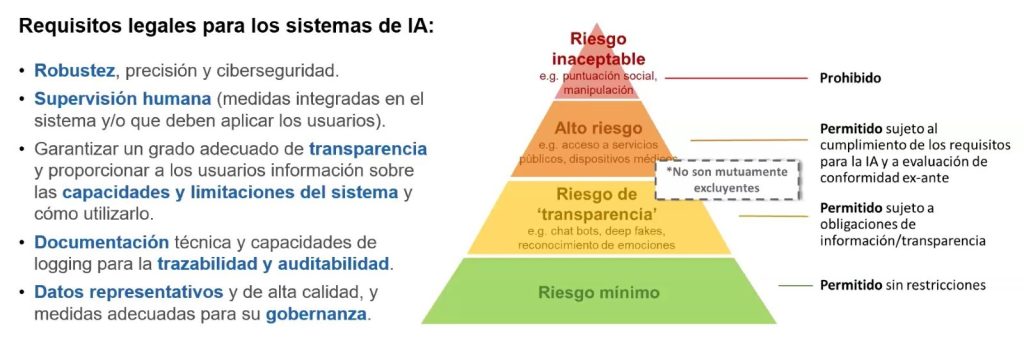
Source: Isabelle Hupont paper
Contributions and examples of María López
María López combines science and business to promote innovations that bring neuroscience closer to daily practice, standing out for her enormous leadership and vision in the technological field. María has a degree in mathematics and a PhD in computer engineering from the University of Zaragoza. She is CEO and co-founder of Bitbrain, a neurotechnology company that helps research, technology, and healthcare professionals leverage neuroscience in practical and reliable ways.
Maria emphasizes how AI is revolutionizing neurotechnology, opening new paths to improve human life. However, every innovation comes with ethical challenges and risks that must be carefully managed.
The context: artificial intelligence accelerates all other deep techs
María López begins her presentation by highlighting the current situation and controversy surrounding the regulation of artificial intelligence (AI) in Europe, addressing concerns about whether these regulations could slow down technological progress and reduce the continent’s competitiveness. However, he highlights that many criticisms emerge from a lack of knowledge about the challenges that AI and other advanced technologies are presenting. López proposes a historical reflection by recalling how innovations such as the smartphone have revolutionized our lives in a relatively short period, underlining the speed and profound impact of these technologies, which she calls deep tech, on society.
Maria argues that we are in a unique era in human history, in which multiple disruptive technologies are converging simultaneously – not only AI, but also neurotechnology, wearables, quantum computing, blockchain and IoT, among others. In particular , it highlights the catalytic role of AI in the development of these deep techs, accelerating their evolution and enhancing their impact in different sectors. It uses a quote from an event organized by UNESCO to illustrate how AI, when combined with neurotechnology, acts as an enhancer, multiplying its capabilities and possibilities. López stresses that this phenomenon is not limited to neurotechnology; AI has the power to “put steroids” on a wide range of disruptive technologies, accelerating their development and expanding both their opportunities and challenges. This context places society at a crossroads of great potentials and significant challenges, inviting a deep reflection on the future we want to build with these tools.
AI-powered neurotechnology
Neurotechnology is a key field at the confluence of technology and biology, focused on the development of tools that interact with the nervous system, especially the brain. López explains that neurotechnology includes both hardware devices capable of measuring brain signals and software that, through artificial intelligence, translates these signals into information that can be used for various purposes. Lopez highlights that, although neurotechnology has existed since before the launch of the first iPhone, its impact has been limited until recently, mainly due to the inability to effectively interpret the brain signals collected.
The introduction of artificial intelligence in this field has been a game-changer, allowing brain signals to be interpreted much more accurately and applying this understanding to advance diagnostics, treatments, and the creation of new brain-computer interfaces. This synergy between AI and neurotechnology has fueled an explosion in investment and interest in the field, with growth promising to continue exponentially thanks to emerging AI-driven advances and applications. This context sets a stage in which the possibilities for improving quality of life and better understanding the functioning of the brain are enormous, as are the ethical challenges and implications of these technological advances on society.
María illustrates this with three areas of application:
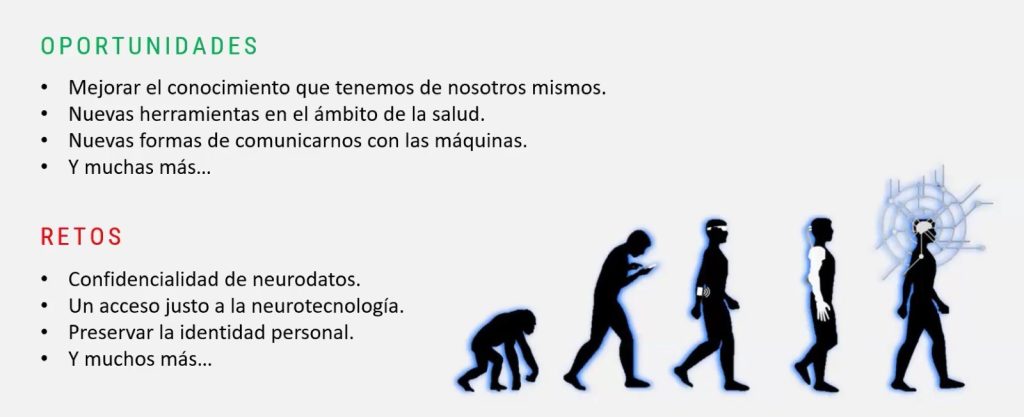
Source: presentation by María López
Understanding people better: monitoring
Brain monitoring is a fundamental application of neurotechnology powered by artificial intelligence, focusing on a deep understanding of the functioning of the human brain. He explains how our brain operates in two main modes: a fast, intuitive, and emotional system (similar to Homer Simpson) and a slow, rational, and conscious system (like Mr. Spock), with most of our time operating in the non-conscious, intuitive mode. This understanding opens the door to a better understanding of our decisions and behaviors, offering the possibility of identifying and correcting unconscious biases.
The opportunity presented by this technology is considerable, promising advances in self-knowledge and personal development, as well as the potential creation of a fairer environment by allowing us to understand and modify our unconscious reactions and decisions. However, it also introduces significant challenges, especially in terms of mental privacy. Lopez points to the controversy generated by the use of monitoring technology in Chinese schools, which measured students’ attention level using an LED light, to illustrate how even in cultures less concerned with data privacy, intrusion into mental space can be considered a step too far. This underscores the critical challenge of protecting mental privacy in an era where technology allows unprecedented access to the brain’s internal processes, raising profound questions about the limits of this access and the need to safeguard our innermost thoughts and mental processes.
Improving human capabilities: intervention or augmentation
The second area of application of AI in neurotechnology focuses on the improvement of human capabilities. Lopez presents two innovative Bitbrain projects that illustrate the opportunities and challenges in this field:
Cognitive improvement in mild cognitive impairment: the first project focuses on increasing the cognitive abilities of individuals with mild cognitive impairment, such as memory and attention, through neurotechnology. This effort seeks to improve the quality of life of those affected and, in addition, explore the possibility of delaying the onset of diseases such as Alzheimer’s. The technology operates through a band that reads brain signals and, with the help of AI, provides real-time visual feedback to stimulate the desired brain activity.
Mobility assistance for quadriplegic people: the second project focuses on quadriplegic people, using neurotechnology to interpret the brain’s movement intentions and translate them into physical actions, such as putting a spoon in the mouth, using an electrical stimulation system. This advance represents a significant leap towards autonomy for individuals with severe movement limitations.
Both examples demonstrate the transformative potential of combining AI and neurotechnology to improve lives. However, López also points to a crucial ethical challenge: equitable access to these technologies. On the other hand, while in the field of health the use of these technologies generates consensus on their beneficial potential, their application in areas such as the military raises deep ethical concerns. The U.S. military’s investment in neurotechnology to create “augmented soldiers” exemplifies this controversy, alluding to a potential technological “cold war” between great powers. This scenario opens the debate about who will have access to the improvements that neurotechnology can offer and whether this could lead to a society divided between those with increased abilities and those without, raising fundamental questions about justice and equity in the future of our species.
Simplifying interaction with machines: communication
In the last field of application, María López addresses the simplification of the interaction between the human brain and machines, a promising field of neurotechnology enhanced by artificial intelligence. It presents a collaborative project with Nissan, which culminated in the development of the first prototype car connected directly to the brain. This system is capable of detecting brain signals anticipating movement – for example, the intention to brake – before the driver physically performs the action, allowing the vehicle to respond more quickly and efficiently, potentially improving driving safety. This breakthrough highlights the potential of neurotechnology to facilitate intuitive and direct communication between humans and technologies, offering a window into future applications where commands do not need to be physically executed but mentally conceived.
However, this development also poses significant ethical challenges, especially when considering technologies that seek deeper integration between the human brain and AI. Maria mentions Elon Musk and his company Neuralink, which aspires to develop advanced brain-computer interfaces capable of connecting the human brain with AI systems. This approach seeks to overcome human limitations by merging with AI and, in addition, prepare humanity for a future in which AI could surpass our cognitive capabilities. While the vision is ambitious and could revolutionize how we interact with technology, it sparks important ethical debates about personal identity, autonomy, and the limits of technology at our core as human beings.
The possibility of such a deep integration between technology and the human brain highlights fundamental questions about what it means to be human and to what extent we are willing to allow technology to penetrate and modify our intrinsic nature. This third area underscores both the extraordinary opportunities and the profound ethical challenges that neurotechnology and artificial intelligence bring with them, inviting critical reflection on the future we wish to build.
Finally, López addresses how the regulation of AI can protect against the risks inherent in these advances, although it may also complicate the development of new opportunities. It argues that, given the magnitude of the associated risks, especially those that could alter the human dimension, the implementation of regulations is a necessary “toll” to explore these opportunities safely. However, it expresses concern about the limited scope of the European regulation, which applies exclusively within Europe, suggesting that the challenges posed by neurotechnology and AI are global in nature and require international consensus and action.
Maria proposes the idea of expanding existing human rights to include “neurorights,” reflecting a growing tide among scientists and experts focused on protecting humanity from emerging challenges. It concludes by emphasizing the importance of a global and collaborative vision to maximize opportunities and minimize the risks presented by neurotechnology and other deep techs, underlining the need for regulatory and ethical measures that transcend borders to ensure a future in which technology advances in harmony with human well-being and equity.
Final Thoughts on Neurotechnology and AI
During the Q session, Maria Lopez and Isabelle Hupont delved into the balance between technological innovation and ethical regulations in the field of neurotechnology and artificial intelligence (AI), sharing their perspectives on how this balance influences the development and implementation of advanced technologies.
María López stresses that, although regulation can slow down the innovation process by requiring more time and investment, it is essential to ensure that technological progress does not compromise ethical and fundamental values. He compares the situation to the fashion industry, where avoiding child exploitation is an ethical imperative, even if it is more costly. For Maria, complying with ethical regulations is not only a moral obligation but also an investment in the sustainable and responsible future of the business.
Isabelle Hupont, from her experience at the European Commission, points out that AI regulations are aligned with fundamental rights, such as non-discrimination and respect for health and safety. Despite concerns about whether regulation could curb innovation in Europe, Isabelle argues that it instead promotes a form of ethical innovation that respects fundamental rights, offering a significant competitive advantage.
In relation to the risks associated with neuromarketing and neurotechnology-based product promotion, Maria explains that as long as consumer participation is voluntary and conscious, and all ethical and privacy regulations are met, market research activities using neurotechnology should be considered in a similar way to traditional methodologies. The key is informed consent and respect for the privacy and autonomy of the individual.
In summary, both experts agree on the importance of technological development that is in harmony with ethics and fundamental rights, emphasizing that adequate regulation, in addition to protecting society from potential risks, can foster more responsible and sustainable innovation.
If you want to delve deeper into this field and other technologies and innovations for human well-being, be sure to check out our report.
You can also access other webinars on the subject:
- Digital neurotherapy: bringing neurotechnologies to the patient’s home with Dr. Javier Mínguez
- Rehabilitation Neurotechnology: From the Laboratory to Everyday Life with Dr. Ander Ramos-Murguialday
- Antibiotics of the future: César de la Fuente’s innovative approach
- Future and Life: Keys to Synthetic Biology with Marc Güell
- Mª José Alonso’s pioneering contribution to nanomedicine and RNA vaccines