
AI-generated summary
The Bankinter Innovation Foundation hosted a webinar featuring Francesco Ferro, CEO of PAL Robotics, to explore the transformative field of humanoid robotics and its impact on industry and society. Ferro provided a global overview of the current state of humanoid robots, highlighting the challenges of achieving true autonomy as most robots remain teleoperated. He reviewed key players like Boston Dynamics, Tesla, and European firms such as PAL Robotics itself, which stands out for being financially self-sufficient through product sales rather than venture capital. The discussion emphasized Europe’s focus on safe, ethical, and collaborative robotics development through partnerships like euRobotics and ADRA, contrasting with the faster but less regulated pace in the U.S.
Ferro detailed PAL Robotics’ evolution, from early prototypes to advanced humanoids like Talos and Kangaroo, designed for industrial automation and healthcare applications. He stressed that the future of humanoid robots lies in working safely and efficiently alongside humans, enabled by advanced software and embodied AI. Real-world applications are growing in logistics, health, retail, and agriculture, with robots optimizing operations, reducing costs, and addressing labor shortages. Ferro acknowledged ongoing challenges in autonomy, safety, adaptation, and social acceptance but affirmed that humanoid robots hold enormous potential to transform how humans and machines collaborate across multiple sectors.
Francesco Ferro, CEO of PAL Robotics, analyses the impact and real applications of humanoid robotics after the Future Trends Forum on Embodied AI in a webinar of the Bankinter Innovation Foundation
The Bankinter Innovation Foundation continues to be committed to bringing the innovation that will mark the future closer to society and professionals. As part of this mission, we have organized a new webinar dedicated to one of the most transformative fields: humanoid robotics.
This event is part of our outreach cycle after the celebration of the last Future Trends Forum, where more than 40 international experts analysed the rise of physical AI (Embodied AI) – artificial intelligence that already interacts directly with the physical world. The FTF’s conclusions have been reflected in our “Embodied AI” report, now available on the web.
To delve into this technological revolution, we had Francesco Ferro, CEO of PAL Robotics and one of the leaders in humanoid robotics worldwide, who also participated in the FTF. The webinar was led by Juan Moreno Bau, director of the Foundation, who introduced the current context: “Artificial intelligence no longer only processes data; now it enters the physical world and redefines how we work alongside machines.”
With more than 20 years of experience and recognized as CEO of the Year in Robotics 2024 by European CEO, Francesco Ferro shared his vision on the role of humanoid robots in industrial automation, the challenges of their real implementation and the opportunities they open up in key sectors such as logistics, health and mobility.
Don’t miss the webinar Humanoid Robotics with Francesco Ferro:
Humanoid robots worldwide
Francesco Ferro opens his speech with a global vision of the current state of humanoid robotics. He stresses that we are facing a technology in full boil, where competition grows and a new player appears every month. However, the technical challenge remains enormous: “most of these robots are not yet autonomous, they are still teleoperated,” he explains.
One of the most relevant elements of the sector is that the vast majority of companies work under intensive models in venture capital investment. In this sense, PAL Robotics makes a notable difference: it reached break-even in 2016 and today it is financed exclusively by the sale of its robotic solutions.
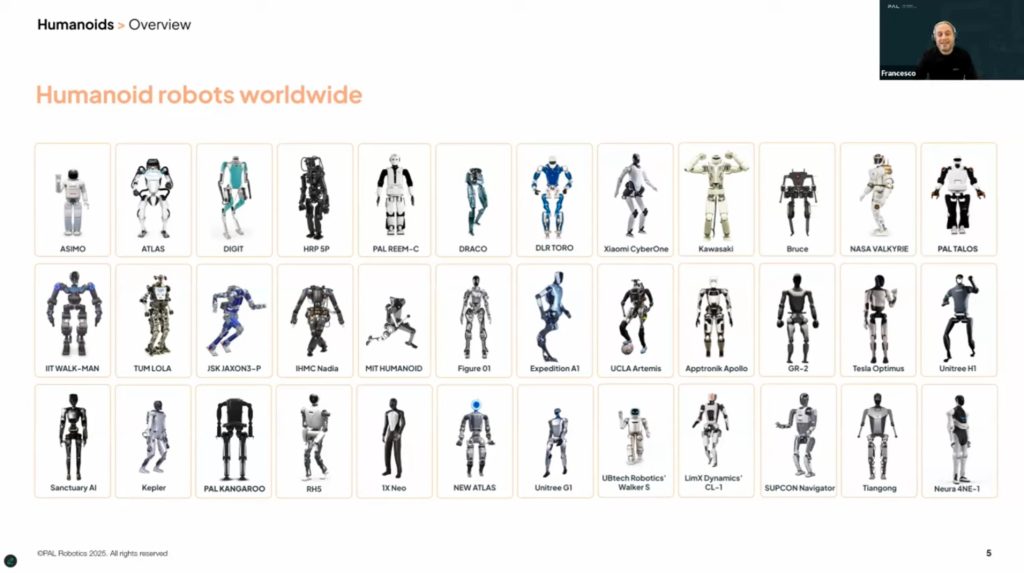
Source: webinar Humanoid Robotics
During his presentation, Francesco reviews the developments of seven key companies:
- Boston Dynamics: With more than 20 years of experience, it was one of the pioneers with its Atlas robot, hydraulic, capable of executing somersaults and jumps with impressive agility. Today they develop robots for industrial logistics. Since their purchase by Hyundai, they are focused on real applications, with public demonstrations that mix technical precision and visual spectacle.
- Tesla (with Optimus): Elon Musk recently announced that Tesla will have “thousands of humanoid robots in factories” in a matter of a year. Ferro is cautious: “They did a large event, with robots moving at the same time, but most are still teleoperated.” The aim is to develop general-purpose robots that can be integrated into production environments without the need for manual reprogramming.
- Agility Robotics: Backed by Amazon, they have managed to make their Digit robot work continuously for eight hours straight on logistics tasks. “The important thing about Agility is that they do less marketing, but they are very robust. They are working seriously on regulations and safety,” says Francesco. In addition, they are focused on their robots being able to operate indoors and outdoors.
- Figure AI: A start-up that has closed deals with large corporations such as BMW. Francesco explains that, although they are still in the early stages, their proposal is aligned with the new generation of robots: bipedal, autonomous, with integrated AI and capable of varied tasks in changing environments.
- Apptronik: Another relevant player, in this case associated with Mercedes-Benz. They are developing robots for automation in factories. Ferro points out that there is so much potential market that “even if we all produced the same robot, we would not be able to meet the current global demand.”
- 1X Technologies: One of the most promising European players, backed by OpenAI. Its EVE robot seeks to facilitate human-robot interaction in logistics and household tasks. Francesco appreciates its focus on secure and scalable integration, although with less media exposure.
- Unitree Robotics: From the Asian ecosystem, Unitree has gained notoriety for its agile robots and large-scale production. Ferro points out that it is a “very aggressive in prices” company, which offers functional humanoid robots starting at about $16,000, well below market standards. This can be a disruption in terms of technological accessibility.
To close the block, Ferro is clear: “There will not be a single winning company. There is so much work to be done that the market can absorb so many players. The important thing now is to move towards truly autonomous and safe robots.”
Robotics partnerships: focus on Europe
After offering a global overview of the main developments of humanoid robots, Francesco Ferro focuses his attention on the partnerships that are driving robotics and artificial intelligence applied to the physical world, especially in Europe.
He explains that, in the face of the commercial speed set by the sector in the United States, Europe is committed to building a solid basis for collaboration between companies, universities and research centres, prioritising safety, ethical regulation and responsible development.
Francesco highlights three key partnerships:
- euRobotics: Europe’s leading association dedicated to promoting research, innovation and industrial deployment of robotic technologies. euRobotics powers initiatives such as SPARC, the world’s largest civilian robotics research and development programme. PAL Robotics participates in European projects within this framework, where not only technological excellence is sought, but also to build European industrial sovereignty.
- ADRA (AI, Data and Robotics Association): A strategic alliance that unites leading organizations in artificial intelligence, data, and robotics. ADRA coordinates innovation efforts and helps define ethical frameworks and interoperability regulations for Europe to advance physical AI safely and reliably.
- IFR (International Federation of Robotics): Although global in scope, Francesco stresses that the IFR is a crucial source of statistics and trends to understand the evolution of the market. From Europe, it is closely monitored to align strategies with the global context.
At this point, Ferro provides key figures that show the expansion of the sector:
- The global market for industrial robots is growing at a rate of 12% per year, according to the latest open reports published by IFR.
- Traditionally, industrial robotics was dominated by sectors such as automotive and electronics. Today, other sectors such as services are gaining weight at an accelerated rate.
In addition, it identifies five global trends in robotics:
- Physical and analytical integration, including the generation of adaptive and autonomous behaviors.
- Specific-purpose humanoids: Although there is a lot of interest in general-purpose robots, the dominant trend now is to create humanoids for specific tasks, such as manufacturing or industrial production.
- Sustainability and energy efficiency: new developments prioritise the reduction of energy consumption.
- Opening up new market segments: sectors such as agriculture, agri-food and chemicals are beginning to adopt advanced robotics.
- Responding to labour shortages: in sectors where finding qualified personnel is a growing challenge.
On the areas where the adoption of humanoid robots is growing the most, Francesco details:
- Transport and logistics, with 113,000 robots installed and a growth of 35% per year.
- Protocol and customer service robots, where 54,400 robots operate, growing at a rate of 31%.
- Agriculture, with 20,000 robots in use and an increase of 21%.
- Professional cleaning, which reaches 12,000 robots (+4%).
- Health and medical care, which although it starts from a smaller base (6,200 robots), shows the highest percentage growth with +36% per year.
These data confirm that logistics currently leads in number of units, but that healthcare is the sector where the adoption of robotics is expanding the fastest.
To close the block, Francesco sends a clear message: “The European approach is slower than the American one, yes, but it is a safer approach. It is important to regulate well before deploying robots in industries or in open environments. We cannot afford to fail when we talk about collaborative robots that interact directly with people.”
About PAL Robotics
Francesco Ferro dedicates a central part of his presentation to explaining the origin, structure and technological evolution of PAL Robotics, one of the oldest and most respected companies in the world of humanoid robotics.
Founded in 2004 in Barcelona, PAL Robotics was born with a clear vision: to create robots that improve people’s quality of life. In these 20 years, it has grown to have more than 115 employees, mainly engineers, with a presence in Spain, France (Toulouse) and Italy (Bari).
Unlike many technology startups, PAL Robotics has managed to be self-sufficient since 2016, financing itself exclusively through the sale of its products, without relying on venture capital.
Currently, the company organizes its activity into three business areas:
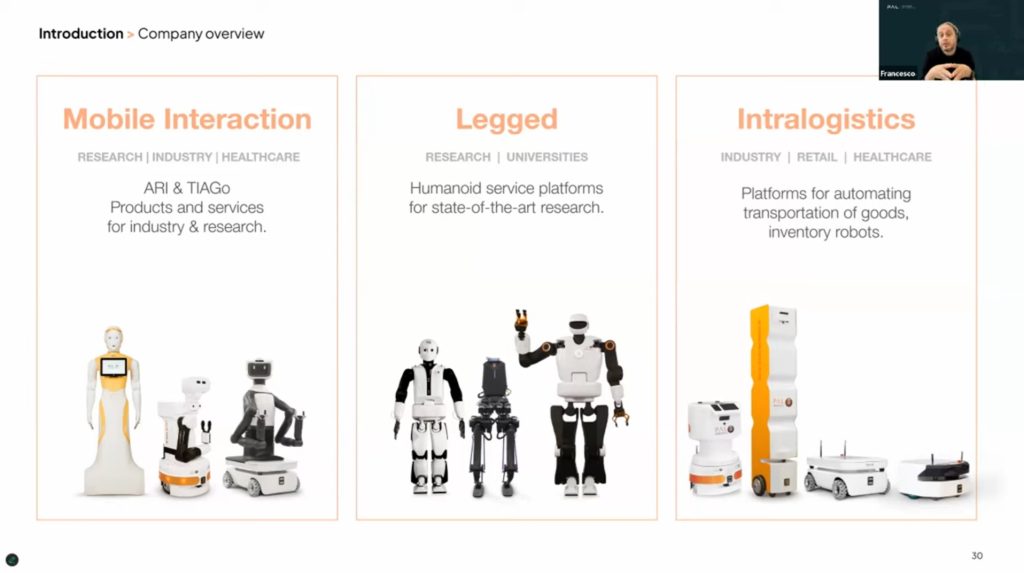
Source: webinar
- Mobile Interaction: Development of mobile manipulator robots such as Tiago and Tiago Pro, widely used in research and industrial and health environments. Tiago Pro incorporates compliance control to operate safely alongside humans.
- Legged Robots: Focused on bipedal robotics, where industrial pilots are being carried out to validate the usefulness of humanoids in manufacturing, logistics and technical assistance.
- Intralogistics: Solutions for internal logistics, such as the StockBot robot, capable of carrying out automatic inventories in stores and warehouses, interacting with people autonomously.
The evolution of its humanoid robots
Ferro reviews PAL Robotics’ trajectory in humanoid robotics through several milestones:
- REEM-C and the first developments: Historical robots that are now part of the permanent collection of the Science Museum in London, as symbols of the history of European robotics. These prototypes allowed to accumulate critical experience for subsequent developments.
- Talos: One of their most advanced robots. Designed in collaboration with the University of Toulouse and in connection with Airbus, Talos is prepared to support loads of up to 6 kilos with an outstretched arm, an essential capacity for industrial applications. Airbus was a pioneer in relying on bipedal robots to certify and optimize industrial processes, still collaborating today with PAL Robotics on new projects. Talos is able to walk, walk up and down stairs, plan complex movements, and work in structured and semi-structured environments. To ensure safety, the speed of their movements is regulated, avoiding any risk to people.
- Kangaroo: The evolution towards a more agile, robust and resilient platform. Designed headless, since it does not need to interact socially in industrial environments, Kangaroo optimizes weight, energy efficiency, and drop resistance. Francesco highlights that Kangaroo incorporates free walking (autonomous walking with joystick), getting up after falls and swinging in real time, using torque control and reinforcement learning technologies.
- Kangaroo Pro: Its next generation, focused on sustainability and efficiency. With a height similar to that of humans (167 cm), it is designed for complex industrial tasks and, in the future, could reach seven degrees of freedom for more dynamic applications.
- PRIMI Project: Within the framework of the European PRIMI project, PAL Robotics is working on providing Kangaroo with a head for neurological rehabilitation functions in hospitals. This collaboration is part of an approach focused on medical and care robotics.
Focus on advanced software
Ferro places special emphasis on the software challenge: although AI may seem simple in demos, developing real capabilities for the physical world involves enormous technical challenges.
PAL Robotics works on:
- Real-time torque control and compliance to maintain balance in the face of unexpected disturbances.
- Optimal control for motion planning.
- Reinforcement learning by applying massive simulations (up to 4,000 parallel models) to train robust and adaptive behaviors.
Finally, Francesco stresses that PAL Robotics actively collaborates in European projects to continue promoting advances in key sectors such as manufacturing, health and agriculture.
“The future of humanoid robots will not be just moving or lifting objects. It will be working side by side with us, safely, autonomously and efficiently,” he concludes.
Real-world applications
After analysing technological advances and his own experience at PAL Robotics, Francesco Ferro focuses the conversation on the most important thing: how and where humanoid robots are already starting to have real applications.
He explains that industry and logistics are currently the most advanced sectors in the adoption of humanoid robotics. And he points out that the revolution is not just about improving efficiency: it is about changing the way we work alongside machines.
According to Francesco, humanoid robots make it possible to:
- Optimize warehouse management: Thanks to their ability to walk, manipulate objects, and adapt to unstructured environments, humanoid robots can perform picking, internal transport, and relocation of goods. Ferro points out that its bipedal shape facilitates work in warehouses designed for humans, without the need to modify the facilities.
- Reduce operating costs: Although the initial investment can be high, the savings in the medium term on repetitive and physically demanding tasks are significant. In addition, robots reduce the rate of occupational accidents associated with the handling of loads or repetitive movements.
- Improve efficiency in the supply chain: By integrating humanoid robots into warehouses and distribution centers, bottlenecks can be eliminated, process flexibility can be increased, and demand spikes can be better reacted.
- Facilitating collaborative work: One of the most profound transformations that Ferro predicts is the natural coexistence between human workers and robots. “The challenge is not only technical, it is also human: learning to work side by side with robots that make decisions and adapt to the environment,” he explains.
But Francesco also focuses on other emerging applications:
- Health: Humanoid robots capable of assisting in hospitals, moving medical equipment or collaborating in tasks to support health personnel. Robotics can free professionals from logistical work, allowing them to focus on direct patient care.
- Mobility and personal assistance: In the near future, humanoid robots will be able to assist elderly people or people with reduced mobility in everyday tasks, such as opening doors, bringing objects or accompanying them on trips.
- Retail: PAL Robotics has already developed robotic solutions for automatic inventory and customer support in large retail outlets. Francesco mentions that part of his experience in this sector comes from years of collaboration with large retail companies.
Ferro insists that we are still in the first steps of this transformation: “Humanoid robots are now like the first personal computers of the 80s. They are still expensive, they still have limitations, but the potential for change they bring is enormous.”
Finally, he points out that one of the key objectives is to make robots truly multitasking, capable of changing activities without the need to manually reprogram them. To do this, the combination of advanced hardware and Embodied AI will be crucial.
Questions Answers
The webinar ends with an intense Q session from the audience, in which Francesco Ferro addresses with frankness and precision the main challenges, opportunities and nuances of humanoid robotics.
In what scenarios does a bipedal robot make the most sense?
Ferro explains that bipedal robots make sense in unstructured or laddery environments, where a wheeled or even tracked platform would be too expensive or inefficient. “The biped is complex, but it is the one that best adapts to the type of environments where we ourselves move,” he points out.
And what about quadrupeds?
Although PAL Robotics does not develop quadrupedal robots, Francesco says that their main current use is in inspecting hazardous environments. He adds that, in the future, bipeds will be preferable for domestic or industrial tasks because their footprint is better suited to spaces designed for humans.
Why replicate the human form in robots?
Francesco is emphatic: “Our entire environment is built for us: doors, utensils, tools…”. Therefore, adapting robots to our physiognomy is not a whim, but a functional necessity.
He explains that they are already experimenting with Tiago Pro robots with three arms in collaboration with the University of Rennes, adding an additional arm instead of a head, equipped with sensors, to improve the perception of the environment.
What autonomy do industrial robots have? What kind of batteries do they use?
Currently, they use lithium batteries, although Francesco acknowledges that there are strong regulatory limitations in Europe on which technologies can be used. Autonomy depends on the type of robot and its specific application, and PAL Robotics is attentive to integrating the best solutions available.
How is progress being made in safety and sensitivity when working around humans?
Ferro explains that industrial robotics already uses cobots (collaborative robots), but that translating this concept to bipedal mobile robots is much more complex.
They currently combine model-based control (such as torque control and impedance control) with physical sensors. Artificial intelligence, although advancing, is still not enough on its own to guarantee security in uncontrolled environments.
Does security depend more on sensors or software?
Both are essential. Ferro stresses that, as long as there is no artificial intelligence capable of guaranteeing safe behavior in dynamic environments, control based on physical models is still essential.
He adds that, with the right sensors, robots can react in real time to external forces, which is key to their safe interaction.
How long does it take for a robot to adapt to an industrial environment?
For simpler robots like StockBot (inventory and logistics), installation can take a few hours. For humanoid robots, the adaptation time depends on the complexity of the environment and the level of prior preparation.
The future trend, according to Ferro, is to use reinforcement learning and Generative AI to reduce this time drastically.
Is there progress towards a “robotGPT”?
Francesco says that the robotics community dreams of a “robotGPT”: a model capable of understanding instructions in natural language and executing complex actions reliably.
Today, voice commands work quite well, but the control of multimodal autonomous movements (video, action) is still far from being a reality.
What challenges does robotics pose in healthcare environments?
In medical environments, the challenges are enormous due to the need for certification and extreme security.
PAL Robotics works on hybrid solutions where robots can act autonomously for simple tasks and be teleoperated in critical situations. This allows, for example, an operator to supervise 10 robots remotely in home care environments for the elderly.
What impact does robotics have on agriculture?
The agricultural sector suffers from a severe lack of labour for seasonal jobs, such as harvesting.
Francesco explains that agricultural robotics is advancing, but it still faces barriers such as high costs and the need to adapt cultivation methods to new robotic systems.
In Nordic countries such as Denmark and Sweden, solutions are already being implemented, while in southern Europe the process is progressing more slowly.
What is the situation of domestic robots?
Although simple household robots (such as vacuum cleaners or dishwashers ) already exist, the challenge is to develop generalist robots capable of performing multiple tasks in the home.
According to Ferro, the main challenges are:
- High cost.
- Adaptation of housing.
- Cultural and social rejection of the constant presence of machines.
He warns that to overcome these challenges it is necessary to work both on the hardware and on the humanization of interaction through design, adequate speed of movement and robotic empathy.
How does human-robot design and interaction influence?
Ferro explains that robot design must also avoid the uncanny valley effect: robots must look familiar enough without provoking rejection.
He adds that co-design work, social robotics (based on LLMs) and physical control of movement is key to making interaction natural and safe.
What is the relationship between humanoid robotics and exoskeletons?
Both technologies share technical fundamentals such as force control, but the level of safety required in exoskeletons is much higher due to direct contact with the human body.
In humanoid robotics, occasional errors can be tolerated during the testing phase. In exoskeletons, a mistake is not acceptable.
What impact will robotics have on employment?
Francesco recalls that history shows that technological progress does not eliminate work, but transforms the type of employment. The Internet, more than robotics, has been the great labor disruptor of recent decades.
In the case of robotics, countries that are committed to automation (Germany, China, the US) are seeing their employment rates increase in technology sectors.
Ferro stresses the importance of forming new profiles and democratizing access to technologies so that progress benefits society as a whole.

CEO de PAL Robotics