

AI-generated summary
Water scarcity is a mounting global crisis intensified by climate change, population growth, and inefficient water use, with over 2 billion people already facing water stress and projections suggesting half the world will experience scarcity by 2050. The Bankinter Innovation Foundation’s report “Water: our vital resource in check,” based on insights from 40 international experts, emphasizes innovation and technology as key to sustainable water management. Five major trends identified include climate-induced resource scarcity, global health and inequality impacts, urbanization pressures, unequal water access, and technological advancements like AI and biotechnology revolutionizing water use.
The Foundation outlines six strategies to address water challenges: adopting circular water economies, tailoring technological solutions, promoting sustainable practices in high-demand sectors, integrating renewables in water processes, raising social awareness, and strengthening governance. Two pioneering companies demonstrate innovation in action. Jeanologia, led by Enrique Silla, transforms the textile industry by reducing water use by 70% with nanobubble technology (E-Flow), recycling all wastewater (H2 Zero), and integrating sustainable tech into existing factories (CONNECT), aiming for water-free textile production. GENAQ, headed by Carlos García, produces drinking water from atmospheric humidity, providing sustainable, decentralized water access especially useful in remote areas, emergencies, and urban settings, with energy-efficient systems compatible with renewables. These innovations show that urgent water challenges can be met by combining technology, policy, and sustainable practices to secure water for future generations.
Water is a resource in crisis. Discover how Jeanologia and GENAQ are revolutionizing their management with sustainable technology: reducing consumption in the textile industry and generating drinking water from the air
Water is an essential resource for life and human development, but we are facing an unprecedented crisis. More than 2 billion people live in regions with high levels of water stress, and projections indicate that by 2050 half of the world’s population will experience water scarcity. This problem is exacerbated by climate change, population growth and the inefficient use of water resources.
The Bankinter Innovation Foundation, as part of its commitment to sustainability, has analysed these challenges in its report “Water: our vital resource in check“, prepared based on conversations with more than 40 international experts at the Future Trends Forum. This report highlights how innovation and technology can contribute to more efficient and sustainable water management.
During the webinar, Rut Bosque, moderator of the event, presents the vision of Radhika Fox, former Deputy Administrator for Water at the U.S. Environmental Protection Agency and Director of North Star Strategy, who highlighted five major trends that we must take into account to ensure water availability in the future:
- Resource scarcity and climate change: the water crisis is intensifying with climate variability, demanding resilient and sustainable solutions.
- Water crisis and its global impact: the lack of access to drinking water affects communities around the world, generating inequalities and health problems.
- Demographic transformations and urbanization: By 2050, two-thirds of the world’s population is expected to live in cities, which will put water infrastructure to the test and require solutions tailored to each geographic context.
- Inequality in access to water: In many regions, water is a scarce and poorly distributed resource, exacerbating social and economic disparities.
- Technological advances and their role in water management: artificial intelligence, biotechnology and other innovations are revolutionizing the sector, allowing greater efficiency and sustainability in the use of water.
Six key strategies to address the water crisis
The Bankinter Innovation Foundation, in collaboration with the experts of the Future Trends Forum, has identified six strategic lines to face these challenges:
- Adopt a circular water economy, prioritizing reuse and efficiency.
- Develop technological solutions adapted to each environment, including the digitalisation and optimisation of water resources.
- Promote sustainable practices in sectors with high water demand, such as agriculture and the textile industry.
- Integrate renewables into key processes, such as desalination and water treatments.
- Promote education and social awareness on the responsible use of water.
- Strengthen water governance by establishing robust and transparent regulations.
The role of innovation in water management
In this context, innovation plays a fundamental role. New technologies make it possible to improve efficiency in the use of water, reduce the environmental impact of industry and guarantee access to this resource in vulnerable regions. This webinar brings together two experts who are leading change in water management:
- Enrique Silla, founder and CEO of Jeanologia, who has revolutionized the textile industry with eco-efficient technologies that minimize water consumption and eliminate toxic waste.
- Carlos García, CEO of GENAQ, a pioneering company in the generation of atmospheric water, which transforms air humidity into drinking water, offering innovative solutions for water-scarce communities and emergency situations.
Both share their experiences and technological solutions, demonstrating that it is possible to transform water management to make it more sustainable and efficient.
The water crisis is no longer a problem of the future, it is an urgent challenge that we must address today. Innovation and technology are proving that it is possible to transform our relationship with this vital resource. From reducing consumption in industry to generating drinking water anywhere in the world, solutions exist and are within reach. Now is the time to drive change. Find out more about these revolutionary technologies in the full webinar:
Water Sustainability Technology Solutions for the Future
Jeanologia: innovation for a sustainable textile industry
The textile industry is one of the most polluting in terms of water consumption and pollution. According to data from the World Bank, it accounts for 20% of the pollution of the planet’s waters, which makes it a key sector in the global water crisis. Enrique Silla explains in the webinar how his company has led a radical transformation of the sector with innovative technologies that reduce water use, eliminate toxic waste and optimize production processes.
Jeanologia, in addition to reducing water consumption, has an even more ambitious goal: to dehydrate textile production. Silla explains that water has been used for centuries as a “carrier” to transport dyes, softeners and chemicals to fabrics. However, his company has shown that
E-Flow technology: 70% reduction in water consumption
One of Jeanologia’s greatest advances is E-Flow, a system based on nanobubbles that replaces water as a means of transporting chemicals to garments. Instead of using large volumes of water, this system generates millions of nanobubbles in one cubic centimeter, allowing chemicals to adhere to tissues more efficiently.
Thanks to this technology, a reduction of up to 70% in the use of water in the textile finishing process has been achieved, especially in the manufacture of jeans, which is one of the most manufactured products in the world. Currently, 50% of jeans produced globally already use this technology, which has represented an unprecedented advance in the sustainability of the sector.
However, as Silla emphasizes, reducing water consumption is not enough. To achieve a truly sustainable industry, it is necessary to eliminate
H2 Zero: the solution to eliminate polluted water discharges
One of the main problems of the textile industry is the discharge of highly polluted wastewater. Silla explains that, despite advances in water efficiency, there is still a surplus of water that needs to be treated. To address this problem, Jeanologia has developed H2 Zero, a system for recycling and reusing 100% of the water used in the textile process.
How does H2 Zero work?
- Collects wastewater generated during the textile finishing process.
- Removes contaminants through advanced physical-chemical treatment.
- It reintroduces the treated water into the system, allowing it to be reused without generating waste.
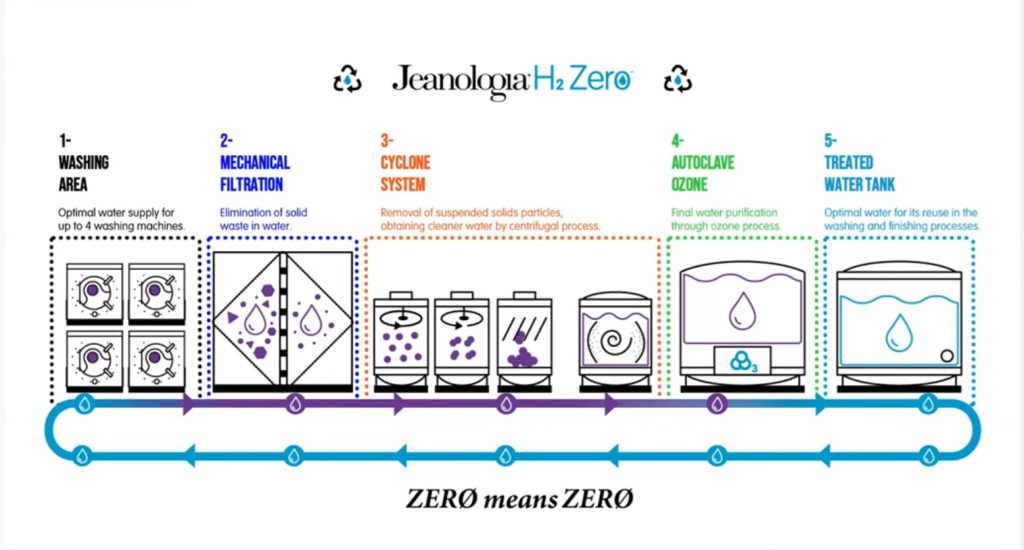
Source: webinar
This system has allowed entire factories to operate without discharging a single drop of contaminated water into rivers or sewage systems, something that until a few years ago was unthinkable in industry. As Silla highlights, this is a key step in reaching the ultimate goal of completely dehydrated and waste-free textile production.
CONNECT: Integrating sustainable technology into today’s textile industry
One of the main challenges in the transformation of the textile industry is how to implement new technologies without the need to replace all the existing machinery. Many factories still use traditional equipment that relies on water and chemicals in their production processes. To solve this problem, Jeanologia has developed CONNECT, a system that allows its sustainable technology to be integrated with the machines and processes already existing in the factories.
CONNECT is a connectivity model that facilitates the adoption of technologies such as E-Flow and H2 Zero in factories that operate with conventional equipment. This means that a textile company does not need to replace its entire infrastructure to start reducing its environmental impact.
Silla explains that one of the biggest obstacles to sustainability in the textile industry is the lack of investment in machinery renewal. CONNECT solves this problem by enabling factories to adopt more efficient and environmentally friendly processes without completely changing their infrastructure.
With this model, Jeanologia seeks to democratize access to sustainable technology, making it easier for any factory in the world to reduce its water and energy consumption without large initial costs. “There are no excuses to continue polluting when technology can be integrated into any production process,” concludes Silla.
Thanks to these advances, the textile sector is at a turning point. If brands and manufacturers adopt these technologies on a large scale, it is possible to achieve a water-free textile industry in the next decade.
Silla closes his presentation with a strong message: “If the textile industry wants to survive in the future, it must be completely sustainable”. It highlights that consumers are increasingly demanding about the environmental impact of their garments, and that brands that do not adopt sustainable production models will lose competitiveness in the market.
GENAQ: Atmospheric Water Generation for a Water-Scarce World
Access to safe drinking water remains one of the greatest challenges of the 21st century. In many regions of the world, natural water sources are insufficient or polluted, affecting millions of people. Carlos García presents an innovative technological solution in the webinar: the generation of water from the air.
GENAQ is a pioneer in atmospheric water capture, a technology that converts moisture in the air into drinking water. This solution is especially useful in remote areas, emergency situations and places where water infrastructure is insufficient or non-existent. In addition, it reduces the use of bottled water in urban environments and ensures a sustainable and decentralized water supply.
Water pollution with microplastics, heavy metals and industrial waste is a growing problem that affects both the environment and human health. 83% of tap water and 93% of bottled water contain microplastics, highlighting the need for safer alternatives.
Atmospheric water generation is presented as a sustainable solution, as it does not extract water from polluted sources, does not contain microplastics and offers greater purity than many supply networks.
Compared to other methods:
- Compared to bottled water, it avoids plastic pollution and reduces the carbon footprint.
- Compared to desalination, it consumes less energy and does not generate saline waste.
- Compared to reverse osmosis, it does not waste water and is more efficient in maintenance.
Source: webinar
The idea of extracting water from the air is not new, but until recently the available technologies were inefficient or very expensive. GENAQ has developed systems that optimize the atmospheric water condensation process, achieving efficient and sustainable production.
GENAQ’s technology captures moisture from the air, condenses it into liquid water, purifies and remineralizes it to ensure its quality, and then stores and distributes it according to the user’s needs. This process makes it possible to generate clean and safe water anywhere in the world, without the need for traditional water infrastructure.
Applications of GENAQ technology
Carlos García explains that GENAQ’s atmospheric water generators have applications in various areas, from supplying communities without access to drinking water to their use in industries and urban environments:
1. Areas with water scarcity and humanitarian crises
In places where there is no access to drinking water or where natural sources are insufficient, GENAQ’s technology represents an immediate and sustainable solution. These devices are ideal for:
- Rural areas and isolated communities where there are no water distribution networks.
- Regions affected by droughts or with deteriorated water infrastructure.
- Emergency situations and natural disasters, where safe water sources are essential.
2. Replacing bottled water in homes and businesses
GENAQ has also developed solutions for urban use, allowing homes, offices and businesses to obtain drinking water directly from the air, thus reducing dependence on bottled water.
Benefits in urban environments:
- Eliminates the consumption of single-use plastics.
- It reduces the carbon footprint associated with the transportation and production of bottled water.
- It ensures a constant supply of clean water, without the need to buy bottles or rely on public networks.
3. Applications in strategic sectors
In addition to its domestic use and in vulnerable communities, GENIAQ’s technology is being implemented in sectors with high water demand:
- Food and pharmaceutical industry, where ultrapure water is required in production processes.
- Armies and security forces, which need autonomous supply solutions in missions and operations.
- Hotel sector, offering a sustainable and differentiating alternative for the generation of water in hotels and resorts.
Sustainability and energy efficiency: key to GENAQ’s innovation
One of the most innovative aspects of GENAQ is its focus on energy efficiency. Traditionally, atmospheric water generation has been an expensive process in terms of electricity consumption. However, GENAQ has developed systems that optimize energy performance, allowing water to be generated with minimal electricity consumption.
Carlos García explains that GINAQ’s generators can operate with renewable energies, such as solar panels, which makes them completely self-sufficient. This is key in regions where access to the electricity grid is limited or expensive.
In addition, it highlights that its technology adapts to different levels of humidity and temperature, which allows it to operate in diverse climates, from tropical regions to arid areas.
Challenges and future of atmospheric water technology
Despite its many benefits, atmospheric water generation technology faces a few challenges:
- Awareness and large-scale adoption: many companies and governments are still unaware of the potential of this solution, so it is necessary to promote its implementation through public policies and strategic alliances.
- Initial implementation costs: although the investment in atmospheric water generators pays for itself in the medium term, the initial cost can be a barrier in certain communities.
- Infrastructure for distribution: in urban environments, it is important to develop efficient models to integrate these systems into the water supply network.
Carlos García emphasizes that atmospheric water generation technology is not intended to replace other sources of supply, but to complement them. Its goal is to decentralize water production and make it accessible anywhere in the world.
Carlos García closes his presentation with a key message: “Water does not have to depend on centralised infrastructures. We can generate water anywhere in the world in a sustainable and efficient way.”
GENAQ represents a paradigm shift in water management. Its technology, in addition to guaranteeing access to drinking water in vulnerable areas, reduces the environmental footprint of water consumption in cities and industry.
García stresses that, in a context of global water crisis, it is necessary to combine multiple solutions to ensure access to water in the future. Technologies such as atmospheric water generation, reuse and desalination will play a key role in building a more sustainable water model.
Questions and Answers (Q&A)
Here’s a summary of the Q session:
How does atmospheric water generation work in dry climates?
Water production depends on absolute humidity, not just relative humidity. In hot and humid climates, the efficiency is higher, while in cold and dry climates, the yield decreases. To determine feasibility, GENAQ uses climatic chambers that simulate local conditions before installing a generator. In addition, the water quality is guaranteed with advanced filtration and ultraviolet light.
When will the domestic version of GENAQ’s generators be sold?
Still in the testing phase, with no confirmed launch date. Pricing and availability will depend on the final results of the prototype.
What barriers does the textile industry face in adopting the closed water loop?
Resistance to change is the biggest obstacle. Many factories use outdated technologies and see the initial investment as a problem, without considering that recycling water reduces costs in the long run. To accelerate adoption, it is key that water reuse is cheaper than buying new water.
What is GINAQ’s energy consumption and how is it integrated with renewable energies?
Nominal consumption is 0.2 kWh per litre of water produced, although it varies depending on the climate. To maximise sustainability, they have developed systems compatible with photovoltaic energy. In an R+D project, they have integrated cold storage in phase-change tanks, allowing the solar energy accumulated during the day to be used at night, without the need for large batteries.
Is Jeanologia’s technology being used in other industries?
For now, only in the textile industry, but its technology could be applied in industrial processes such as leather or meat production. Enrique is open to sharing his knowledge with other sectors interested in implementing a closed water circuit.
What percentage of water is recovered in Jeanologia’s processes?
100% reuse in denim and 90% in dyeing, with the possibility of reaching 100%. In the case of denim, some of the water is returned to the environment in the form of steam. For dyeing, reaching 100% depends on energy costs. The aim is to make recycling water cheaper than buying it to encourage its immediate adoption.
What will water management be like in 20 years’ time?
Enrique Silla:
- Total reuse in industry, eliminating waste.
- Put a real price on water, since “we cannot take care of a resource that we get for free”.
Carlos García:
- Separate drinking and non-potable water networks to optimize their use.
- Eliminate water transport and produce it where it is needed.
Co-fundador y CEO de Jeanologia