

Unfortunately, they still have a long way to go, but some statistics already prove them right.
It’s no secret: women entrepreneurs or Spanish startups are not the majority, but they are not even close to reaching 50% of the sector. And this is not only reduced to the analysis of the company’s workforce, but also when it comes to looking at who runs them or how much they bill.
However, in the midst of a transformation phase we find some factors that deepen the differences and others that, it seems, are increasingly narrowing them. This is the flip side of female entrepreneurship.
The Face: More Money and Less Failure
A question should be asked: why are there so few women entrepreneurs, if it turns out that they are the ones with the best figures? The data is not provided by us, but by a report by The Boston Consulting Group and MassChallenge, which reveals that women entrepreneurs, despite receiving less funding than startups founded by men, actually generate more income.
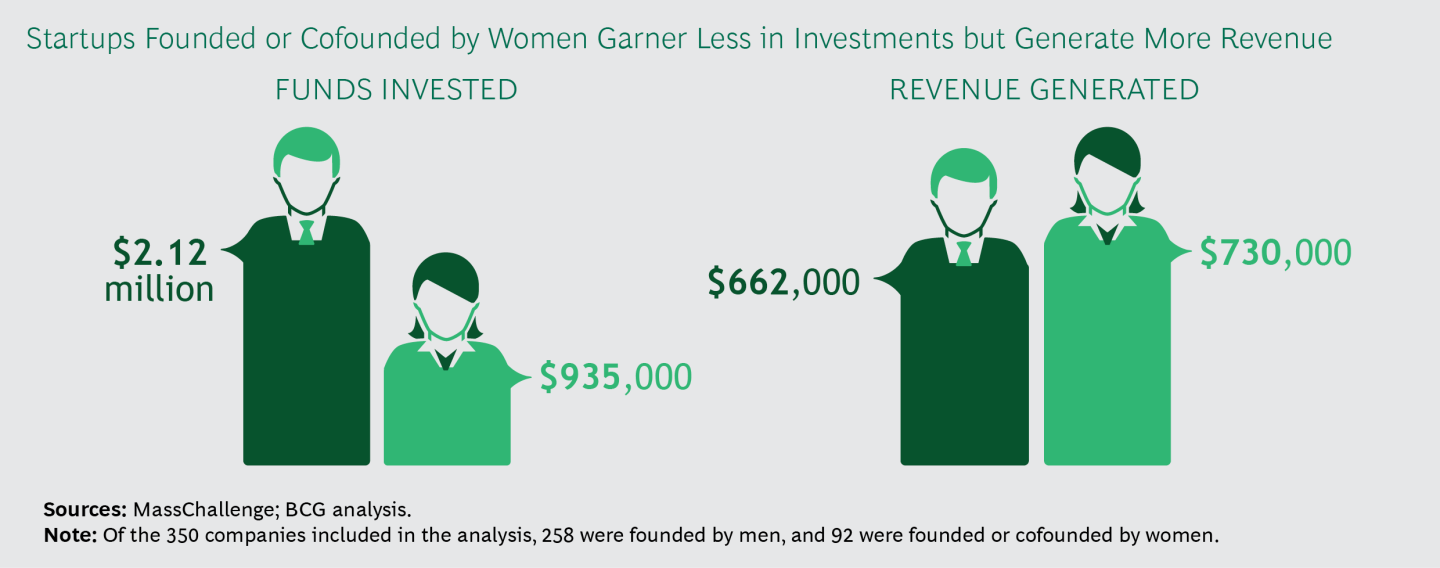
Image: BCG
According to this study, the truth is that, for every dollar of funding received, startups owned by women generate 78 cents in revenue, while those created by men fall further in quantity, with half, only 31 cents in revenue generated.
The analysis of the 2018 Entrepreneurship Map also reveals another curious fact: startups led by women have a lower failure rate than men: women who close their project are 22%, while in the case of men this figure rises to 51% of business failure when trying to do so with a new startup.
The cross: women entrepreneurs are only 22%
The bad news comes from South Summit. According to the 2018 Entrepreneurship Map, analyzing the startups present, it turns out that only 22% have women as founders or co-founders. Does this have any positive points? Perhaps, depending on how we want to look at it, since in 2017 this rate was 18%. In any case, these percentages are still clearly insufficient.
There are no more excuses, therefore: if companies created by women invoice more money than those of men, we should perhaps rethink why they are still a clear minority in the sector.