

AI-generated summary
The COVID-19 pandemic has significantly accelerated the adoption of online education trends, many of which are expected to become permanent. A survey by SimpsonScarborough reveals that only 17% of university students want to return to fully in-person classes, while 41% prefer a hybrid model, and 30% favor entirely online learning. Notably, nearly 40% of first-year students opt for fully online education. This shift is reflected in the explosive growth of Massive Open Online Courses (MOOCs). In 2020, one-third of all MOOC registrations ever recorded occurred, with platforms like Coursera raising $130 million and doubling their valuation to $2.5 billion. Globally, MOOCs have surpassed 180 million students outside China, with thousands of new courses and degrees launched in 2020 alone.
Innovation is also transforming online education through virtual and augmented reality, enhancing hands-on learning experiences. For instance, MIT’s Sloan School of Management uses immersive simulations such as World Climate, engaging over 60,000 participants in real-time role-playing scenarios. Gartner predicts that by 2021, 60% of U.S. higher education institutions will use virtual reality for immersive learning. Additionally, data science is becoming integral to online education, enabling educators to monitor student engagement and tailor support to improve outcomes. Programs like the Bankinter Innovation Foundation’s Akademia exemplify how online platforms can foster diverse, interdisciplinary collaboration among students across institutions.
The pandemic has forced online training for almost a year, multiplying the number of solutions and the number of institutions that offer it, will it be a firm trend or ephemeral?
Experts say that the pandemic has led to an acceleration of trends and that many will be consolidated, such as online training.
Only 17% of university students want to return to a 100% face-to-face scheme as before the pandemic.
41% would prefer a mixed face-to-face / online scheme
30% would prefer to complete all their training 100% online. It is striking that this percentage rises to almost 40% among first-year students.
This is according to a survey conducted in the US by the higher education research and marketing agency SimpsonScarborough.
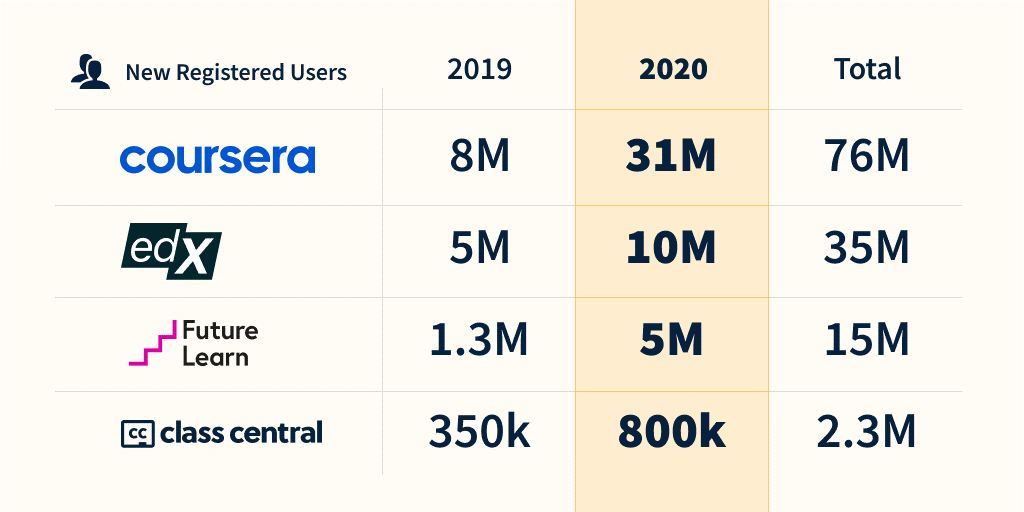
One of the most powerful trends in online training is Massive Online Open Courses ( MOOCs), which have seen demand skyrocket: of all the students who have ever registered on a MOOC platform, a third did so in 2020. To illustrate it with more figures:
- Coursera raised $130 million in 2020 and has a valuation of $2.5 billion, more than double the value in 2019.
- The MOOC movement has surpassed 180 million students, excluding China. Data from Class Central shows that providers launched more than 2,800 new courses, 360 new microloans, and 19 new online degrees in 2020 alone.
Virtual reality and augmented reality will enhance the ability to offer hands-on programs online. For example, at the Massachusetts Institute of Technology’s (MIT) Sloan School of Management, students use World Climate, a simulated role-playing game, where they are assigned roles as UN delegates and asked to negotiate a climate agreement. A simulation model shows students, in real time, the impact of their decisions. According to its creators, more than 60,000 people have already participated in this simulator.
60% of higher education institutions in the U.S. will use virtual reality by 2021 to create simulations and place students in immersive environments, as predicted by Gartner a few years ago.
Finally, it should be noted that online training will increasingly be based on Data Science: With all the data collected in online training, teachers can track the degree of student engagement with course materials, which helps them identify why some students are struggling or how to improve learning outcomes.
The Akademia programme of the Bankinter Innovation Foundation has been running online for more than a year now and this has allowed us to create groups of inter-university students, as well as multidisciplinary ones, providing an enormous wealth of points of view and solutions to exercises.