

AI-generated summary
The Future Trends Forum, organized by the Bankinter Innovation Foundation in Madrid, convened experts to discuss sustainable food challenges, focusing on food security, sustainability, and innovation in agriculture. Estefanía Erro, Director of Marketing and Innovation at the National Center for Food Technology and Safety (CNTA), highlighted how emerging technologies are transforming the food sector. She introduced the Foodtech Opportunity Scenario Map, which identifies nine key areas of innovation, including alternative proteins, sustainability, personalized nutrition, and advanced food quality and safety measures driven by AI and data analytics.
Erro showcased pioneering startups such as Cocuus, which uses 3D bioprinting for plant-based foods; Väcka, which transforms melon seeds into alternative cheese through fermentation; AMC Natural Drinks, innovating probiotics from pomegranate peel by-products; and Nucaps Nanotechnology, which reduces salt content in foods via proprietary technology. These examples underscore the synergy between research centers and startups to foster sustainability, health, and efficiency in food production. However, Erro stressed challenges like bridging the gap between innovation and consumer acceptance, enhancing collaboration and financing for startups, and fostering integration across public, private, and academic sectors. The future of food technology depends on aligning innovation with market needs, strategic planning, and cooperative efforts to address global issues like sustainability, food safety, and personalized nutrition.
Innovation and collaboration: how startups are rewriting the rules of the food industry
The think tank Future Trends Forum, under the slogan Smart Agriculture: the challenge of sustainable food, organised by the Bankinter Innovation Foundation in Madrid, has brought together leading experts and key figures in the field of agriculture and food. This event focused on examining current and future challenges related to food security, sustainability and innovation in the agricultural sector, underlining the critical role of emerging technologies and new methods to revolutionize these essential fields.
One of these key figures has been Estefanía Erro, Director of Marketing and Innovation of the National Center for Food Technology and Safety (CNTA).
In the presentation entitled “Transforming the Future of Food through technology: real world examples“, Estefanía Erro shares real and current examples of how technology is transforming the food sector. These examples illustrate how innovation and collaboration between research centres and companies is driving competitiveness and sustainability in the food industry.
If you want to see Estefanía Erro’s presentation, you can do so in this video:
Estefanía Erro: Transforming the Future of Food through technology: real world examples
Below, we summarize Estefanía Erro’s presentation:
Innovation and technology in food: expanding Foodtech’s horizon
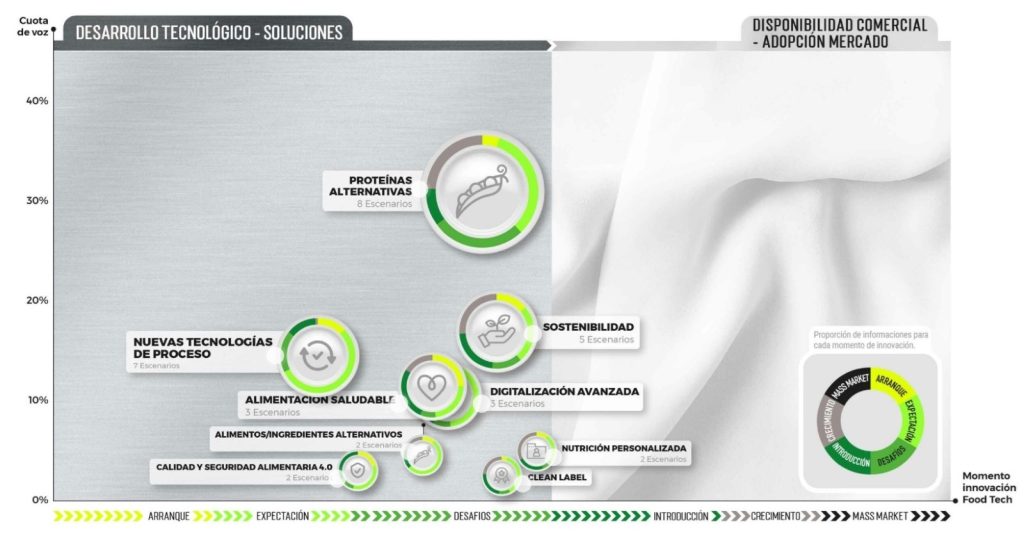
The National Center for Food Technology and Safety (CNTA) has created the Foodt Tech Opportunity Scenario Map. To draw up this map of opportunities, the CNTA closely monitors trends and developments in the Foodtech sector. It analyzes more than 100 media outlets daily to identify and compile relevant information that can help food businesses navigate the technology landscape. This map shows nine macro scenarios that represent opportunities for the industry, with a structure designed to simplify the enormous amount of information and make it accessible and manageable for the players in the sector.
Source: CNTA
Main Focus Areas and Trends
Alternative proteins: According to the map, almost 40% of all Foodtech-related news focuses on alternative proteins. This high level of media interest reflects a considerable amount of investment and activity in this area, underlining the relevance and rapid growth of the sector within the food industry.
Sustainability and health: these are recurring topics in the conversation about Foodtech. Sustainability refers to both the production of food in an ecological way, and how companies can use technology to create processes that maximize efficiency and minimize waste.
Personalized nutrition and alternative ingredients: Beyond proteins and fats, personalized nutrition and alternative food ingredients are gaining traction, signaling a shift toward more personalized and healthier food options.
Food quality and safety: this is an area that the CNTA calls “Food Quality and Safety 4.0”, alluding to Industry 4.0, which involves the integration of advanced technologies such as artificial intelligence and data analysis to improve quality and safety standards and processes in food production.
Estefanía Erro’s presentation highlights how technology is reshaping the food industry and how tools such as the Food Tech Opportunity Scenario Map can guide companies through this complex ecosystem. This proactive approach towards technological innovation is crucial to maintain competitiveness and respond effectively to changing market demands and global challenges such as sustainability and food safety.
Outstanding examples of innovative startups: pioneers in food transformation
During the conference, Estefanía Erro presents several startups that are implementing advanced technologies to address specific challenges in the food industry, demonstrating the potential of technological innovation to revolutionize everything from food production to consumption. These examples illustrate the practical application of new technologies and how these innovations can contribute to sustainability, health and efficiency in the food chain:
Cocuus: innovation in plant-based foods
Cocuus, a startup also mentioned by Julia Espeso, has managed to stand out in the plant-based food sector through the use of 3D bioprinting, a technology that allows production on an industrial scale. With a production capacity of up to 1,000 tons per year, this startup has marked a milestone by offering products in supermarket chains such as Carrefour. Their focus is on production and improving the shelf life of their products, such as plant-based eggs, extending their shelf life from 5 to 18 days, with the goal of reaching 30 days.
Väcka: redefining the use of by-products
Väcka uses fermentation technology to transform melon seeds, which are normally wasted, into an alternative cheese. This approach addresses food waste and promotes the clean label concept, eliminating unnecessary ingredients and making the final product more natural and attractive to health-conscious consumers.
AMC Natural Drinks: Creating Probiotics from By-Products
In collaboration with the CNTA, AMC Natural Drinks has innovated in the use of pomegranate peels, another by-product usually discarded, to develop a probiotic ingredient used in healthy drinks. This process uses extraction and encapsulation techniques to convert waste into valuable ingredients, demonstrating how technology can transform items that were previously discarded into products of high nutritional value.
Nucaps Nanotechnology: solutions for salt reduction
Nucaps Nanotechnology has developed a proprietary technology that allows the salt content in food to be reduced by up to 40%, depending on the food matrix used. This startup has adapted its solution to more than 10 different types of food, demonstrating the versatility and effectiveness of its innovation. This significant reduction in salt responds to the demand for healthier foods, while maintaining quality and taste, essential for consumer acceptance.
These examples reflect how collaboration between research centers such as the CNTA and various startups is catalyzing significant advances in the food industry. By focusing on technologies that respond to real market needs, these startups are contributing to a more sustainable and healthy food future.
Challenges and perspectives in the transformation of the Food Sector
Estefanía Erro highlights the importance of aligning technological innovations with the real needs of the consumer, emphasizing that true change is achieved by ensuring that solutions are adopted and valued by end users.
One of the most significant challenges that Erro identifies is the gap between technological innovation and its acceptance in the market. Technological solutions, no matter how advanced, must resonate with the needs and expectations of the consumer to be successful. Estefanía Erro mentions that unless these needs are met, innovations will not translate into effective changes in the market. This consumer-centric approach is crucial to ensure that new technologies are adopted and have a positive impact on society.
Another aspect discussed is the need to improve collaboration and access to finance to support startups and companies that are at the forefront of innovation in Foodtech. Estefanía Erro emphasizes that many promising initiatives require, in addition to an initial investment, ongoing support to scale and commercialize their products. It highlights the importance of a national strategy that finances early research and development and supports the scale-up and commercialization stages.
Estefanía Erro also addresses the need for greater integration between the different actors in the innovation ecosystem, including the public and private sectors, as well as academic institutions. He mentions the importance of research centers such as the CNTA, which act as bridges between fundamental science and its industrial application. Collaboration between universities, research centres and industry is vital to translate scientific knowledge into practical and marketable solutions that can benefit society at large.
Looking to the future, Estefanía Erro highlights the opportunity to continue exploring and expanding the applications of emerging technologies to address global challenges such as sustainability, food safety and personalized nutrition. These efforts require technological innovations, as well as an integrated approach that includes supportive policies, adequate financing, and a strong orientation towards market demands and consumer expectations.
In summary, transforming the food sector through technology presents both significant opportunities and considerable challenges. The ability to overcome these challenges and seize these opportunities will depend on:
- effective collaboration between all stakeholders,
- the alignment of innovations with market needs, and
- strategic planning that considers both technological development and its practical implementation and acceptance by the consumer.
If you want to delve deeper into the opportunities and challenges of agriculture and food, don’t miss the report Smart Agriculture: The Sustainable Food Challenge.
You can also read articles about other presentations by experts participating in this Future Trends Forum:
- Economic paradoxes in food security and long-term climate adaptation, with Gonzalo Delacámara.
- Deciphering soil DNA: the importance of the microbiome in sustainable agriculture, with Adrián Ferrero.
- The future of agriculture through water, with Miguel Calatayud.
- Big bets for the future of Agriculture: the vision of Rajiv Shah.
- A look at the future of food technology -Foodtech-, with Alessio D’Antino.

Directora de Marketing e Innovación de CNTA