AI-generated summary
Flexible working, including hybrid models combining remote and office work, is increasingly widespread globally and in Spain. Reports from Cap Gemini Research Institute and Boston Consulting Group reveal that many organizations anticipate a significant portion of employees working flexibly, with some expecting over 70% to work remotely several days a week. Employees also show strong interest in flexible arrangements, with many expecting companies to introduce initiatives that foster commitment and belonging.
While flexible work offers greater ease in balancing personal and professional tasks, it presents challenges in three key areas: mental and physical health, social relationships, and gender equality. Remote work can cause stress, longer hours, and difficulty disconnecting, which can be mitigated by setting clear workspaces, schedules, and boundaries, along with maintaining physical activity and healthy habits. Socially, in-person office days remain crucial to nurture interpersonal connections and a sense of belonging, complemented by focused virtual interactions and socializing outside work hours. Regarding gender equality, hybrid work has potential to rebalance unpaid domestic responsibilities disproportionately borne by women, but this requires ongoing dialogue, empathy, and agreed measures.
In summary, flexible work models are beneficial but not a cure-all. Success depends on thoughtful implementation focused on efficiency, well-being, and preserving human relationships, rather than teleworking for its own sake.
Working some days from home and others from the office can be very good for the reconciliation of family and work life, once the pitfalls have been avoided.
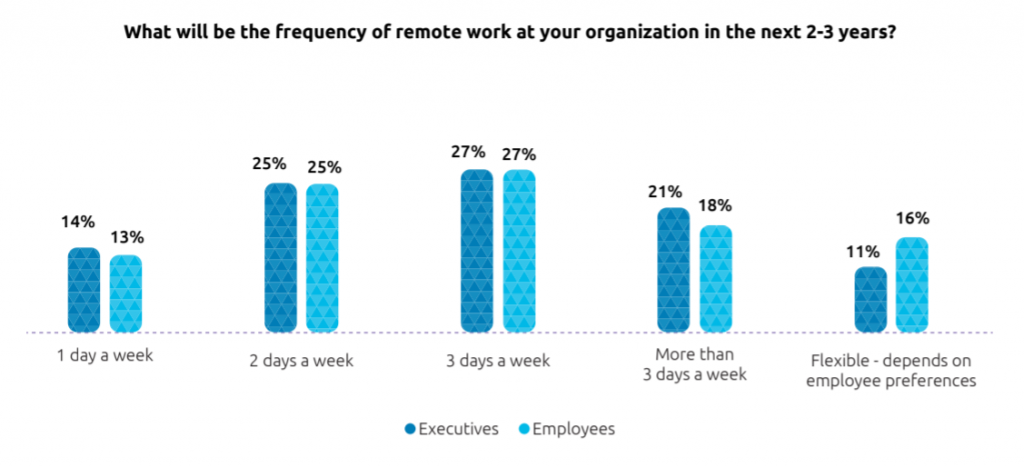
Flexible working is already a reality in many companies, both in our country and in the rest of the world. Many others are waiting for the start of autumn to define the hybrid framework. This is according to the Cap Gemini Research Institute’s report, “The Future of work: From remote to hybrid“: Three-quarters of organizations expect 30% or more of their employees to work flexibly, and more than a quarter expect more than 70% of their staff to be working remotely a few days a week.
According to that same report, about 45% of employees think they will spend three days or more a week from a remote location:
Along the same lines, and according to the study prepared by Boston Consulting Group and the think tank enClave de Personas, “New ways of working. Reflections on the future“, 65% of Spanish companies have decided or are deciding on a flexible model that combines teleworking and working in the office. Regarding professionals, the study points out that 94% expect their companies to launch initiatives related to new ways of working to increase their commitment and sense of belonging.
Given this new reality, how does this model affect the reconciliation of work and family life?
At first, we might think that everything is advantageous, as the model gives professionals greater flexibility when it comes to combining certain personal and family tasks with professional ones. But the advantages can be overshadowed by some major drawbacks.
In this article we want to point out the pitfalls you may encounter and how to avoid them, so that the hybrid work model is really positive in terms of work-life balance and your quality of life.
We found potential drawbacks in 3 areas:
1.- Mental and physical health:
Professionals have a responsibility to take reasonable care of our own health and safety at work when we do it outside the office. When working at home, people may experience issues such as stress, depression, and anxiety, have a harder time disconnecting from work and working longer hours, and even feel pressure to work while sick.
To avoid these problems, some recommendations you can follow are:
- Don’t work anywhere in the house. Have your space, which allows you to work comfortably and concentrate.
- Create start and end times for work, agreed with your team, and establish who and how to inform if you are not going to be available for a personal matter. Take regular screen breaks.
- In the same way, you have to agree with your family unit on minimum rules of interruptions, schedules and availability.
- Do at least the same physical activity you did when you went to the office every day. Better, away from home.
- Avoid staying up late, as it generates tiredness and aggravates the condition of anxiety.
- Avoid information overload.
- Eat healthy.
2. Social relationships.
Work has a very strong component of social relationships, which is something intrinsic in human beings: work creates interpersonal networks that give us a sense of usefulness and belonging. As
In addition to going to the office to maintain and cultivate social relationships, there are some recommendations when you are working at home:
- Attend only the strictly necessary virtual meetings and have all your senses focused on them during their celebration. If you attend to other things during the virtual meeting, it is likely that the other attendees will perceive it and believe that you have a lack of interest. In addition, it will cause you to feel guilty for not having been aware and contributing everything you could.
- Give plenty of notice if you have any scheduling problems due to personal or family matters.
- Don’t forget to meet your coworkers during leisure hours, even if you work outside the office. These are good times to relax and strengthen your social ties.
- Communicate and agree on your work and socialization plans with your family environment, in order to have a healthy work-life balance in all directions.
3.- (dis)Gender equality.
Whether we want to admit it or not, the data is stubborn: women spend much more time than men in unpaid jobs (mostly household activities and childcare and care for the elderly). Globally, more than 1.1 trillion hours a year, compared to less than 400 billion hours for men, according to the report “The future of women at work: Transitions in the age of automation” by the McKinsey Global Institute (MGI).
The only way for this to happen is through dialogue, understanding with empathy and reaching agreements that are maintained over time.
Hybrid work can and must balance the inequality pointed out: it is a matter of putting into practice the measures with which the majority of people agree: gender inequality is a remnant of the past that can be solved by walking the path and setting an example.
In conclusion, the flexible working model is positive, but it is not the solution. In addition to the recommendations we have collected, we must not lose sight of what David Barroeta Santamaría, associate professor at IE Business School and Director of People at OPTICALIA, says in a recent article published by the Harvard Deusto Business Review: “It is not about teleworking for teleworking’s sake, but about doing it thinking about the why and the how, in efficiency at all times and in the satisfactory maintenance of our human relationships“.