AI-generated summary
The Bankinter Innovation Foundation supports an innovation ecosystem that includes patrons, startups, experts, alumni and mid-market Spanish companies like those in Cre100do. As part of a series highlighting Cre100do members, they interviewed Antonio Gómez-Guillamón, CEO and founder of AERTEC, an Andalusian aerospace firm founded in Málaga in 1997. Present in over 40 countries and a strategic Airbus supplier, AERTEC focuses on airport infrastructure, aircraft industrial services, on-board systems and unmanned aerial systems. The company’s growth followed key milestones: early involvement in Airbus’s A400M program, a strategic pivot after the 2008 crisis to become a purely aerospace and internationally focused firm, and a move from consultancy to product development—most notably the TARSIS family of fixed-wing drones.
AERTEC’s four integrated business units share an aeronautical perspective: airport engineering centered on aircraft operations; full-cycle industrial services for aircraft manufacturing; development of certifiable on-board electronics emphasizing electrification, connectivity and AI; and unmanned systems exemplified by TARSIS—high-end drones with long endurance and beyond-visual-range capability used in civilian and military missions. International from the start, AERTEC learned to scale selectively and act locally, navigating export controls and cultural integration. Looking ahead, the company aims to lead aviation’s twin transitions to sustainability (electrification) and digitalization (autonomy and new platforms). Gómez-Guillamón values Cre100do for peer learning, shared expertise and advocacy for mid-sized companies.
From Malaga to the world. High-performance drones, on-board systems and aircraft electrification. This is how this Cre100do company innovates in the aerospace sector
At the Bankinter Innovation Foundation we have an ecosystem of innovation and knowledge that is nourished by multiple valuable sources: from our patrons to the startups in which we invest, including world-renowned experts, alumni of our Akademia program and the most innovative companies in the Spanish middle-market , which are part of the Cre100do Foundation.
We continue with our series of interviews with Cre100do companies to make visible how innovation drives sustainable growth, global competitiveness and the creation of quality jobs. On this occasion, we chatted with Antonio Gómez-Guillamón, CEO and founder of AERTEC, an Andalusian technology company specialising in aeronautics and aerospace with international projection.
AERTEC was founded in Malaga in 1997 and today is present in more than 40 countries, with its own offices in Europe, the Middle East and Latin America. It is a strategic supplier to Airbus and is positioned as a benchmark company in airport infrastructure design, on-board systems engineering and development of high-performance drones. With more than 700 professionals, AERTEC combines aeronautical knowledge, industrial capacity and technological vision to lead the challenges of the future of aviation.
A leap without a network
The history of AERTEC begins in the nineties with two young aeronautical engineers who decided to leave behind the security of their jobs to found a company in an incubator. Without godparents, without a powerful network of contacts, but with a lot of ambition. “We started with one hand in front and one behind,” sums up its CEO and co-founder, Antonio Gómez-Guillamón.
That first step already marked the character of the company: long-term vision, technical capacity and a lot of determination. The first big boost came just a few years later, when Airbus chose Seville as the venue for the final assembly plant for the A400M, its large military transport aircraft. AERTEC, which was still very small at the time, was one of the local companies that Airbus decided to incorporate into the project. An opportunity that allowed them to grow, gain industrial experience and position themselves as a trusted supplier in the aerospace world.
But it was not all growth. With the financial crisis of 2008, AERTEC experienced one of its most critical moments. Its business until then was strongly supported by the infrastructure and airport sector, which came to an abrupt standstill. Far from resisting change, they made a strategic decision: to abandon their dual approach and transform themselves into a purely aerospace company, with an international vocation.
That change even included a change of name: they changed their name from Aertec Engineering and Development to Aertec Solutions, a gesture that reflects a profound change in identity and global ambition. They also adapted their web domain, went from .es to .com and reordered their commercial strategy and market positioning.
The third major milestone came with the commitment to the development of its own product. For years they invested in R+D to stop being just an engineering consultancy and become a company with on-board technology, their own equipment and internally developed systems. This commitment was materialised with AERTEC’s entry into the market as a supplier of aircraft systems, including its own drones: TARSIS systems.
Four lines of business, a single aeronautical vision
Although its activity covers different areas, AERTEC maintains a clear common thread: everything revolves around the aeronautical world. This coherence has allowed it to consolidate itself as a unique player in the international aerospace sector. As Antonio Gómez-Guillamón explains, its structure is articulated into four large business units that work in a coordinated manner, under a single corporate and brand strategy.
1. Airports: engineering with a pilot’s vision
AERTEC designs and plans airports all over the world, from Lima to Hong Kong. Its differential approach? They put the plane – and the air operation – at the centre. Compared to large firms focused on civil engineering or transport, AERTEC approaches projects from an aeronautical perspective: with the eye of an engineer who understands how an aircraft takes off and lands, and what this implies for the design of runways, taxiways, control towers or platforms.
“We define ourselves as the most aeronautical airport engineering in the world,” says its CEO. It’s not a marketing phrase, it’s a statement of principles.
2. Engineering Services for Aircraft Industrial Cycle
From the conception of the infrastructure to the final tests before delivery to the customer, AERTEC covers the entire industrial cycle of the aircraft. His experience includes process design, manufacturing media, automation and validation. This comprehensive capability has led them to become
3. On-board systems and own product
AERTEC does not only design for others: it also develops its own electronic equipment and on-board systems, with a focus on three key areas of the future of aviation: electrification, connectivity and unmanned aerial systems. From electrical power management solutions to communication technologies in and between aircraft, its portfolio responds to the major technical challenges posed by new aviation.
4. Technology applied to unmanned flight
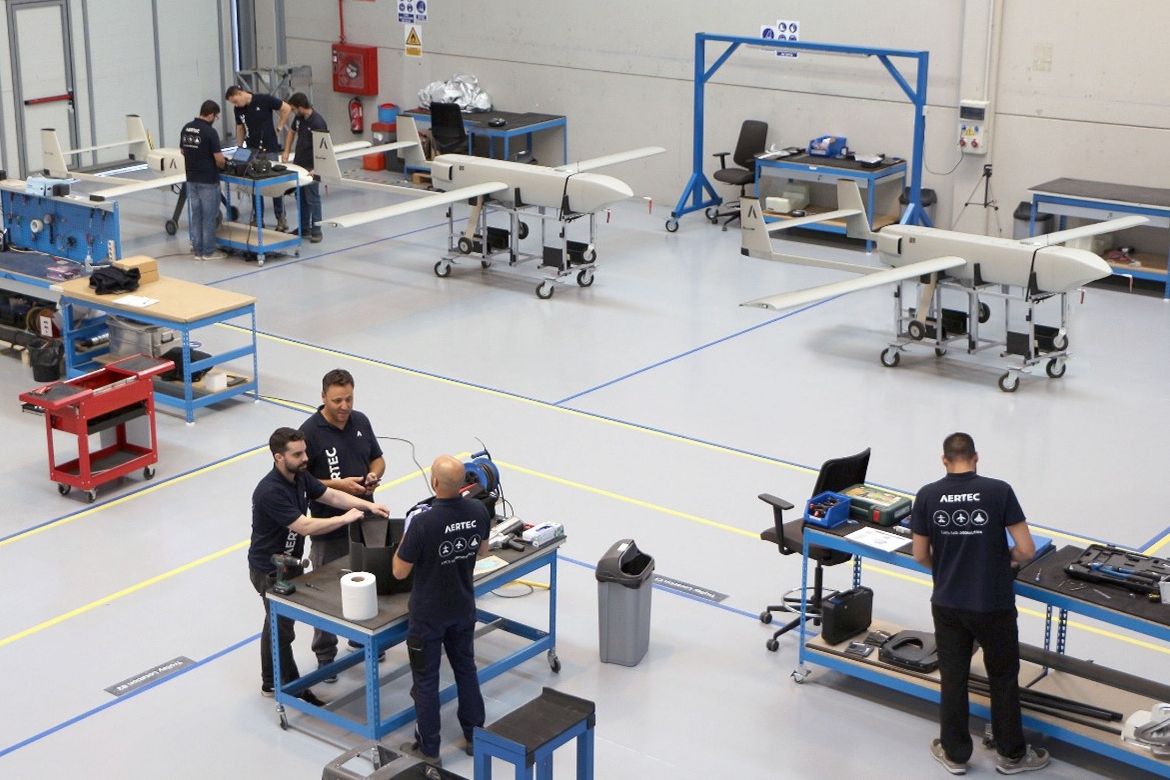
The fourth line of business translates into a high-impact product: TARSIS, a family of fixed-wing drones, with great autonomy and operational capabilities in complex missions. It is a 100% in-house development, which combines hardware, software and advanced sensors. Its value goes beyond the commercial: it demonstrates that AERTEC has the technological and industrial capacity to design, manufacture and operate complete platforms.
TARSIS: Spanish engineering in flight
In a sector where many talk about drones, AERTEC makes a difference with facts. Its TARSIS system is not a consumer multirotor, nor a technological toy: it is a high-performance unmanned aerial platform, developed from scratch by the company as a strategic commitment to the future of aviation.
TARSIS is a fixed-wing unmanned aircraft, with up to 12 hours of autonomy, capable of flying beyond visual range and operating at high altitude, maintaining safe communication with the base up to 150 kilometers away. It is designed for observation, surveillance, intelligence, or data acquisition missions, in both civilian and military contexts.
Why develop it? For two reasons, explains Antonio Gómez-Guillamón. First, because it represents its own product line, with a real market. And second, because it acts as a capability demonstrator: if AERTEC has been able to design this complete system – platform, avionics, sensor integration – it can also offer tailor-made engineering services to any customer who wants to develop their own UAVs.
TARSIS has already proven its usefulness in scenarios such as forest fires, where it can operate throughout the night – when manned aerial means have to withdraw – monitoring the evolution of the fire from the air and sending information in real time. In the military field, its applications are expanded: reconnaissance, tactical surveillance, border control, target identification. This Spanish drone represents an advanced industrial vision, an example of how a technology-based company can turn knowledge into product, and product into added value.
Differential technology: certifiable electronics and learning systems
In a world where everything is labelled as “intelligent” or “AI-powered”, AERTEC stands out for having done its homework long before the hype. Its differential comes from technical solidity.
The turning point came when the company decided to bet on mastering certifiable programmable digital electronics. A critical capability in the aeronautical sector, where safety and reliability are everything. It is not just a matter of designing complex electronic systems, but of doing so in compliance with the most demanding certification standards. In the words of its CEO, “everything you do has to be able to board a plane, and that changes the rules of the game”.
This knowledge allows them to design and develop on-board systems ranging from electrical power management to cabin connectivity technologies or communication between aircraft. This is where another of its technological commitments comes into play: advanced connectivity, including the use of 5G for aeronautical environments.
And now, artificial intelligence is beginning to take its place. AERTEC is integrating AI algorithms into its on-board systems and drones, which allows these systems to learn from their own operation and act with increasing autonomy. The combination of AI with certifiable programmable electronics is one of the most advanced frontiers in the industry and they are already there.
Internationalization: global vision from minute one
International ambition was not a consequence of AERTEC’s growth, it was part of its DNA from the beginning. When they were still an airport-focused micro-enterprise, they were already working on the London-Luton Airport project. “Although there was plenty of work in Spain, we wanted our knowledge to go abroad from the beginning,” recalls Antonio Gómez-Guillamón.
This conviction has led them to operate today in more than 40 countries, with their own offices in France, the United Kingdom, Germany, Colombia and the United Arab Emirates, and projects in Latin America, the Middle East, Asia and Europe. But the road has not been easy.
Like many companies that launch abroad with enthusiasm, AERTEC also made mistakes. “We were excited about bidding in 27 countries at the same time, until we learned that it is better to bid in five and win in four.” They learned to internationalize with strategy, focus and realism.
And they understood something key: no matter how global you are, you have to act locally. That means hiring talent in each country, understanding the business culture and avoiding the vision of the “foreigner who comes to rule”. Real internationalization implies integration, not imposition.
Added to this is an added complexity: the export of aeronautical and defence technology, where regulatory compliance is critical. AERTEC has developed capabilities to move safely in this field, understanding regulations, export controls and legal frameworks that condition the international deployment of its technology.
Its international focus is, in addition to commercial, cultural and strategic. They do not seek to be “a Spanish company that exports”, but a global company with roots in Spain.
The future of aviation: sustainable, autonomous and with new platforms
Aviation is at an inflection point. For decades, the changes were incremental: more efficiency, less noise, better experience. But today the sector is facing a structural transformation driven by two major drivers: sustainability and digitalisation.
Antonio Gómez-Guillamón sums it up well: “Since I was a child, airplanes have not changed so much. But now we are really entering a new era.” And AERTEC wants to be at the centre of this change.
On the one hand, there is the challenge of emission-free aviation. The progressive electrification of the aircraft is one of the key paths, and AERTEC is developing its own technologies for the management of electrical power on board. In addition to replacing mechanical components with electrical components, it is about redesigning how an aircraft flies, making it more efficient and less dependent on fossil fuels.
On the other hand, digitalization is allowing the emergence of new aerial platforms. From increasingly intelligent drones to aircraft intended for urban air mobility – such as air taxis or autonomous logistics systems. Here, AERTEC brings its experience in unmanned systems engineering, as well as its mastery of on-board and communications environments.
On both fronts – electrification and new platforms – the company is already developing applied technology, with projects underway and its own products. And they do so with a practical approach: with the capacity to design, validate and certify in real environments.
Cre100do: Community, Scale, and Peer Learning
For a company that has ceased to be an SME, but that does not identify with large corporations, Cre100do offers something essential: belonging, says Antonio Gómez-Guillamón. “When you’re no longer small, but you’re not in the big league yet, you can feel a little orphaned,” he explains. Cre100do creates a space where you can share concerns, challenges and solutions with other companies that are in the same phase of evolution.
Sessions with experts, peer-to-peer conversations and thematic working groups allow key topics such as talent, financing growth, innovation or internationalisation to be addressed from a practical and close perspective. In Antonio’s words, “it is a pleasure to be able to learn from others who are experiencing the same thing as you”.
A clear example is the participation of Paula Such, AERTEC’s talent director, in the Cre100do talent group, where Cre100do companies share approaches and strategies to attract and retain professionals in competitive environments.
In addition to the shared knowledge, Antonio highlights Cre100do’s work in making visible and defending medium-sized companies as a category of their own within the Spanish productive fabric. A group that generates employment, exports, innovates and scales, but that needs adequate support frameworks to continue growing.
Thank you very much Antonio! And may the successes continue!
If you want to know more about the Cre100do Foundation, the companies that are part of the program and their activities, we invite you to visit their website.