
AI-generated summary
Technological advancements and scientific research are fueling the commercialization of space, turning it into a thriving business opportunity on Earth. Although space lies just 100 kilometers away, reaching it by rocket remains an expensive endeavor, costing tens of millions of euros. However, as launch costs decrease—dropping by 80% over 15 years due to economies of scale—space traffic is growing exponentially. This surge is reflected in the increasing number of satellites launched annually: from around 100 in the early 2000s to over 2,500 in 2022, with over a million satellites planned by 2028. This rapid increase brings a mounting problem: space debris.
Space debris consists of defunct satellites, discarded rocket parts, and fragments resulting from collisions in Earth’s orbit. These collisions, occurring at high velocities, generate more fragments, escalating the risk of a chain reaction known as the Kessler syndrome, where debris density could render space travel hazardous. To address this, experts propose various cleanup strategies, such as capturing debris with nets or redirecting it to the Moon for recycling. Additionally, regulating orbital space through fees or taxes is suggested, though it may not curb growth. This expanding satellite presence also raises questions about detectability from nearby exoplanets, highlighting humanity’s increasing footprint in space and the urgent need for sustainable orbital management.
Technology and scientific research are driving the commercialization of space and a business opportunity on our planet. Space is very close, just 100 kilometres away, a distance that would take barely an hour by car but that by rocket requires tens of millions of euros. Leaving the planet is a challenge and a remarkable investment, […]
Technology and scientific research are driving the commercialization of space and a business opportunity on our planet. Space is very close, just 100 kilometres away, a distance that would take barely an hour by car but that by rocket requires tens of millions of euros.
The drop in the price of rocket launches makes us launch more and more
Every year that passes there are more objects in orbit. What’s more, with each passing year, the difference between objects in orbit and the previous year is greater. Space traffic is growing exponentially as previous launches make those that will come after cheaper than those that will come later.
There is an unnatural law that says that every time the orders for a job are doubled, its price falls by 20%. We’ve launched a lot of rockets, so in 15 years the cost has plummeted by 80%, so now more are being launched. There are more than 10,700 tons in the form of 32,540 objects floating (literally, falling) up there.
The (growing) problem of space debris
In the 2000s, around 100 satellites were launched annually. In 2020, more than 1,200 were launched. In 2022, more than 2,500 were launched. For 2028, 1,119,866 satellites are scheduled, already confirmed. Waste will grow in proportion, and it does so for multiple reasons.
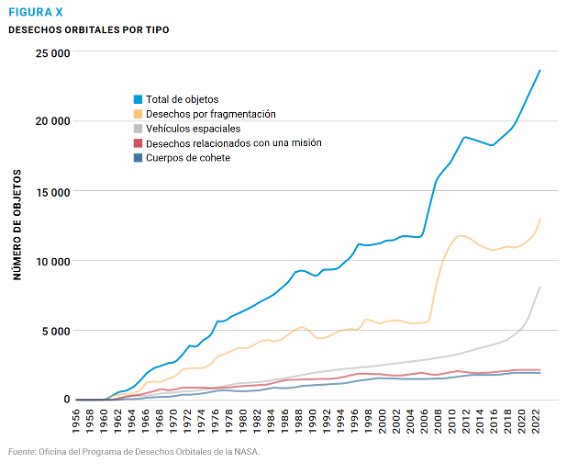
On the one hand, there are the payloads deliberately thrown into space, such as the remains of ships that are better ejected. Also abandoned space missions. However, the most dangerous waste is that produced by fragmentation events: what was once one object, is now many.
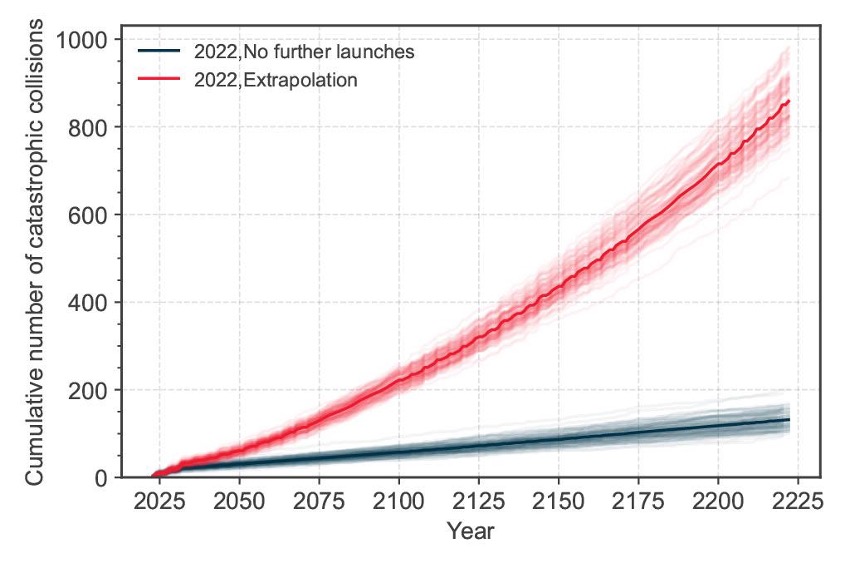
This occurs when one object impacts another. And in an environment that increases in density and in which objects are moving at tens of thousands of kilometers per hour, collisions are to be expected. In fact, the number of ‘catastrophic collisions‘ is exponential whether or not more satellites are launched (because a satellite turned into fragments due to a collision with fragments generates secondary impacts with other satellites).
Space debris, space debris, space pollution
Kessler syndrome is a hypothetical state in which the accumulation of space debris causes any rocket we launch to become fragments as it cannot escape from a planetary orbit full of space debris. How do we clean up this space pollution?
One of them is to consider space junk as useless, and to use techniques to get objects out of it, either by pushing them into space or by making them fall onto the planet. But the most coherent is to consider it as rerecoverable waste. Putting them up there has cost millions of euros per kilogram, and it is smarter to capture the waste to give it a second life.
Some projects are considering spatial cleaning brigades to help capture these fragments and remains. And in incredibly creative ways. In some versions,
As the Megatrends 2024 report points out, the space to which we send communication satellites is finite, and experts point out that “it will be necessary to regulate their allocation of space more strictly”: applying orbit use fees or tightening taxes on rockets, which is consistent if their emissions are taken into account. However, these Pigouvian taxes do not seem to be going to stop exponential growth. Humanity will have to find solutions for the dense off-planet traffic.
What if someone sees us?
In one of the most interesting scientific studies on satellite density, the solar physicist at the Instituto de Astrofísica de Canarias Héctor Socas-Navarro wonders : How many satellites will have to be put into orbit for a civilization with our technology to detect us from Proxima b? The answer is not too many, and certainly far fewer than we will have by the end of the decade.