
AI-generated summary
The Future Trends Forum in Madrid examined how innovation—especially vertical farming—could reshape food systems by bringing production closer to consumption and turning urban waste into resources. Vertical farms stack trays of crops in controlled, LED-lit environments, using hydroponics or similar methods to cut land use, inputs like pesticides and nitrogen, fuel and emissions, and enabling composting and nutrient recirculation. North America, China, Singapore and Taiwan lead current deployments, particularly for leafy greens. Yet the high-tech facilities demand skilled labor, large electricity supplies, generate technological waste, and still struggle to replicate the soil microbiomes critical for nutrient assimilation.
Whether vertical farming is efficient depends on climate, crop and local energy sources: in cold, energy-rich places it can reduce greenhouse gases; in some cities greenhouses or traditional fields remain more land- or energy-efficient. Vertical farming cannot feed modern cities alone—typical per-person land needs (20–100 m2, much higher for animal-based diets) far exceed available urban space. A likely future mixes peripheral, solar-powered growing districts with urban vertical farms: photovoltaic arrays powering intensive indoor production on city edges, creating a ring of energy and food production that complements, rather than replaces, conventional agriculture.
The Future Trends Forum, Tech to Table: Advances in agriculture that will define the future of food, organised by the Bankinter Innovation Foundation in Madrid, reflected on the challenges in the agricultural sector and the role of innovation in transforming challenges into opportunities. The activity and impact of agriculture is not only located in the […]
The Future Trends Forum, Tech to Table: Advances in agriculture that will define the future of food, organised by the Bankinter Innovation Foundation in Madrid, reflected on the challenges in the agricultural sector and the role of innovation in transforming challenges into opportunities. The activity and impact of agriculture is not only located in the fields. Cities are great devourers of food resources, as well as excretors of waste.
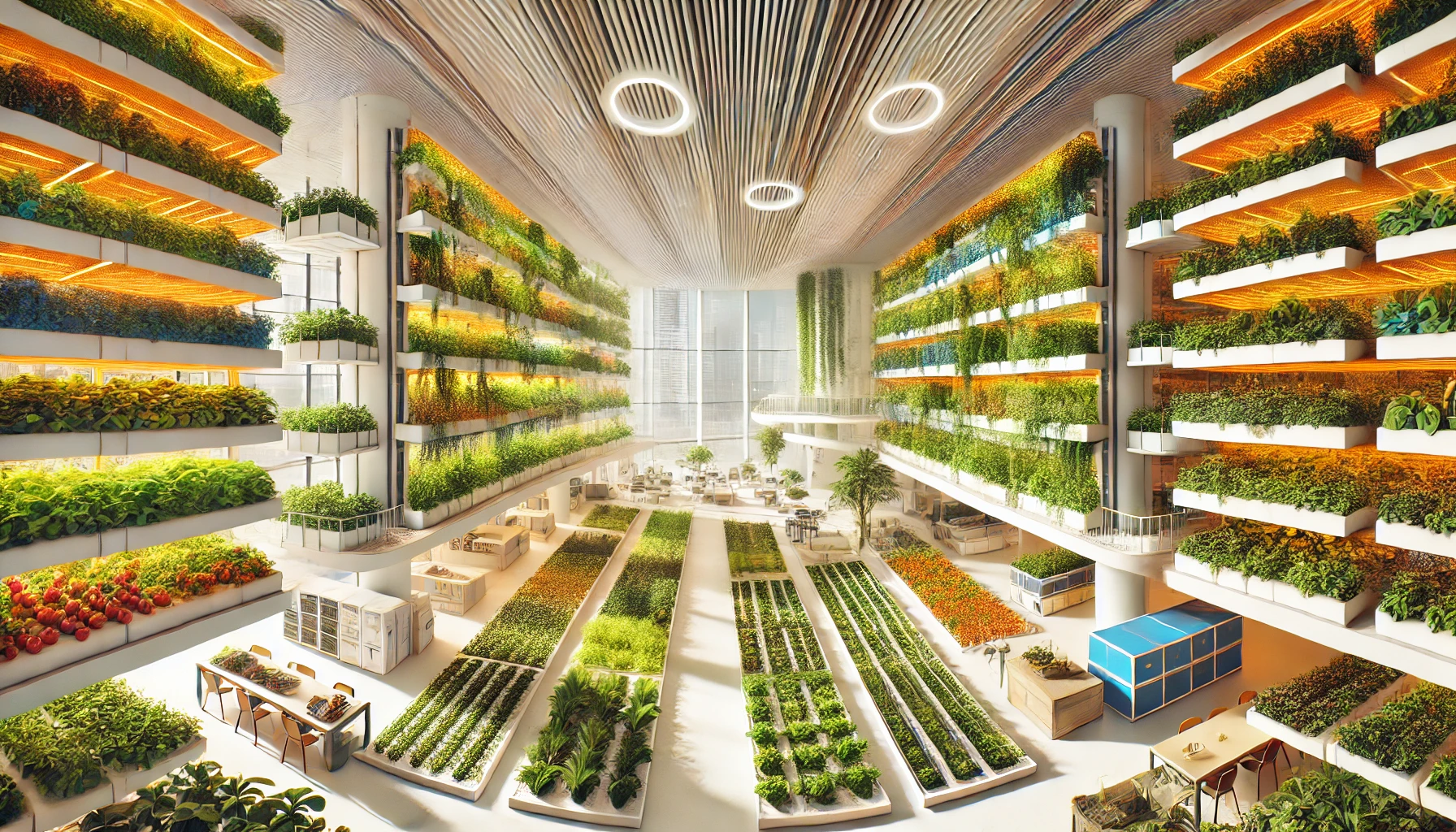
Can cities close the loop on their food production? Is it possible to include vertical farming plots within buildings? Vertical farming – stacking trays of crops up to the ceiling of industrial buildings irrigated with LED light or columns full of crops – is postulated as one of the future agricultural formulas waiting for a new agricultural revolution that competes with drones in the fields and satellites that monitor crops.
The state of the art of vertical farming
When someone enters a vertical lettuce plantation, the first thing they realize is that the farmers are not tanned and, if it were not for a narrow strip through which the eyes are seen, they would not even be there. They wander around dressed entirely in white with foot coverings, gloves, and often protective lab goggles. They wear hairnets in their hair as if they were handling space material. And almost, because it is the only way to grow in space.
Stacked on shelves several tens of metres high, millions of trays contain an infinity of small plants planted in recycled substrate that floats in a liquid with a high concentration of nutrients. The pinkish light resulting from combining blue light with red light bathes the leaves (green under white light, purple under that atmosphere). It is a very efficient machine that uses the right energy, materials and nutrients.
One in three of the hydroponic crops (plants floating in liquid, without soil) were concentrated in North America. The United States and Canada are experts in growing leafy greens like lettuce with their more than 2,500 vertical farms. It is closely followed by
Pros and Cons of Filling Cities with Vertical Crops
Among the many advantages of urban vertical farming are:
- Bring production closer to the place of consumption.
- Recirculate organic matter through composting that produces fertilizers.
- Reduce the impact of the crop on the environment.
- Significantly compress the area of the crops (10 ha in 1000m2).
- Reduction or practically non-existence of inputs (nitrogen and pesticides included) when working in closed environments.
- And a notable reduction in fuel use and emissions.
On the other hand, the disadvantages continue to weigh on many locations and types of crops: urban land is expensive and introducing volumes of crops would raise the square metre even more, the workforce becomes technified so that a large part of the farmers would be left out of the model, the volume of technological waste would increase significantly, electricity would multiply its demand. And we cannot fail to mention one of the biggest challenges, collected by the Future Trends Forum dedicated to the challenge of food: microorganisms play a key role in the assimilation of nutrients, and we do not know how to replicate them.
How efficient is vertical farming in the city? It depends on the city, it depends on the crop
One of the most relevant articles analysing vertical farming and comparing it with other forms of cultivation was published in 2022 and analysed the potential yield of six vegetables in three modalities: traditional intensive farming, greenhouse farming and vertical farming. The conclusions were crystal clear: it depends on many things.
It was concluded that in cold climates vertical farming made sense if the objective was to reduce greenhouse gas emissions, that the greenhouse is relatively more efficient than the other two modes if occupied area is measured, that only in Reykjavik was vertical farming the best of the typologies (due to the abundance of geothermal energy), that in Stockholm vertical farming competed with open-air farming or that in the United Arab Emirates indoor farming was ideal. This is logical if you take into account that it is one of the most unfavorable climates for cultivation.
Is it possible to feed cities with vertical farming alone?
No, it’s impossible. At least, if the cities are like the current ones. It is estimated that each adult person requires between 20 and 100 square meters of arable land to produce the food they require to live, depending on the type of food, the expected nutrients, and the climate. No less than 10 and no more than 200 (if the diet is plant-based, if it includes meat products, the scales are multiplied by 10). So where would they come from?
It is enough to take a look around to verify that there is not so much free area in urban environments. Who can do without 20 to 100 square meters of their home when often multiple people live in buildings smaller than that maximum? Yes, vertical farming allows you to stack trays, but it has its limits. Increasing efficiency, each person needs to allocate a bedroom to produce their own food.
Photovoltaic cities surrounding lettuce cities surrounding the city of humans
From the beginning of this technology it is clear that it is not viable to produce 100% of the food within the city, so many of the crop fields are moved to the urban periphery where the price of land is low and where it is possible to install photovoltaic on a massive scale. After five centuries we return to an urban model in which cultivation surrounds the city, although now it is inside buildings.
However, and despite the fact that these crops usually need much less energy per unit of nutrient (there is no adverse weather, there are no pests, there are no thefts, and it is also very efficient), it is still an electro-intensive technology that requires significant areas of photovoltaic panels. So it is to be expected that if the technology becomes popular we will have photovoltaic cities surrounding cities of lettuce that surround the city of humans.