
AI-generated summary
Annual Recurring Revenue (ARR) is a crucial metric for businesses relying on recurring customer relationships, offering insight into revenue stability, planning ability, and growth potential. ARR measures the total recurring revenue expected annually based on existing contracts, excluding one-time or uncertain income, making it a reliable indicator of a company’s structural revenue capacity. While commonly linked to software companies, ARR applies broadly across sectors like telecommunications, insurance, and industrial services, helping management and investors understand the stable revenue base without new customer additions.
ARR is calculated by annualizing the recurring revenue from all active contracts, whether monthly, annual, or multi-year, and is distinct from but complementary to Monthly Recurring Revenue (MRR), which provides short-term revenue trends. It also differs from Annual Contract Value (ACV), which reflects the average size of contracts rather than total recurring revenue. ARR growth depends on four levers: acquisition of new contracts, retention of existing customers, reactivation of lost customers, and expansion through increased service within the customer base. Sustainable ARR growth requires well-designed contracts, evolving value propositions, active customer lifecycle management, and pricing aligned with value delivered. Ultimately, managing churn (customer loss rate) and increasing Lifetime Value (LTV) are key to enhancing ARR quality, ensuring long-term, predictable, and scalable business success.
Find out what ARR (Annual Recurring Revenue) is, how to calculate it, and why it's key to assessing the strength and sustainable growth of businesses with recurring revenue.
Annual Recurring Revenue (ARR) has established itself as one of the most widely used metrics to understand the economic strength of business models based on recurring customer relationships. The ARR provides particularly valuable reading on a company’s revenue stability, ability to plan, and medium- and long-term growth potential. In a context where predictability and efficiency in the use of capital have returned to the center of the debate, understanding what the ARR actually measures – and how to interpret it correctly – is key for any entrepreneur or manager who aspires to build sustainable growth.
What exactly does Annual Recurring Income mean?
The ARR expresses the volume of recurring revenue that a company can anticipate in an annual horizon based on the contractual commitments it already has in place. It is not a commercial forecast or an estimate; It is a normalized picture of the recurring business in its current state.
Its value lies precisely in what it leaves out. ARR only incorporates revenue that repeats over time and is supported by stable contracts or agreements. One-off projects, non-recurring services or any income whose continuity is not reasonably assured are excluded. That’s why it’s considered a run-rate metric: it reflects the structural capacity to generate revenue.
Although the term is frequently associated with software, and specifically the SaaS model, ARR is applicable to a much broader spectrum of business models. It is used by B2B service companies with annual contracts, telecommunications and utilities operators, industrial maintenance companies, insurance companies, fintechs and, in general, any organization that builds its relationship with the customer on recurring revenue, whether in the digital or physical sphere.
Seen in this way, the ARR allows us to answer a particularly relevant question for management teams and investors: what is the stable revenue base of the business if, for a period, no new customers are incorporated. This answer is what makes the ARR a key reference to evaluate solidity, visibility and real capacity for sustainable growth.
How to Calculate ARR
Calculating the ARR is not complex from a mathematical point of view, but it does require conceptual clarity. The starting point is always the same: identify what part of the business’s revenue is really recurring and can be projected consistently over a year.
ARR Reference Formula
Generally speaking, ARR is obtained as the sum of the annualized recurring revenue of all active contracts. It is a standardisation that allows different situations to be compared – monthly, annual or multi-year contracts – under the same time frame.
In practice, this involves:
- In annual contracts, take directly their annual value: Formula:
ARR = Ingreso recurrente anual. - In monthly contracts, annualize the income by multiplying it by twelve: Formula:
ARR = Ingreso recurrente mensual × 12. - In contracts of longer duration, consider only the appellant corresponding to one year, not the total amount of the contract: Formula:
ARR = (Ingreso recurrente total del contrato ÷ duración en años).
An example outside the field of software helps to understand it better. Consider an industrial services company that manages maintenance contracts. If you have 40 active contracts, each with an annual value of €10,000, your ARR amounts to €400,000. That figure represents the recurring revenue base that the business can anticipate with a high degree of certainty.
One of the most common mistakes when calculating ARR is to incorporate “probable” revenues or trade forecasts that have not yet materialized. The ARR measures only commitments, leaving out expectations. It only includes that which is repeatable and supported by existing agreements. This discipline is what makes ARR a reliable metric for strategic decision-making.
Differences Between ARR and MRR: When to Use Each?
ARR and MRR measure, in essence, the same reality – recurring revenue – but they do so from different time perspectives and therefore answer different questions. Understanding this difference is key to avoiding misreadings of the business.
MRR (Monthly Recurring Revenue) offers a short-term view. It allows you to observe with greater granularity how recurring revenues evolve month by month, detect trend changes quickly and analyze the immediate impact of commercial, pricing or product decisions. That’s why it’s a particularly useful metric for operational management and day-to-day growth tracking.
ARR (Annual Recurring Revenue), on the other hand, introduces a strategic layer. By annualizing recurring revenue, you reduce short-term noise and facilitate a more stable reading of the size and strength of the business. It is the metric that is commonly used in the context of reporting, comparative analysis between companies and conversations with investors, precisely because it allows the potential of the model to be evaluated with greater perspective.
| Metrics | What it measures | Time horizon | When it brings the most value |
| MRR (Monthly Recurring Revenue) | Recurring revenue in one month | Short term | Operational monitoring, trend analysis, immediate impact of business decisions |
| ARR (Annual Recurring Revenue) | Annualized recurring revenue | Medium and long term | Strategic reporting, cross-company comparability, investor conversations |
Both metrics do not compete with each other. They complement each other. MRR helps to understand how the business behaves in the short term; the ARR allows you to explain where you are going.
ARR vs ACV
ARR and ACV (Annual Contract Value) often appear together in financial analyses and investor presentations, but they do not measure the same or serve the same type of decision. Confusing them is a common source of business misreadings.
| Metrics | What it measures | What helps to understand |
| ACV (Annual Contract Value) | Average annual value of a contract | The economic size of each customer |
| ARR (Annual Recurring Revenue) | Total sum of annualized recurring revenue | The size and scale of the recurring business |
A simple example illustrates this. If a company has an average LCA of €20,000 and has 50 active contracts, its ARR amounts to €1,000,000. In this case, the LCA allows the economic relevance of each business relationship to be assessed, while the ARR offers an aggregate view of the recurring revenue base on which the company is based.
Both metrics are complementary. LCA helps to analyse commercial positioning, the complexity of the sales process or the dependence on large accounts. The ARR, on the other hand, is the reference to understand the real dimension of the recurring business, its stability and its capacity for growth over time.
Used together, they allow a much more complete reading of the company’s economic model to be constructed.
The 4 levers of the ARR
The ARR does not grow linearly or respond to a single variable. It evolves like a cascade, in which different forces add or subtract recurring revenue over time. This logic is common to any business based on stable contractual relationships, regardless of the sector.
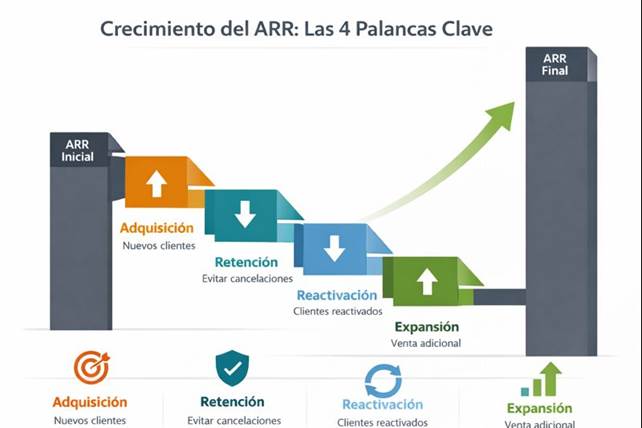
The first lever is acquisition. It is the most visible and often the one that concentrates the most attention. It refers to the new ARR that enters the system through new contracts. Although it is essential for growth, it is also often the most expensive lever in terms of time, capital, and commercial effort.
The second is retention. Here it is not a question of growing, but of not losing what has already been built. The ARR that is maintained thanks to renewals and the absence of cancellations is, in many cases, the main determinant of the stability of the business. A strong recurring base often depends more on the ability to retain than on the ability to sell consistently.
The third lever is reactivation, less visible but relevant. It refers to the ARR that is recovered from customers who had canceled and re-hire. It can be associated with improvements in the value proposition, changes in the customer context or more mature lifecycle management. Although it is not always systematic, it introduces efficiency in growth.
The fourth lever is expansion. It is the increase in ARR within the existing customer base, either due to expansion of scope, greater volume of service or evolution of the contract. From a strategic perspective, this lever is often particularly valued because it indicates that the model generates more value over time.
This growth structure is common to software companies, recurring professional services, infrastructures or B2B contractual models. Understanding how these four levers interact is essential to correctly interpret the evolution of the ARR and avoid simplistic readings of growth.
How to increase your ARR and reduce churn
The sustainable growth of the ARR is based on a coherent business model architecture. In the strongest recurring businesses, ARR increases because the customer relationship is well-designed from the start and actively managed over time.
This starts with clear, renewable contracts that reduce friction in the continuity of the relationship and make planning easier for both the customer and the company. It continues with a value proposition that is renewed, that does not run out at the time of the initial sale, but evolves and remains relevant throughout the customer life cycle.
Active management of that lifecycle is another key element. Identifying early signs of risk, accompanying the customer at critical moments and understanding how their context changes allows churn to be reduced in a structural, not reactive, way. In addition, a pricing design aligned with the use, scope or value generated is added, which allows the relationship to grow naturally without the need for constant renegotiations.
When these pieces fit together, the ARR is no longer solely dependent on the pace of trade. In the most mature recurring businesses, a simple logic is true: the ARR is able to continue growing even when sales slow, because the existing revenue base is maintained, expands and gains weight over time.
Churn and LTV: Two Metrics That Explain ARR Quality
Reducing churn rate and increasing LTV (Lifetime Value) are two sides of the same coin. In fact, the quality of the ARR – not just its growth – depends directly on how these two variables evolve.
Churn measures the rate at which the recurrent base is eroded. An ARR that grows solely on acquisition, but loses customers quickly, is structurally fragile. Conversely, a low churn rate amplifies the value of each new contract and reinforces the predictability of the business.
LTV, on the other hand, reflects the total economic value that a customer brings throughout their relationship with the company. It increases when the customer stays longer, when the relationship expands, or when the value proposition deepens. In this sense, LTV acts as a leading indicator of the ARR’s ability to grow without proportionally increasing commercial effort.
From this perspective, optimizing ARR is achieved by designing longer-lasting and more valuable relationships. When churn and LTV evolve in the right direction, ARR becomes a robust metric: less dependent on the short term and more aligned with sustainable growth.