AI-generated summary
CRISPR transformed biology by making gene editing faster, cheaper and far more precise than previous methods. Derived from a bacterial immune system that stores fragments of viral DNA to recognize invaders, CRISPR uses a guide RNA to find a specific DNA sequence and a Cas protein to cut it, after which the cell’s natural repair mechanisms introduce the desired change. This search-and-edit approach — likened to a word-processor’s “find” function rather than simple scissors — has democratized genetic work and become central to synthetic biology, which combines biology, engineering and computation to design organisms with tailored functions.
Its practical impact spans medicine, agriculture and industry. CRISPR-based therapies are already approved for some inherited blood disorders, and many more treatments are in clinical trials. In agriculture and manufacturing, gene editing speeds development of disease- or drought-resistant crops and optimizes microbes for producing fuels, materials and pharmaceuticals. Challenges remain, including off-target cuts and unpredictable cellular repair, plus ethical and regulatory debates over germline editing. As CRISPR tools evolve to edit single DNA letters or control genes without cutting, their promise grows — but so does the need for careful oversight, international consensus and public trust.
CRISPR has revolutionized gene editing. Find out how so-called molecular scissors work, what applications they have, and why they are a key tool for the future of synthetic biology.
CRISPR has changed the way DNA is researched and modified. This technology makes it possible to edit genes with a precision and speed that seemed unattainable just two decades ago. Its impact is already being felt in medicine, agriculture and industry, and it has become one of the key tools of synthetic biology.
The possibility of modifying DNA in a precise way has been one of the great objectives of biology for decades. Today this capacity exists thanks to CRISPR, a gene-editing technology that has transformed biomedical research and opens up new opportunities to treat diseases, develop more resistant crops or design microorganisms capable of manufacturing materials and medicines.
CRISPR is part of a much broader scientific revolution: synthetic biology. While genetic engineering made it possible to modify specific genes, synthetic biology aspires to design biological systems with specific functions, combining biology, engineering and computer science. At the Bankinter Innovation Foundation we analyse this evolution in the report Synthetic Biology, where international experts explore how these technologies are redefining sectors such as health, food, industry and sustainability.
Among all the tools available, CRISPR stands out for having democratized gene editing. Its ease of use, precision, and relatively low cost have accelerated thousands of research projects in laboratories around the world.
What is CRISPR?
CRISPR is a gene-editing tool that allows a specific DNA sequence to be located and modified with great precision. Thanks to this system, scientists can remove, correct or introduce changes in specific genes much faster than with traditional techniques.
Its name comes from the English Clustered Regularly Interspaced Short Palindromic Repeats, a name that refers to repeated sequences present in the DNA of certain bacteria.
Although it is often known as the “molecular scissors”, this metaphor explains only part of how it works.
Why the scissors metaphor falls short
Imagining CRISPR as scissors helps us understand that it can cut DNA. However, scissors alone do not know what to cut.
The real innovation of CRISPR is that it first finds exactly the piece of DNA it is looking for and only then makes the cut.
A more accurate analogy would be the “Search” function of a word processor. When we use Ctrl + F, the program locates a specific word within a document of hundreds of pages. CRISPR acts in a similar way: it searches for a specific sequence among the approximately 3,000 million letters that make up the human genome.
Once located, the protein responsible for making the cut comes into action.
That ability to search before acting is what has made CRISPR a revolutionary tool.
Where did CRISPR come from: the defense system that bacteria have been using for millions of years
As with many great scientific advances, CRISPR was born by observing nature: bacteria have been fighting viruses called bacteriophages for millions of years, which try to infect them in order to reproduce.
During this evolutionary battle, they developed a sophisticated immune system. When a bacterium survives a virus attack, it retains small fragments of its DNA as if they were photographs of the invader. If that same virus attacks again, the bacterium immediately recognizes its genetic material and activates proteins capable of destroying it.
CRISPR is precisely part of this natural defense mechanism.
The big leap came when different scientific teams understood that this system could be adapted to edit practically any fragment of DNA, including in plants, animals or human cells.
This discovery completely changed the landscape of molecular biology and opened a new stage for genetic research.
How CRISPR works step by step
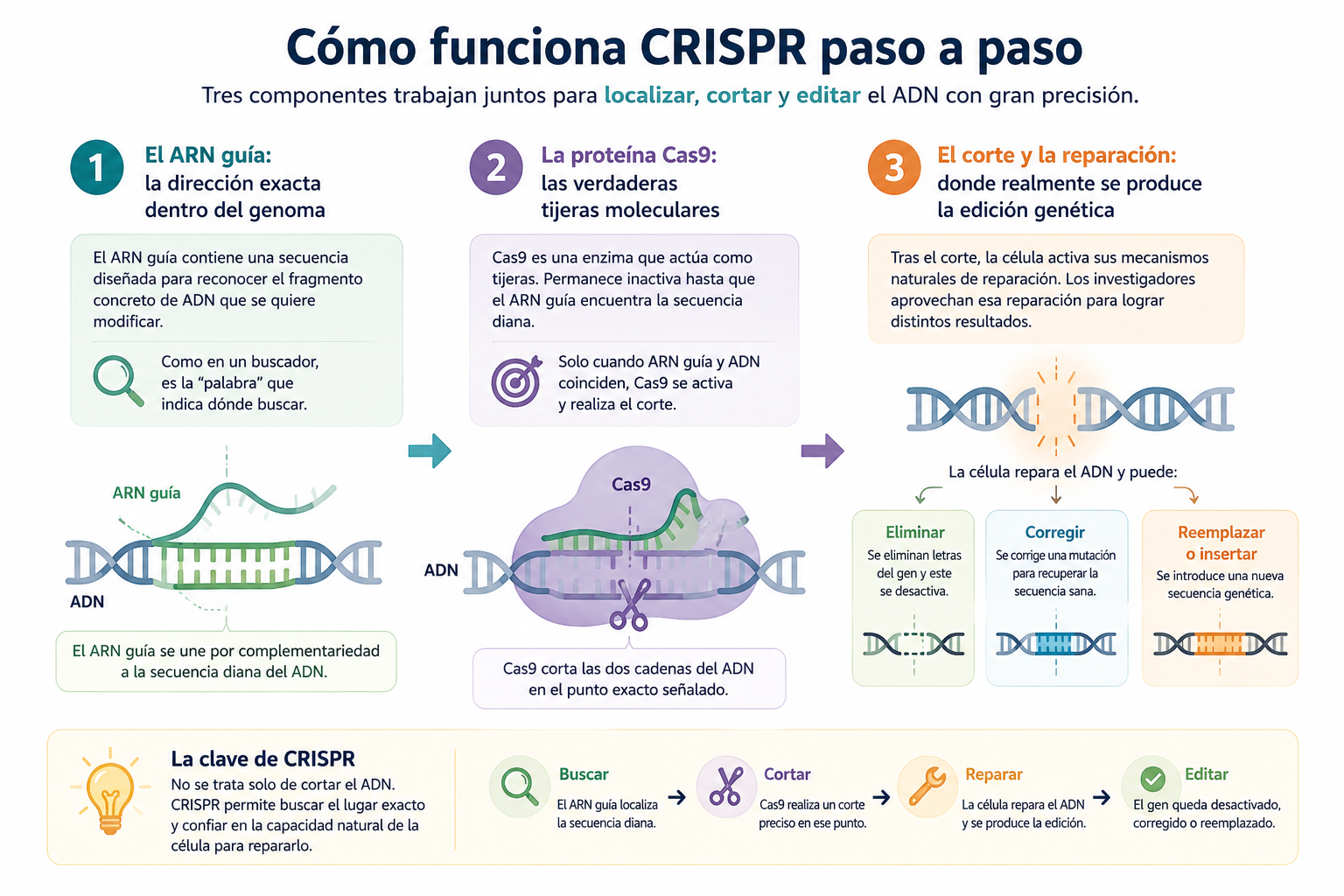
Although there is enormous biological complexity behind it, the basic functioning of CRISPR can be understood by following three steps.
Guiding RNA: the exact direction within the genome
The first component is the guide RNA.
Its function is to indicate where the system should act. To do this, it contains a sequence designed to recognize the specific fragment of DNA that you want to modify.
Following the analogy of the word processor, the guide RNA would be the word we type in the search box.
Without this information, the system would not know where to go.
The Cas9 protein: the true molecular scissors
The second component is the Cas9 protein.
Cas9 acts as an enzyme capable of cutting the two strands of DNA. However, it remains inactive until it finds the exact sequence indicated by the guide RNA.
Only when both elements coincide does the editing process begin.
This combination of search and cut explains the high degree of precision of the technology.
Cutting and repairing: where gene editing actually happens
Once the cut has occurred, a mechanism that already existed in the cells themselves comes into play.
DNA can be broken for different reasons, so cells have natural repair systems.
Researchers take advantage of precisely this ability to achieve different results.
In some cases, the repair removes part of the gene and manages to deactivate it. In others, a new genetic sequence is introduced that replaces the original or corrects a mutation responsible for a disease.
In reality, CRISPR doesn’t directly “rewrite” DNA. What it does is create the exact point where the cell will carry out the repair. That difference explains why many scientists prefer to talk about gene editing rather than genetic modification.
Much more than cutting genes
The first generation of CRISPR tools was designed to make cuts in DNA. However, technology continues to evolve at great speed.
Today there are variants capable of modifying a single “letter” of DNA without completely breaking the double strand, editing RNA instead of DNA, or activating and deactivating genes without altering their sequence.
This constant evolution makes CRISPR a technological platform with increasingly broad applications and places it at the center of the development of synthetic biology. More than a specific tool, it represents a new way of understanding the engineering of biological systems.
The fine print: CRISPR isn’t perfect
The precision of CRISPR has transformed genetic research, but that does not mean that it is an infallible tool.
One of the main challenges is the so-called off-target effects. Sometimes, the system can make a cut in a region of DNA very similar to the sequence sought. Although these errors are becoming less frequent thanks to new generations of Cas proteins and the improvement of guide RNAs, they are still a key aspect in the development of clinical applications.
There is also uncertainty about how the cell repairs the DNA after cutting. This process is biological and, therefore, can produce different results depending on the type of cell or tissue where the editing is applied.
Therefore, before a CRISPR-based therapy reaches patients, it must go through years of research, preclinical trials and clinical studies to guarantee its safety and efficacy.
Far from detracting from the technology, these challenges reflect the rigor with which biomedical research is advancing.
What’s already healing
For years, CRISPR was a promise of the laboratory. Today it is beginning to become a clinical reality.
One of the most important milestones came with Casgevy, the first CRISPR-based treatment approved for patients with sickle cell anemia and beta thalassemia in different countries. These inherited diseases alter the production of hemoglobin and can cause serious complications throughout life.
The treatment consists of extracting stem cells from the patient himself, editing them using CRISPR in the laboratory and reintroducing them into his body to produce healthy red blood cells.
This advance marks a turning point. It shows that gene editing can no longer be an exclusively experimental tool and become a real therapeutic option for certain diseases.
Research continues to advance in other hereditary pathologies, some types of cancer, eye diseases and neurological disorders. Although many of these applications are still in clinical trials, the pace of development is one of the fastest in biomedicine today.
Beyond Medicine: Agriculture and Industry
The potential of CRISPR goes far beyond the health field.
In agriculture, it allows the development of plant varieties that are more resistant to diseases, pests or droughts without the need to incorporate DNA from other species. It also facilitates the production of crops with better nutritional properties or adapted to new climatic conditions.
These applications are particularly relevant in a context of population growth, pressure on natural resources and the need to produce food in a more sustainable way.
Industry is also incorporating CRISPR to optimise microorganisms used in manufacturing processes. Yeasts, bacteria and other organisms can be modified to produce medicines, enzymes, biofuels or bio-based materials more efficiently.
In all these cases, gene editing reduces research times, reduces costs and accelerates the development of new products.
CRISPR and synthetic biology: a new way to design biological systems
CRISPR is often presented as a standalone technology, but its true potential appears when it is integrated into a much broader field: synthetic biology.
While traditional genetic engineering focused on modifying specific genes, synthetic biology combines biology, engineering, chemistry, and computer science to design biological systems capable of performing specific functions.
In this context, CRISPR acts as one of the fundamental tools to build microorganisms that produce new materials, develop innovative medicines, capture carbon dioxide or manufacture chemical compounds through more sustainable processes.
The Synthetic Biology report by the Bankinter Innovation Foundation’s Future Trends Forum analyses precisely this evolution and explains how these technologies are shaping a new industrial revolution based on the programming of biology.
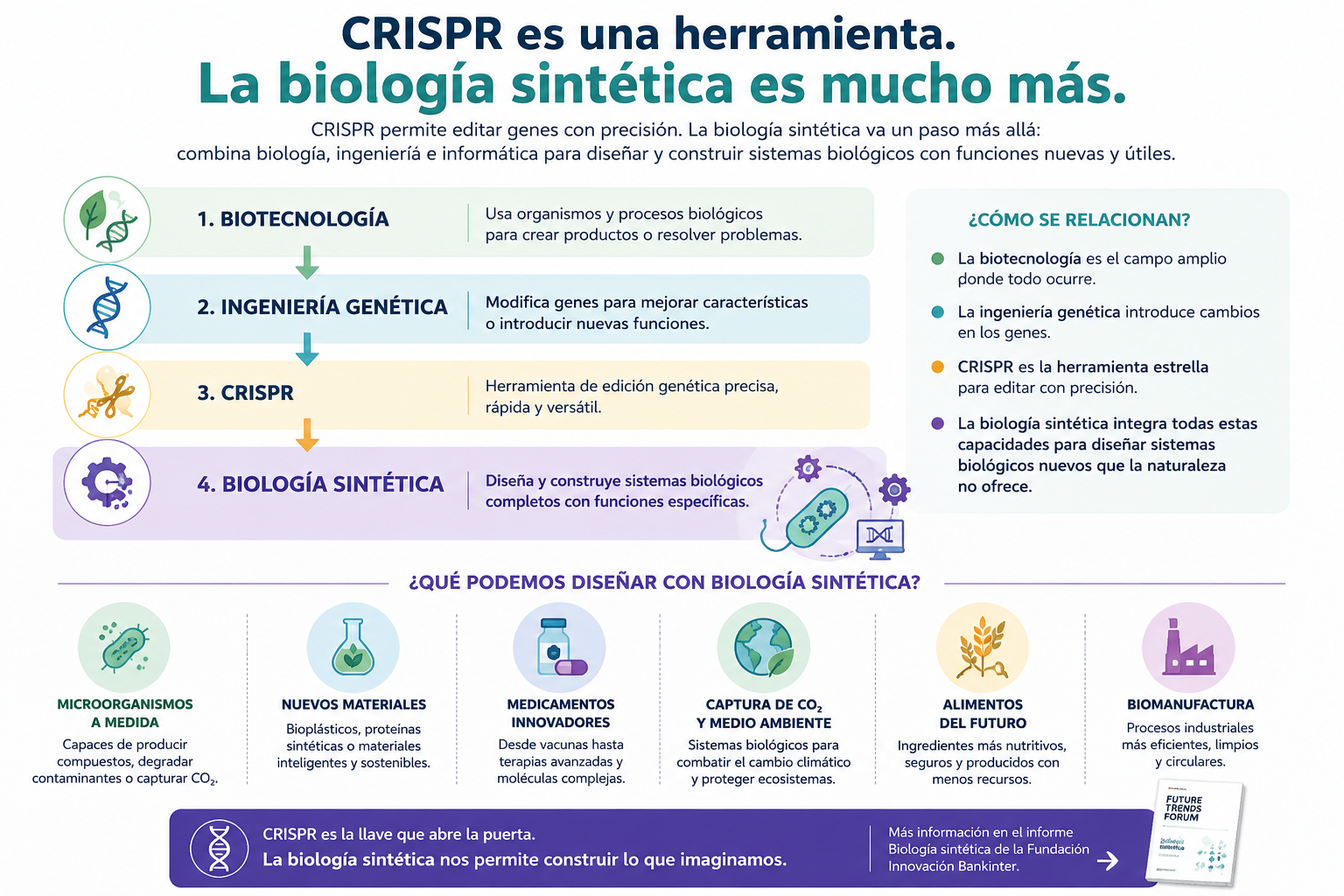
The ability to design organisms with specific functions opens up opportunities for sectors as diverse as health, food, energy, the chemical industry or environmental sustainability.
The Coming Debate: How Far Should We Rewrite Life
The ability to edit DNA also raises questions that transcend science.
There is a broad international consensus on the use of CRISPR to research diseases or develop treatments for specific patients, always under strict regulatory controls.
However, the debate changes when the possibility of editing human embryos whose changes could be inherited by the next generations is raised.
The scientific community clearly distinguishes between cure and improvement.
Correcting a mutation responsible for a hereditary disease pursues a therapeutic objective. Very different would be modifying characteristics such as height, intelligence or physical performance, issues that raise important ethical and social questions.
Another relevant aspect concerns regulation. Each country maintains different legal frameworks on gene editing, which requires progress through international agreements capable of balancing innovation, safety and responsibility.
As has happened with other disruptive technologies, the future of CRISPR will depend both on its scientific advances and on the trust it is able to generate in society.
CRISPR Basic Glossary
| Term | Definition |
| CRISPR | Gene editing technology that allows specific DNA sequences to be modified. |
| Cas9 | A protein that cuts DNA at the point indicated by the guide RNA. |
| Guide RNA | A molecule that directs Cas9 towards the genetic sequence to be edited. |
| DNA | A molecule that contains the genetic information of living beings. |
| Gene | A fragment of DNA with instructions for making proteins. |
| Gene editing | Precise modification of a specific DNA sequence. |
| Genetic engineering | A set of techniques to modify the genetic material of an organism. |
| Synthetic biology | A discipline that designs and builds biological systems with specific functions. |
| Off-target | Unwanted cutting of DNA in a region other than the one intended. |
Frequently asked questions about CRISPR
What does CRISPR mean?
CRISPR is the acronym for Clustered Regularly Interspaced Short Palindromic Repeats. It refers to sequences present in the DNA of certain bacteria that are part of their natural defense system against viruses.
Why do we talk about “molecular scissors”?
Because the Cas9 protein can cut DNA at a specific point. However, the metaphor is incomplete: before cutting, a guide RNA locates the exact sequence that needs to be modified.
Can CRISPR cure diseases?
There are already approved treatments for some inherited diseases, such as sickle cell anemia and beta thalassemia. In addition, dozens of therapies are currently in different stages of clinical research.
Is editing genes the same as modifying genetic organisms?
Not exactly. Gene editing allows very precise changes to be made to a specific gene. Genetic modification is a broader concept that includes different techniques to alter the genetic material of an organism.
Is it a completely safe technology?
CRISPR has greatly improved the precision of gene editing, but there are still limitations, such as potential off-target effects or the complexity of cell repair mechanisms. For this reason, each new clinical application requires rigorous evaluation before approval.