
AI-generated summary
Low Earth orbit (LEO) — roughly 160–2,000 km above Earth — has shifted from a domain for science and defense into a major global connectivity layer. Its proximity to the surface yields much lower latency (20–40 ms) than medium (MEO) or geostationary (GEO) orbits, enabling near-real-time applications such as telemedicine, remote industry, education, and connectivity for air and maritime mobility. The trade-off is that rapidly moving LEO satellites cover small areas briefly, so continuous service requires massive constellations and frequent, cost-effective launches. Advances in reusable rockets, standardized satellite production, and high launch cadence have made that model economically viable and driven a commercial space race led by megaconstellations like Starlink, OneWeb and Project Kuiper.
LEO’s rise creates a new industrial and geopolitical landscape. It combines scientific platforms (e.g., the ISS), high-throughput broadband, and frequent Earth observation, giving rise to data-driven services across agriculture, energy and logistics. Challenges include orbital congestion, debris and the Kessler syndrome, demanding stronger governance and active deorbiting practices. States view LEO as critical infrastructure for resilience and sovereignty — prompting initiatives such as the EU’s IRIS² and growing national programs. For businesses and policymakers, LEO is now a structural element of the digital economy, reshaping connectivity, competition and strategic autonomy.
What is low Earth orbit (LEO) and why it drives fast satellite internet, with low latency and global coverage. Key trend in telecom.
Low Earth orbit is experiencing a decisive moment. In a few years it has gone from being a space reserved for scientific and military missions to becoming the new global connectivity infrastructure. Big tech companies and space companies compete to position themselves in this ring around the Earth that promises high-speed internet, low latency and almost total coverage.
For professionals related to innovation, the key question is clear: what exactly is low Earth orbit and why does it concentrate so much investment and strategic attention today?
Definition: What is considered Low
Earth Orbit? Low Earth Orbit (LEO) is the region of space located between 160 and 2,000 kilometers above the Earth’s surface. In that slot, satellites complete one trip around the planet in approximately 90 to 120 minutes.
Unlike academic definitions focused on orbital mechanics, from a business point of view, LEO is first and foremost a strategic data infrastructure. It is the spatial layer where the reduced distance from Earth allows for faster and more efficient communications.
In LEO:
- The signal travels less distance than in other orbits.
- The response time is much shorter.
- Constellations of many satellites are required to ensure continuous coverage.
This last characteristic explains the rise of the so-called megaconstellations.
LEO, MEO and GEO: three layers, three business models
To understand the differential value of LEO, it is useful to compare it with other orbits used in telecommunications. Near-Earth space is structured in three large orbital layers that respond to different technological and economic logics.
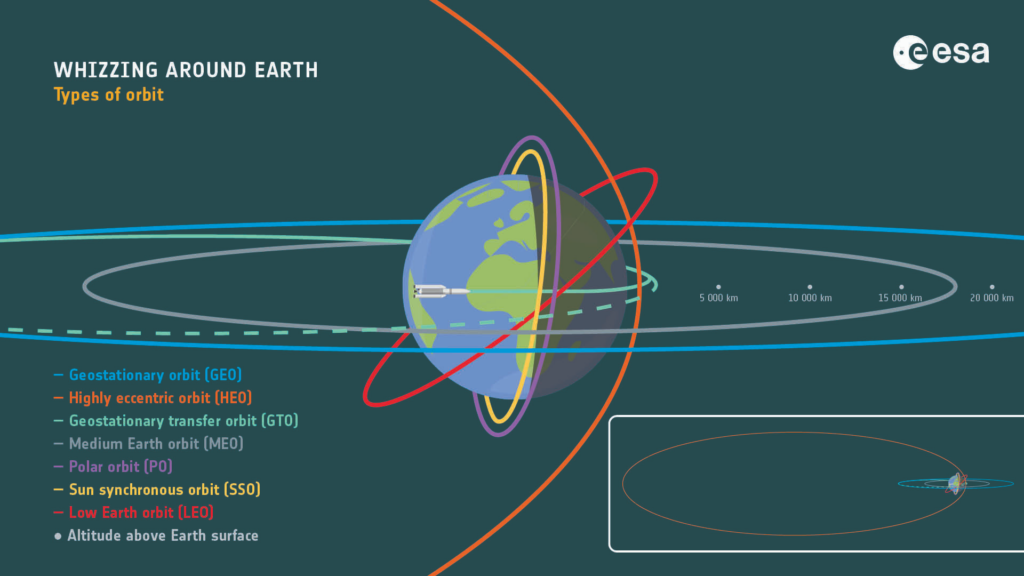
| Orbit | Approximate altitude | Estimated latency | No. of satellites needed | Typical use |
| LEO | 160 – 2,000 km | 20–40 ms | Miles | Satellite internet, observation |
| MEO | 2,000 – 35,786 km | 100–150 ms | Tens | GPS, |
| GEO | 35,786 km[a1] | 500–700 ms | 3–4 for global coverage | Satellite TV, traditional communications |
GEO: stability and wide coverage
In geosynchronous orbit (GEO), the satellite remains fixed to a point on Earth. From the ground it appears motionless. This feature has been key to satellite television and stable communications links in corporate or government environments.
Its advantage is coverage: with three or four satellites you can cover practically the entire planet.
Its limitation is physical: distance. At an altitude of 35,786 km, the signal must travel a very long distance. The result is a latency that can exceed 600 milliseconds.
For television transmission it is irrelevant. For video calls, online gaming, real-time trading or distributed cloud services, it makes the difference.
MEO: Accuracy and Global Navigation
Medium orbit (MEO) occupies the space in between. Navigation systems such as GPS operate here. Latency is lower than in GEO, but it is still high for real-time digital applications.
MEO responds to another logic: precision in positioning, orbital stability and less need for massive constellations.
LEO: Proximity, Speed and Scale
Low Earth orbit introduces a different logic. Proximity to the surface drastically reduces the time it takes for the signal to travel. There is talk of latencies of between 20 and 40 milliseconds, comparable to many terrestrial networks.
The trade-off is structural: by moving rapidly around the planet, each satellite covers a small area for a few minutes. To ensure continuous service, thousands of units coordinated in constellation are needed.
This change alters the operating model:
- GEO prioritizes stability with few assets.
- LEO prioritizes speed with massive and dynamic deployments.
- MEO occupies a specialized intermediate space.
A paradigm shift in telecommunications
The transition from GEO to LEO in broadband connectivity represents a strategic shift. Satellite infrastructure is no longer a marginal complement to isolated areas and now competes in performance with terrestrial networks.
Low orbit does not replace the others. It complements them. But in the context of the digital economy, low latency and global demand for data, LEO introduces a decisive competitive advantage.
And that is why it has become the new epicenter of the commercial space race.
The revolution: why does everyone want to be in LEO?
The turn in low-Earth orbit is strategic. The change is economic and digital.
For decades, access to space was limited by high costs and long industrial cycles. In recent years, the reuse of launchers and standardization in satellite manufacturing have transformed the financial equation of the sector.
In 2023 and 2024, SpaceX exceeded 90 annual launches, many destined for its Starlink constellation. At the same time, Rocket Lab increased its frequency of commercial missions. The space market today shows a cadence and competitiveness that was unthinkable a decade ago.
This dynamism is also reflected in Europe. In Spain, PLD Space is positioned as one of the emerging players in reusable small-load launchers. After the success of the Miura 1 and the development of the Miura 5, the company represents a structural change: access to LEO is no longer exclusive to great powers and becomes an industrial opportunity for new technological ecosystems.
In a conversation with the Bankinter Innovation Foundation, its Executive Chairman, Ezequiel Sánchez, stressed that the key is no longer to reach space, but to do so in a recurrent, competitive and sustainable way.
The consequence is clear: recurrent, industrialised and increasingly efficient access to LEO.
The structural advantage of low latency
Latency measures the time it takes for a data packet to travel from the user to the server and back. In GEO orbit, the journey can be close to 72,000 kilometers round trip. That distance directly impacts the digital experience.
In LEO, proximity reduces travel and speeds up transmission. Starlink reports typical latencies of between 20 and 40 milliseconds, figures that are close to many terrestrial networks.
This enhancement enables critical applications:
- Interactive online education in rural environments.
- Telemedicine with real-time response.
- Remote industrial operations and predictive maintenance.
- Connectivity in air and maritime mobility.
For data-intensive industries, LEO enters the competitive terrain of terrestrial infrastructure and expands the global connectivity perimeter.
A new industrial model in space
The reuse of the Falcon 9’s first stage has reduced the cost per kilogram put into orbit. This decline has a direct impact on the economic viability of massive constellations.
In addition, LEO satellites follow a production logic close to the technology industry: more compact sizes, modular architecture, short development cycles and continuous iteration capacity.
Space adopts dynamics typical of advanced software and hardware. Scalability, constant updating and progressive deployment set the pace.
LEO is thus consolidated as a strategic infrastructure for the digital economy. And it explains why so many players today compete to position themselves in this orbital layer.
Main tenants of Low Orbit
LEO has become a strategic infrastructure with very different actors. Science, connectivity and data coexist in the same orbital strip. Each segment responds to a different economic and technological logic.
The International Space Station
The International Space Station orbits at an altitude of about 400 kilometres. It is one of the most ambitious scientific and international cooperation projects in recent history.
For more than two decades it has functioned as a laboratory in microgravity, a platform for experimentation in biomedicine, materials and advanced physics, and a test bed for future space missions. It has also shown that low orbit can be managed as a space shared between powers and space agencies.
With the retirement planned for the next decade, a new stage marked by private stations and commercial models in LEO is opening.
Internet Megaconstellations
The second large block of tenants is made up of telecommunications constellations:
- Starlink: thousands of satellites deployed to deliver global broadband.
- OneWeb: focus on business and government connectivity.
- Amazon’s Project Kuiper: progressive deployment with global ambition.
The objective is strategic: to expand internet access throughout the planet. According to the International Telecommunication Union, about a third of the world’s population lacks a stable connection. LEO acts as a complement to fiber and 5G, especially in rural, maritime or hard-to-reach regions.
Here low orbit becomes critical digital infrastructure.
Earth observation satellites
The third large group drives the geospatial data economy.
Observation satellites in LEO make it possible to:
- Monitor crops and optimize agricultural yields.
- Measure emissions and assess climate impact.
- Anticipate natural disasters through predictive analytics.
- Monitor critical infrastructure and logistics chains.
Proximity to Earth provides higher image resolution and high frequency of revisits. This translates into more accurate and up-to-date data, key for sectors such as energy, insurance, agriculture or urban planning.
Together, LEO concentrates advanced science, global connectivity and data economics. Three layers of value that explain why this orbital strip has become one of the most strategic spaces in today’s technological economy.
Space Debris and Kessler Syndrome
The exponential growth of satellites poses a critical challenge: orbital congestion.
The so-called Kessler Syndrome describes a scenario in which collisions between objects generate a cascade of fragments that increases the risk of new impacts.
Today there are tens of thousands of objects tracked in orbit. Space sustainability requires:
- Controlled deorbiting systems.
- Coordinated international regulations.
- Design of satellites with limited useful life.
- Active monitoring of space traffic.
The governance of space becomes a strategic priority. National and multilateral regulatory bodies work on common standards, although the pace of technological deployment sometimes exceeds the regulatory rate.
The Future of LEO: Space Tourism and Private Stations
LEO is evolving towards a diversified orbital economy.
After the gradual retirement of the ISS planned for the next decade, private companies are developing commercial stations. Suborbital space tourism is already an incipient reality and private missions to low orbit are beginning to consolidate.
In addition, microgravity manufacturing, pharmaceutical research and the production of advanced materials are emerging as new verticals.
Impact on telecommunications and the global economy
Low Earth orbit redefines telecommunications architecture:
- It complements terrestrial networks.
- It introduces resilience in crisis scenarios.
- It democratizes access to digital services.
For sectors such as education, health, energy or logistics, universal connectivity opens up opportunities for efficiency and growth.
From an innovation perspective, LEO represents a strategic infrastructure comparable to fibre optics in the 1990s. Companies that integrate this connectivity layer into their business models will be able to design global services from the outset.
LEO and Geopolitics: The New Critical Infrastructure
Low Earth orbit is no longer just a technological environment. It has become a strategic asset.
The conflict between Russia and Ukraine has highlighted the role of LEO constellations as critical infrastructure. When terrestrial networks were damaged, satellite connectivity made it possible to keep civil, governmental, and military communications operational.
In this context, Starlink came to play a top-level geopolitical role. Connectivity has become a strategic tool.
This episode opens up several key questions for governments and regulators:
- Should a global critical infrastructure depend on corporate decisions?
- How is digital sovereignty articulated in space?
- What role should Europe and other regions play in the development of their own constellations?
The career for LEO no longer responds only to market criteria. It also incorporates:
- National security.
- Infrastructure resilience.
- Strategic autonomy.
- Technological deterrence capacity.
At the same time, countries such as China are accelerating their own mega-constellation programs, while Europe is promoting initiatives for space sovereignty and secure connectivity.
Europe makes a move: IRIS² and space sovereignty
In this context, the European Union is promoting IRIS² (Infrastructure for Resilience, Interconnectivity and Security by Satellite), its future constellation of secure connectivity in low and medium orbit.
IRIS² responds to three strategic objectives:
- Ensuring secure communications for governments and critical services.
- Strengthening European strategic autonomy in digital infrastructure.
- Boosting the European space industrial ecosystem.
The project combines public funding and private participation. The logic is clear: to ensure institutional resilience and, at the same time, strengthen the continent’s technological competitiveness.
At the same time, European players in the launcher and satellite sector, such as PLD Space, are contributing to consolidating their own value chain in access to space. Autonomy begins with the ability to put assets into orbit on a recurring basis.
Low orbit is integrated into the debate on technological sovereignty, in the same way as the cloud, semiconductors or artificial intelligence.
For Europe, the challenge is twofold: to ensure secure connectivity and to consolidate industrial leadership.
For companies, the message is clear: spatial connectivity is no longer a purely technological vector and becomes a structural element of the competitive environment.
A structural trend, not a cyclical one
The current moment of low Earth orbit responds to profound dynamics that are redefining global infrastructure:
- Sustained reduction in the costs of access to space.
- Growing demand for secure and low-latency connectivity.
- Technological maturity in miniaturization, mass manufacturing and constellation management.
- Emergence of space sovereignty as a strategic priority.
LEO evolves from a technical category of orbital mechanics to a critical infrastructure of the global digital system.
Connectivity, data, resilience and technological autonomy converge in this orbital strip. Competition already combines market, industry and geopolitics.
For the Bankinter Innovation Foundation community, the issue is strategic:
- What position does Europe want to occupy in this new spatial architecture?
- How are public-private partnerships articulated to guarantee competitiveness and sovereignty?
- What regulatory frameworks allow for industrial growth and orbital sustainability?
- What opportunities are emerging for the Spanish business ecosystem?
The next decade will define who controls the global connectivity infrastructure. And LEO is already at the center of that conversation.
[a1]35,786 km is the only altitude where a satellite rotates at the same rate as Earth.
That synchronization makes GEO a stable platform with global coverage with very few assets.