

AI-generated summary
Market validation tests whether an idea truly solves a relevant problem for a specific group and can become a sustainable business before large investments. Rather than relying on enthusiasm or positive feedback, validation turns assumptions into measurable hypotheses and uses interviews, prototypes, experiments, and early transactions to gather evidence. Effective signals are those that change decisions—about target customers, prioritized problems, features, channels, or pricing—rather than merely showing superficial interest. Techniques include smoke tests, rapid prototypes, concierge and Wizard of Oz tests, and building an MVP that focuses on the riskiest assumption. Validation should follow a clear process: define the segment, describe the problem, isolate the riskiest hypothesis, design the smallest experiment, set success metrics in advance, and then iterate, persevere, or pivot based on results.
Rigorous validation reduces startup risk by producing quick learning cycles that inform whether to continue or scale. Key indicators of product-market fit vary by business but center on acquisition, activation, retention, and improving unit economics. Metrics like CAC, LTV, the LTV/CAC ratio, CAC payback, cohort retention, and NPS help quantify demand and sustainability. Combining qualitative interviews with quantitative experiments ensures the startup understands customers, demonstrates real engagement (bookings, pilots, payments), and can prioritize the initial market. A validated startup—one showing retention, recommendation, and economic promise—is far more investable than an untested but compelling idea.
Validating the market allows you to check whether an idea solves a relevant problem, appeals to a particular segment, and can become a sustainable business before committing large resources. A good idea can be attractive in a presentation, arouse enthusiasm within the team, and convince early collaborators, but a startup needs something more to become […]
Validating the market allows you to check whether an idea solves a relevant problem, appeals to a particular segment, and can become a sustainable business before committing large resources.
A good idea can be attractive in a presentation, arouse enthusiasm within the team, and convince early collaborators, but a startup needs something more to become a company: customers who recognize the problem, value the solution, and are willing to change their behavior or pay for it.
Market validation allows you to gather that evidence before making a massive investment in product, contracting, marketing, or infrastructure. Its role is to transform the founding team’s hypotheses into testable questions and answer them through conversations, prototypes, experiments, and real transactions.
This approach is especially important during the pre-seed and seed phases, when the startup is still looking for a repeatable and scalable model. The Customer Development methodology, developed by Steve Blank, states that an emerging company starts with hypotheses and must test them in the market, while the Bankinter Innovation Foundation’s financing guide places the construction of the Minimum Viable Product (MVP) and the search for product-market fit among the central objectives of the early stages.
Validating requires more than just getting a collection of positive feedback. A useful signal should modify a decision: which customer to serve, which problem to prioritize, what functionality to build, what channel to use, or what price to try. When an experiment barely influences the team’s decisions, it’s probably measuring superficial interest rather than demand.
What is market validation?
Market validation verifies whether there is a sufficiently defined group of people or organizations that share a relevant problem, actively seek a solution, and show a real willingness to adopt or purchase a particular proposal.
This definition brings together four elements: the customer, the problem, the value proposition, and the economic mechanism. A solution aimed at “everyone” prevents the design of accurate messages, channels, and experiences; an infrequent or infrequent problem rarely drives a purchase; a diffuse value proposition makes it difficult to understand the promised outcome; and a weak economic model limits the ability to sustain growth.
Validation advances when the team replaces general statements with measurable hypotheses. “Small companies need to automate their invoicing” provides little decision-making power. “Firms with between five and twenty employees spend more than eight hours a month reconciling invoices and would pay a fee to reduce that work by half” allows interviewing, prototyping, pricing and defining a signal of success.
Why Market Validation Reduces Startup Mortality
A startup works in conditions of extreme uncertainty and can make mistakes about the user, the urgency of the problem, the acquisition channel, the frequency of use, the price or the ability to retain customers. Building for months without contrasting these variables accumulates risk and makes any subsequent changes more expensive.
Validation reduces that risk through short learning cycles. Each experiment provides information to continue, adjust, or pivot, so capital is first used to resolve critical uncertainties and then to scale what already shows evidence of demand. Steve Blank describes this process as the search for a repeatable and scalable sales model, based on testing hypotheses to real customers.
From the idea to the customer: the paradigm shift of the Lean Startup
The traditional development model placed most of the effort before market contact: a detailed plan was defined, a complete product was built, and a broad launch was prepared. Lean Startup and Customer Development reverse that order by treating the initial plan as a set of assumptions to be tested.
Eric Ries popularized the build-measure-learn cycle, while Steve Blank articulated Customer Development as a discipline for discovering customers, validating a business model, and preparing for growth. In both approaches, validated learning has more value than the number of finished functionalities.
Asking “would you use this solution?” often leads to polite and unreliable answers. It’s more helpful to reconstruct past behaviors: how the customer solved the problem last time, how much time or money they spent, what alternative they used, who approved the purchase, and what the consequences of maintaining the situation were.
A booking, recurring test, letter of intent, or prepayment contains more information than a positive review, because it implies real engagement. The quality of a validation increases as the experiment requires the user to invest time, money, reputation, data, or internal resources.
How to validate a business idea with an MVP
A practical validation process can be organized into six steps: define the customer segment, describe the problem and its impact, identify the riskiest hypothesis, design the smallest experiment capable of testing it, establish a metric and decision threshold before starting, and review the results to persevere, iterate, or pivot.
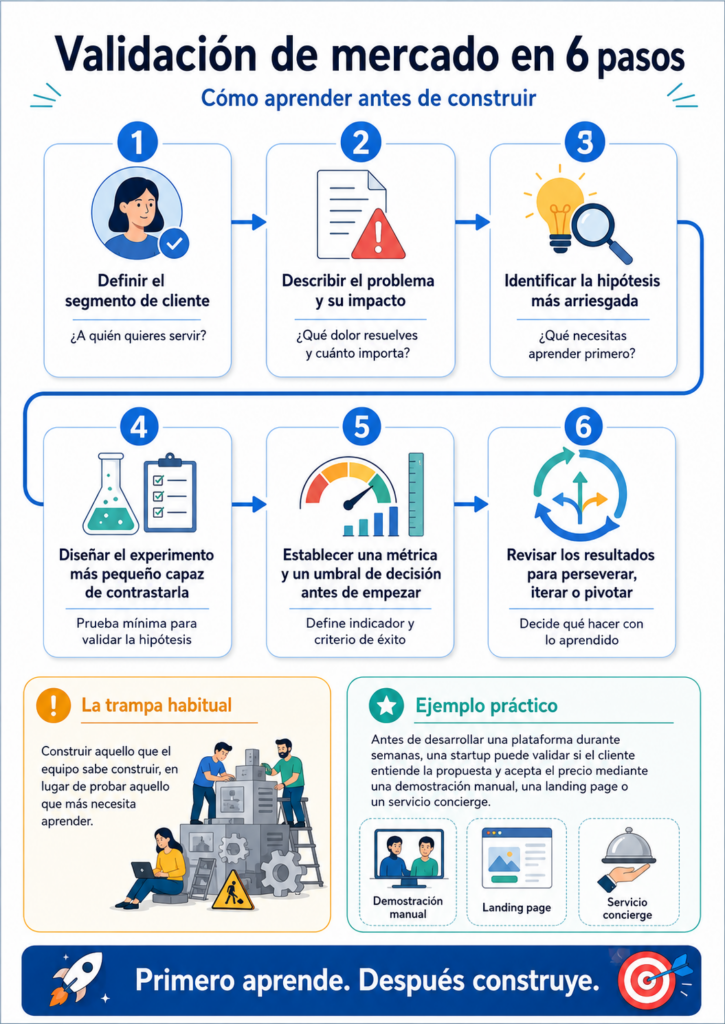
This order avoids a common trap: building what the team knows how to build, rather than testing what they need to learn the most. A software startup can take weeks to develop a platform when a manual demo, landing page, or concierge service would first check whether the customer understands the proposal and accepts the price.
What is a minimum viable product and how to build it
A Minimum Viable Product or MVP is the simplest version of a solution that allows reliable learning about a business hypothesis to be obtained. The word “minimum” refers to the scope needed to experiment; the word “viable” requires that the user be able to perceive the core value. Eric Ries defines it as the version that allows you to gather the maximum validated learning about customers with the least possible effort.
The right MVP depends on uncertainty. Interviews help verify the problem; a navigable prototype allows the value proposition to be contrasted; a priced offer measures willingness to pay; and a manual pilot tests delivery before automating it.
To build it, the team must start with a specific sentence: “We believe that this segment will perform this action because it obtains this result.” Then it must define the evidence that it will accept as valid.
An example might be to have ten operations managers complete a pilot, at least six to use it for four weeks, and four to agree to continue with a payment contract. The exact figure will depend on the industry, price, and buying cycle, although the criteria should be set before looking at the data to reduce self-serving interpretations.
The MVP also doesn’t have to replicate all future experience. It should focus on the assumption that generates the most risk. When the main question is demand, it becomes unnecessary to develop a scalable infrastructure. When the risk is in the technology, a landing page will provide little information about technical feasibility.
Smoke tests, rapid prototyping and Customer Development
Smoke tests allow you to measure interest before the full product exists. A landing page with a specific proposal, a price, and a specific action can compare messages or segments. The relevant data appears as you move down the funnel: request a demo, leave professional information, book a place, or initiate a payment.
A high click-through rate may indicate that the message generates curiosity, but validation is strengthened when the user completes actions close to the purchase. The team should measure each step of the journey to discover where interest is lost and what objection is preventing progress.
Rapid prototypes help validate understanding and usability through linked screens, physical models, videos or simulations. They allow you to observe if the user identifies the main functionality, understands the flow and achieves the promised result without receiving constant explanations.
The Concierge Test and the Wizard of Oz Test allow you to test value and operation when the technology is still expensive. In the first, the team manually provides the service and learns from each interaction. In the second, the user perceives an automated experience while part of the process is executed manually.
Customer Development rounds off these experiments with structured conversations. Steve Blank distinguishes between uncovering problems and validating a repeatable sales model, an important separation because the initial interest in a solution must then translate into a viable business process. Interviews should explore facts, budgets, buying processes, alternatives, and decision makers, and their findings should be contrasted with usage and transactions.
What metrics demonstrate product-market fit
Product-market fit appears when a proposal intensely solves a problem in a specific market and generates behavior capable of sustaining the business. It lacks a universal metric, because a daily consumption application, an enterprise SaaS and a biotechnology company have completely different cycles.
The most useful metrics answer four questions: do customers arrive?, do they activate the core value?, do they return or renew?, does the economy improve as the business learns? The answer should be analyzed by cohorts, segments, and channels, because averages can hide critical differences.
A startup could have a good average retention and discover, when segmenting the data, that almost all of it comes from a single type of customer. Far from representing a problem, this finding can point to the initial market in which it is convenient to concentrate product, sales and communication.
CAC, LTV and the ratio investors are looking for
Customer acquisition cost or CAC measures how much the startup invests to acquire a new customer. A basic formula divides the sales and marketing costs of a period by the number of new customers acquired during that same period:
CAC = sales and marketing costs / new customers acquired
The calculation should include the costs actually linked to the acquisition, such as campaigns, business tools, sales team salaries, commissions, and external services. Comparing CAC by channel allows you to identify which sources generate profitable customers and which produce low-quality volume.
Customer lifetime value or LTV estimates the gross margin that a customer will generate during their relationship with the company. In a SaaS it can be approximated by average revenue per account, multiplied by gross margin and adjusted by churn rate:
approximate LTV = average revenue per customer × gross margin / churn
Very early startups should treat this figure with caution because they still have few cohorts, short observation periods, and unstable retention. Projecting several years of revenue from a few weeks of activity can produce an overly optimistic picture.
The LTV/CAC ratio compares the value generated with the cost of capture. Bessemer Venture Partners uses a minimum ratio close to 3x as a reference for SaaS businesses and considers ratios of 5x or more to be higher, although this benchmark must be interpreted according to the sector, the margin, the speed of growth and the quality of the calculation.
A low ratio suggests an acquisition that is difficult to sustain. An extremely high ratio also deserves attention, because it may indicate that the company is underinvesting in growth or that LTV has been calculated using overly favorable assumptions.
Along with this relationship, it is advisable to measure the recovery period of the CAC, i.e. the months needed to recover the commercial investment through gross margin. In the early stages, this metric can be clearer than a projected LTV over several years, because it shows how much capital the startup needs to finance its growth.
Retention, NPS and real signs of traction
Retention measures what percentage of users or customers are still active after a given period. Sequoia Capital considers it one of the best indicators of value and product-market fit, because it shows whether people who tried the product found reasons to return.
The appropriate frequency depends on the use case. A collaboration tool can analyze weekly retention; an accounting close software will need monthly windows; a travel platform will require longer cycles. The definition of an “active” user should tie to the action that delivers value, rather than just login.
The most useful way to look at it is to create cohorts of customers who started in the same week or month. A curve that drops rapidly to near zero reveals initial interest with no habit or persistent value. A curve that stabilizes shows a core of retained users. When recent cohorts perform better than old cohorts, the product is learning and iterations begin to generate results.
The Net Promoter Score or NPS adds a recommendation measure. Bain & Company calculates this by subtracting the percentage of detractors, who score from 0 to 6, from the percentage of promoters, who score 9 or 10. Responses of 7 and 8 are considered passive.
The result helps to track the evolution of loyalty, although it should be accompanied by an open question and evidence of behavior, such as referrals, renewals, repeat purchases or account expansion. A positive NPS provides context; a recommendation generated by a new customer provides validation closer to the business.
The strongest signal comes when multiple metrics tell the same story: users reach the moment of value quickly, return, pay, recommend, and require less business effort as the team fine-tunes the product and segment.
Validate to decide before scaling
Market validation gives the startup a system to make evidence-based decisions and reduce uncertainty before increasing spend. Rigorous validation combines qualitative and quantitative information: interviews explain why a behavior occurs, experiments show if it occurs, and metrics allow you to see if it repeats and improves.
At the Bankinter Innovation Foundation we support those who promote the entrepreneurial ecosystem through our Startups program, which brings together tools and initiatives such as the Startup Observatory and Scaleup Spain Network to provide data, knowledge and useful connections to entrepreneurs, investors and institutions.
A startup that’s ready to grow presents more valuable than a compelling idea: it shows that it knows its customer, solves a relevant problem, and has observable signals of retention, recommendation, and economic sustainability.