
AI-generated summary
In January 2022, the James Webb Space Telescope (JWST) reached its operational position at the L2 Lagrange point, about 1.5 million kilometers from Earth, marking a significant milestone in space exploration. Developed since 1996, JWST is the most advanced space telescope ever built, poised to succeed the Hubble and Spitzer telescopes. This international collaboration involves 17 countries and is jointly operated by NASA, ESA, and CSA, reflecting a modern shift from competitive space races to cooperative global scientific efforts. JWST’s primary missions include observing the earliest galaxies, discovering exoplanets, and analyzing their atmospheric compositions.
JWST features a sophisticated five-layer sunshield, measuring 21 by 14 meters, that protects its 18 gold-coated beryllium mirrors, enabling it to observe faint cosmic objects without interference from sunlight. Equipped with advanced instruments such as MIRI, NirCAM, NIRISS, and NIRSpec, it can perform infrared observations and spectroscopic analysis critical for studying distant celestial bodies. Beyond its scientific goals, the project has significantly advanced aerospace, chemical, and optical industries, generating economic growth and new business opportunities. Historically, space exploration technologies have led to numerous everyday innovations—from medical imaging to solar power—suggesting that JWST’s technological breakthroughs will similarly benefit society in unforeseen ways.
The James Webb Space Telescope, a substitute for Spitzer and Hubble, is already observing the origin of galaxies.
In mid-January 2022, the James Webb Space Telescope (JWST) opened its wings and slowly approached the L2 Lagrange point of the Sun-Earth system. There it will rest a million and a half kilometers from our planet while observing the cosmos for us. This piece of engineering, in development since 1996, constitutes another step in the space race and a milestone for humanity.
What is the James Webb Space Telescope?
The James Webb is the best space telescope ever designed and sent into outer space. There it will replace the Hubble Space Telescope and the Spitzer Space Telescope – retired in 2020. In addition, he is the precursor of the Nancy Grace Roman.
When we talk about the James Webb, we also talk about the power of cooperation: up to 17 countries have collaborated in its construction and it will be operated jointly by three space agencies – NASA (USA), ESA (Europe) and CSA (Canada). It is clear that the concept of a space race has changed a lot since the United States and the USSR were itching to see who could reach the Moon first.
Among the many objectives of the James Webb are the observation of the first galaxies – so distant that the light from their formation now reaches our solar system – the discovery of exoplanets and even the chemical composition of their possible atmospheres.
A sun protection factor of one million
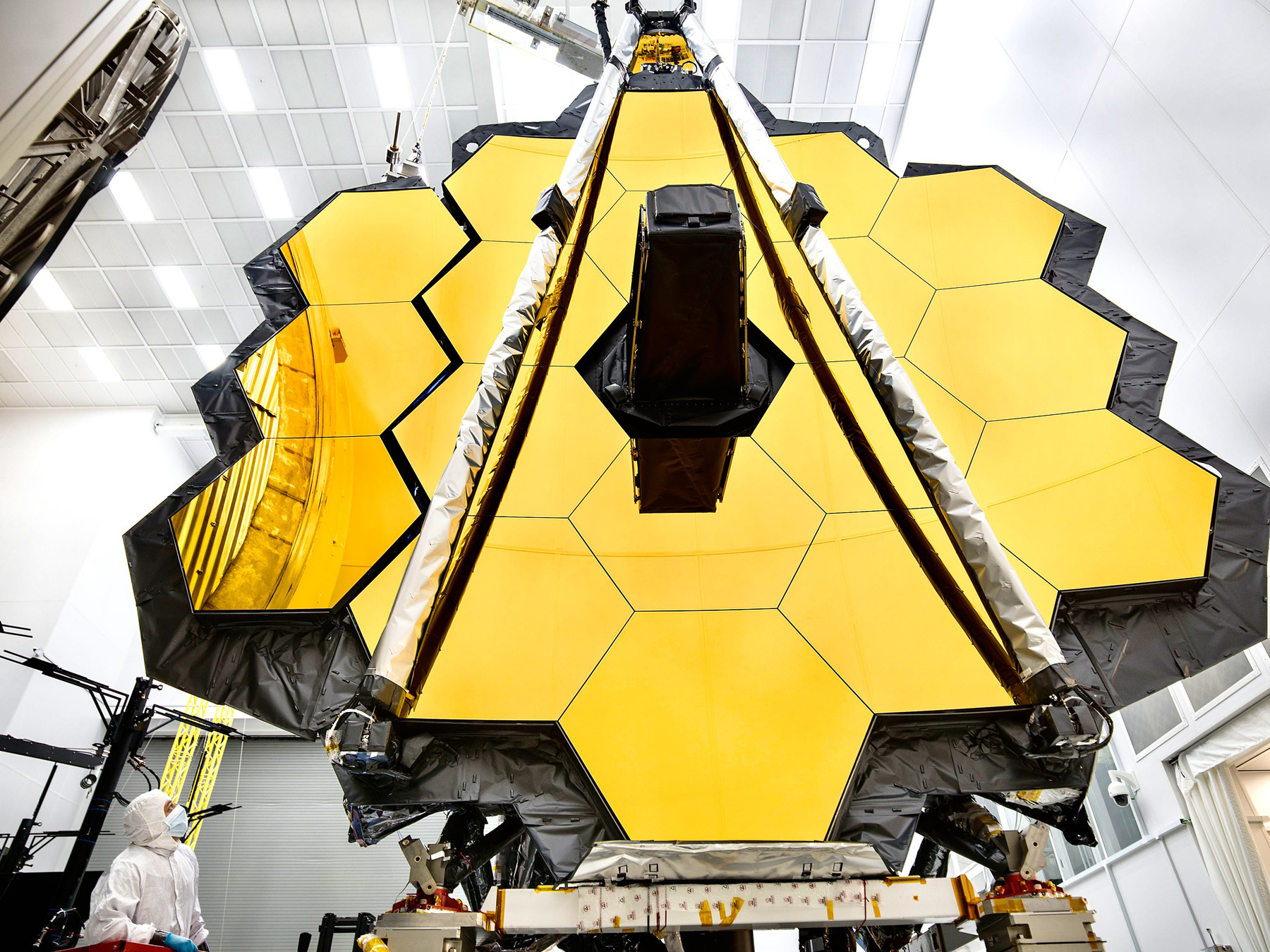
After a month-long trip, the space telescope successfully reached the halo orbit of L2, a stable point located beyond the line formed by the Sun and Earth. Its sunshade, a 21-meter by 14-meter, five-layer engineering marvel, protects the 18 gold-covered beryllium mirrors and optical lenses with a sun protection factor of one million.
Thanks to this gigantic flexible panel, the James Webb will be able to observe galaxies perpendicular to the plane of the ecliptic – the plane that the planets travel through with the exception of Pluto – without the powerful sunlight affecting the measurements. To this end, it has several instruments:
- Mid-Infrared Instrument (MIRI), to observe cold objects and make a spectroscopic map. Developed by ESA and NASA.
- NASA’s Near-Infrared Camera (NirCAM), capable of seeing the most distant objects ever observed.
- Near-Infrared Camera and Slit-Free Spectrograph (NIRISS), which will be able to study temperatures, mass or chemical composition of objects (CSA).
- Near-Infrared Spectrograph (NIRSpec), which does the same on up to 200 objects in the infrared band at a time (ESA).
The enormous importance behind the James Webb’s innovation
This telescope, which has cost close to 9,000 million euros to date, is one of the most important scientific and technological projects of humanity. Not only because of the milestone that the cooperation of so many countries represents for the space race , or because of what has been discovered millions of light-years away.
The construction of the James Webb – a journey of 15 years – has been a decisive boost to the aerospace, chemical and optical industries. In addition to these sectors, there are many others affected by the driving force of this type of international project, which translates into quality jobs or taxes, among others. As stated in our report ‘Commercialisation of Space’ by the Future Trends Forum, technological advances and scientific research in this field are already leading to new business opportunities.
Of course, the scientific process behind the project will also have a significant positive impact on people’s lives. While it’s hard to see the relationship between observing the atmospheric chemistry of exoplanets and the average person, the technology discovered in the process of innovation during space exploration has been offering benefits for decades.
Medical CT scans, solar photovoltaic technology, laser surgery, dehydrated food, smoke detectors, polarized sunglasses or the most reliable climate models are some of the thousands of innovations developed thanks to the funds of space exploration and accidental discoveries. Only time will tell which ones will derive from the James Webb.