
AI-generated summary
The Bankinter Innovation Foundation’s “Coffee with Entrepreneurs” series spotlights Spanish founders who turn ideas into scalable brands. This edition features Juan de la Rica, founder and CEO of Juancho’s BBQ, a premium hamburger chain born in a tiny 17 m² stall in Madrid’s Chamberí Market. From a varied, non-linear career—including consulting and international projects—Juan applied adaptability and hands-on learning to build a product-first concept centered on charcoal cooking, craftsmanship, and a single standout burger that now drives over half of sales. Organic demand, an award for Spain’s best hamburger, and disciplined iteration helped Juancho’s grow to ten locations while preserving its identity.
The interview covers practical lessons for entrepreneurs: validate with a small, low-risk prototype; copy-and-improve rather than chase novelty; prioritize product quality over short-term margins; and design systems that preserve consistency as you scale. Operational realities—hiring, delegation, delivery logistics, location strategy, and the move toward franchising—are explored candidly. Juan stresses resilience, pragmatic pricing, and protecting brand value even when margins tighten. Looking ahead, Juancho’s aims to expand internationally via franchising, with Mexico City a prime target. The talk emphasizes that sustainable growth comes from executing well, simplifying operations, and never losing the core product that brings customers back.
In this Coffee with entrepreneurs, Juan de la Rica, founder of Juancho's BBQ, shares how he went from a 17-square-metre stall in the Chamberí Market to building a premium restaurant brand with ten locations and international ambition.
The “Coffee with Entrepreneurs” initiative of the Bankinter Innovation Foundation brings together leaders of the Spanish entrepreneurial ecosystem to learn first-hand how they build their projects, how they make decisions and how they turn an idea into a recognizable and scalable brand.
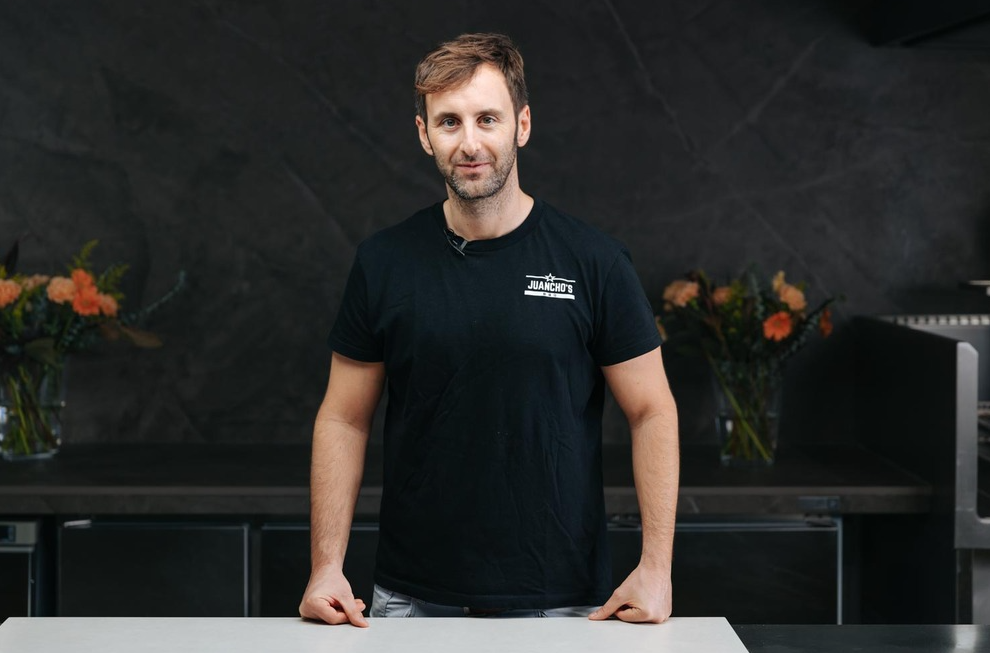
On this occasion, the coffee is with Juan de la Rica, CEO and founder of Juancho’s BBQ, the premium hamburger chain that has established itself in the restaurant sector in Spain by betting on the product, charcoal cooking and a proposal focused on quality and authenticity. What began in a small 17-square-meter stall in the Chamberí Market is today a company with ten establishments and a community of loyal customers that has made Juancho’s a reference within the gourmet burger phenomenon.
The meeting, presented by José Carlos Huerta, Director of the Foundation’s Startups Program, traces Juan de la Rica’s entrepreneurial path: from his first jobs in consulting and business development to the moment he decided to bet on catering after becoming unemployed while working in New York. Throughout the conversation, he shares how the idea for Juancho’s was born, the importance of finding a real differential in the market and the lessons learned behind the growth of a brand that has been able to combine product experience, its own identity and organic growth.
You can see the full interview here:
Coffee with Juan de la Rica, founder of Juancho’s BBQ
From a non-linear trajectory to a brand with its own identity
Behind Juancho’s BBQ there is an unconventional trajectory. Juan de la Rica defines himself as “chaotic”: from Madrid, an economist by training and with a university career that lasted longer than expected. While finishing it, he tried very different paths. He was a motor journalist, went through consulting, worked in business development and participated in international projects linked to public works tenders in Latin America.
His last stage before starting a business was in a Russian software company for regulated parking. There he learned to move in complex, multicultural and changing environments. A school that is not obvious to open a hamburger restaurant, but very useful for something essential in any startup: adapting quickly, listening, solving and moving forward with what is available.
That journey explains part of Juancho’s BBQ’s DNA. A brand born from the mixture of craft, intuition and continuous learning. Because many times the entrepreneurial path begins precisely there: in a trajectory that seems scattered, but that ends up connecting the dots.
Juancho’s BBQ: Start small, think big
Juancho’s BBQ was born in 2018 as a premium restaurant proposal focused on the product, charcoal cooking and a very specific way of understanding the hamburger. Today it has 10 establishments, most of them in Madrid, and has become a reference for those looking for a gastronomic experience that is simple in appearance, but very elaborate in execution.
The first store was a stall of just 17 square meters in the Chamberí Market. Juan de la Rica remembers it as a “survival” decision. After the unexpected closure of the company where he worked in New York, he returned to Spain in a complicated situation. Unemployed, with money pending collection and few answers when moving his resume, he decided to look at something he had always liked: cooking with charcoal.
The initial idea was not even to open a hamburger restaurant. Juancho’s was born as an informal steakhouse with a couple of hamburgers on the menu. But the market was talking. The product connected, the queues grew organically and the brand began to find its place.
The turning point came in 2019, when Juancho’s won the award for the best hamburger in Spain. When he returned to the premises, Juan found a queue of 50 or 80 people before lunchtime. That’s when he understood that something had changed.
For any entrepreneur, history leaves a powerful idea: starting small can be an advantage. A minimum premises, a contained investment and a very clear proposal allowed the concept to be validated, listen to the customer and grow from real demand.
Copy, improve and find a real differential
In a market as competitive as the restaurant industry, and especially in a category as effervescent as the premium hamburger, differentiating yourself requires more than just following a trend. For Juan de la Rica, copying a model can be valid if the goal is to improve it. In the end, a good part of innovation consists of observing what already exists, detecting areas for improvement and executing better.
The key is to have a clear answer to a basic question: why should someone come here and not the place next door?
In the case of Juancho’s BBQ, that answer started with the product. Before opening, Juan spent a lot of time finding the perfect blend: the mix of meat, cuts and fat that fit with the hamburger he had in his head. It was a process of trial and error, almost handmade, until we reached that “eureka” moment when the product finally worked.
That previous work made the difference. Juancho’s proposal was born from an obsession with cooking well, taking care of each variable and building a recognizable experience. For entrepreneurs, the lesson is straightforward: an idea may seem simple from the outside, but the competitive advantage is usually in the details that almost no one sees.
Scaling without losing the soul of the product
Going from one place to ten forces you to make difficult decisions. For Juan de la Rica, scaling a gastronomic proposal with identity implies accepting a constant tension: maintaining the essence and, at the same time, simplifying processes to reduce the margin of error.
When Juancho’s had only one restaurant, there was more freedom to try, improvise, and adjust as you go. With ten locations, each decision must go through another filter: Can it be executed well in every restaurant? Does it reduce or increase the chance of failure? Does it help maintain a consistent experience?
This is where one of the great lessons of growth appears: scalability requires method. The more a company grows, the more important it becomes to design systems that protect quality. In catering, errors multiply quickly if the operation loses control.
The leap out of Madrid left another key lesson. Operating premises within a close radius is manageable. Doing so hundreds of kilometers away is a game-changer. Juancho’s even closed a restaurant after assuming that correcting the negative trend required too many resources. The decision was clear: accept the learning and redesign the model.
This change has led the company towards franchising as a way to grow outside Madrid. The logic is simple: transfer Juancho’s know-how, brand and standard to local operators who know each market better. For an entrepreneur, it is a very valuable reflection: growing also consists of knowing what part of the business should remain in your hands and what part needs new partners to scale better.
People, delegation and focus: the operational challenge of growing
As Juancho’s grows, the product is no longer the only challenge. Team management becomes a critical part of the business. In hospitality, attracting, motivating, and retaining talent is especially complex. Juan sums it up frankly: hiring well is one of the most difficult tasks for any entrepreneur.
In his case, attitude weighs as much as experience. At Juancho’s, a person with desire, commitment and the ability to learn can grow very quickly. The trade is taught. Attitude makes the difference.
That learning connects with another key leap: going from being on the front line to running the company. Juan admits that it was difficult for him to delegate. At the beginning he wanted to be in everything, review every detail and make sure that each service was perfect. But growing requires trust. And that confidence comes when you find the right people.
Delegating well allowed him to get out of the “one-man band” role and dedicate time to more strategic tasks: structure, expansion, brand, and business model. For any founder, this change is decisive. A company only scales when it stops depending on a single person.
A market with more competition and less room to fail
Juancho’s operates in a very dynamic sector, but also very demanding. Restaurants in Spain are experiencing a time of great supply, especially in categories such as premium hamburger restaurants. For Juan, consumption remains reasonably stable, but the market is much more competitive: “it’s the same cake, but with many more people at the party.”
This context forces us to fine-tune. Having a clear concept, a solid operation, good margins and a recognizable brand is no longer desirable: it is essential. In the coming months, Juan foresees a natural purification of the market. Those who do things better will survive, whether in terms of product, operational efficiency, ability to connect with the customer or a combination of all of these.
The lesson for entrepreneurs is clear: growing in a hot market may seem easy at first, but the real test comes when competition increases. There you see who has a brand, who has an operation, and who has a sustainable business.
Adapt fast when everything changes
The pandemic came at a particularly delicate time for Juancho’s: the second restaurant had just opened. The confinement forced the closure of face-to-face operations almost immediately, but it also opened up a route that the company had barely explored until then: delivery.
The product fit well with that channel and the new location allowed it to be operated. The response was immediate. Juan remembers how they opened the application for just a few minutes, orders came in non-stop and they had to close it to be able to manage demand.
Delivery became the company’s lifeline during those months. The brand already had traction, the product traveled well and the team knew how to react quickly.
The lesson that Juan takes away from that stage is simple and forceful: anything can happen. No one had a pandemic in their business plan. When a scenario like this arrives, the advantage is to adapt quickly, make practical decisions and take advantage of the assets you already have. In his case, product, brand and ability to execute.
Branding: that the product keeps the customer coming back
In a market full of hamburger restaurants, Juancho’s is committed to a very clear path: product, product and product. The brand is built on each visit, when the customer tries a hamburger cooked over charcoal, with careful meat and differential suppliers.
For Juan, the goal is simple: that whoever goes once wants to come back. The locals accompany, but the brand memory is in the flavor. In an increasingly competitive category, this obsession with the product continues to be his main differentiation strategy.
Pricing, Margins, and Location: Growing with Realistic Numbers
The rise in costs has hit the restaurant industry hard. At Juancho’s, working with quality products means assuming a constant tension between real cost and perceived price. The hamburger has a clear psychological barrier for the customer, and transferring the entire increase to the menu would put demand at risk.
The consequence is direct: lower margins. For Juan, the price is set by what the customer is willing to pay, not just what it costs to produce.
In expansion, the location is also decided pragmatically. Juancho’s avoids excessive rents and looks for streets close to premium areas, but with less financial risk. In addition, delivery weighs heavily in the decision: the heat maps of its suppliers help to detect demand, avoid overlaps between premises and open with more data on the table.
Delivery as a strategic variable
Delivery has become a key part of Juancho’s model: it already accounts for almost half of sales. Its growth has been clear since the pandemic, but it has also brought new operational challenges.
For Juan, the channel works and brings volume, although the experience has become more difficult to control. Average times have increased and so has the variability of the service. One more reason to treat delivery as a central part of the business, from the choice of the location to the daily management of the operation.
Undertaking without romanticizing the path
If Juan could sit down with his 2018 self, he would give him a hug and a clear message: get ready to work 100 hours a week and enjoy it. Because the beginnings were hard, but also very stimulating. Everything was new. Everything demanded energy.
Juan acknowledges that he has been happier working for himself, although he avoids romanticizing entrepreneurship. Entrepreneurship is hard, risky and full of problems that appear everywhere: suppliers, operations, administration, people, costs. Even so, he maintains a powerful idea: in eight years, no day has he regretted it.
Protecting the brand before the margin
In a context of rising costs, Juancho’s has decided to maintain the quality of the product, even if that means assuming lower profitability. For Juan, trying to earn a few more points at the cost of worsening the product can damage the brand in the long term.
The answer lies in processes, focus and operational control. One of the recent fronts has been to reduce shrinkage: understand where product is lost, cross-reference data, review purchases, detect errors and close leaks. Every point recovered there helps to sustain quality without transferring all the pressure to the customer.
For an entrepreneur, the idea is clear: when the margin is tight, the solution is not always to raise prices. Many times it is to operate better.
Growing without oversizing the structure
The move towards franchising seeks precisely that: to grow outside Madrid without triggering the internal structure. Juancho’s already has a central team that covers operations, kitchen, dining room, human resources, maintenance, IT, marketing, accounting and finance. But the idea is to maintain a light model.
For Juan, franchising allows you to transfer your brand, product and know-how to local operators, without taking on all the complexity of opening and managing directly hundreds of kilometres away. Growing, yes. But with control.
A stable menu and a clear star
Juancho’s menu is born from a very direct logic: do what the team likes and trust that it also connects with the customer. Today the criterion adds one more layer: each novelty must make gastronomic and operational sense. If it complicates the kitchen too much, it loses strength.
That’s why the menu changes little. Innovation comes above all with a monthly hamburger, designed for the most loyal customers.
The main protagonist is The Bacon Juancheeseburger, winner of the award for the best hamburger in Spain and responsible for more than 50% of the revenue. A simple proposal – meat, cheese, bread and bacon – that sums up Juancho’s philosophy very well: when the product is good, it doesn’t need to be hidden.
Entrepreneurship in gastronomy: focus, resilience and a look to the future
Juan’s advice for those who want to start a business in gastronomy is direct: be clear about the differential and prepare to suffer. It can be product, price, experience, marketing or operation. The important thing is to know why someone will choose your proposal. It
also encourages trying. Entrepreneurship has risk, but each attempt leaves learning. The key is to launch yourself with ambition and with your feet on the ground.
The conversation also opens a reflection on robotics in catering. Juancho’s has explored some options for dining rooms, although they have not yet been implemented. The challenge is to understand how the customer will react: they can see it as a differential experience or as a loss of closeness.
This debate connects with one of the major trends analysed by the Bankinter Innovation Foundation in one of the latest editions of its Future Trends Forum: Physical Artificial Intelligence, artificial intelligence that comes out of the digital environment and is integrated into physical devices capable of interacting with the real world. In catering, as in so many sectors, the next frontier may lie in how to combine operational efficiency, human experience and new technologies.
Looking abroad: Juancho’s next challenge
When Juan thinks about the future of Juancho’s, the word he repeats the most is illusion. After consolidating the brand in Madrid and redefining its expansion model, the next objective is outside Spain.
The new franchise strategy has already opened international conversations and there is one market that stands out especially: Mexico City. For Juan, it is an environment with room for a differential proposal like Juancho’s and an opportunity to take the brand to a new level.
Beyond growth, the conversation leaves several key ideas for any entrepreneur: build something differential, obsess over the product, learn to delegate, adapt quickly and understand that growing is also about simplifying.
Because behind Juancho’s BBQ there are not only hamburgers. There is a very clear way to build a company: start small, execute well and improve every day without losing the essence.
Next Coffee with entrepreneurs: Juan Moliner and Invopop
The conversation with Juan de la Rica is part of the “Coffee with entrepreneurs” initiative, which will continue to bring real stories of creation and growth of startups.
The next session will be on Thursday, May 28 at 4:00 p.m., with Juan Moliner Malaxechevarría, co-founder ofInvopop. Invopop is a platform that simplifies international sales for companies, allowing them to operate in multiple countries from a single point and manage payments, taxes and tax compliance in an integrated way.
With this next coffee, the Bankinter Innovation Foundation will continue to explore how Spanish entrepreneurs detect real problems, build scalable solutions and open up new business opportunities. Don’t miss it! Register now!