

AI-generated summary
Energy innovation is shifting toward distributed, efficient, and integrated systems, and piezoelectric materials are emerging as a key tool for capturing energy from everyday motion, pressure, and vibrations. These materials generate an electrical charge when mechanically stressed and can deform when electrically stimulated, enabling bidirectional conversion between mechanical and electrical energy. While natural crystals like quartz were historically important, modern advances rely on engineered ceramics (e.g., PZT) and flexible polymers (e.g., PVDF) that can be tuned for sensitivity, flexibility, and integration into textiles or surfaces. Although each event yields only small amounts of energy, repeated or widespread use—such as footsteps, traffic vibrations, or continuous machine motion—can produce meaningful power for low-energy devices.
The most promising applications center on energy harvesting for IoT sensors, smart infrastructure, wearables, and medical biosensors. Embedded piezoelectric layers could power distributed monitoring nodes in bridges, roads, and public spaces, reducing battery needs and maintenance. Wearables and biosensors could harvest body motions and physiological signals for longer autonomy. Challenges remain in efficiency, materials sustainability, manufacturing, and large-scale integration, but piezoelectricity’s low-visibility nature belies strategic potential: enabling sensorized, battery-light systems that convert everyday movement into useful energy across cities, industry, and personal devices.
Piezoelectric materials: what they are, how they work, and their role in energy harvesting and sustainable energy generation.
Energy innovation is moving towards a more distributed, more efficient and more integrated model in the environment. In this change, piezoelectric materials are gaining relevance as a technology capable of capturing energy where it was previously lost: in the movement, pressure and vibrations of everyday life.
The physical principle has been known for decades. What is changing now is its application. Today, these materials connect science, sustainability and industrial design in solutions ranging from smart sensors to wearables and new urban infrastructure.
Understanding what piezoelectric materials are and how they work allows us to see more clearly an underlying trend: converting small everyday gestures into useful energy.
What are piezoelectric materials?
Piezoelectric materials are those capable of generating an electrical charge when a mechanical force is applied to them, such as pressure, vibration or deformation. They can also do the reverse process: deform when receiving an electrical signal.
Its uniqueness lies in its internal structure. When the material is compressed, bent, or vibrated, its charge distribution changes and a difference in electrical potential appears. That energy can be captured and used in different devices.
This ability to convert bidirectional between mechanical energy and electrical energy makes piezoelectric materials a key part of sensors, actuators and low-intensity energy harvesting systems.
In other words, they are materials that allow movement to be translated into electricity. And this property, applied intelligently, opens up very interesting possibilities in electronics, health, mobility and sustainability.
How does the piezoelectric effect work?
The piezoelectric effect is based on a direct relationship between mechanical force and electrical response.
When pressure is applied to a piezoelectric material, its crystal structure is deformed. That deformation displaces positive and negative charges within the material and generates a voltage between its faces. If that voltage is channeled into a circuit, it can power a sensor, activate a signal, or be stored for later use.
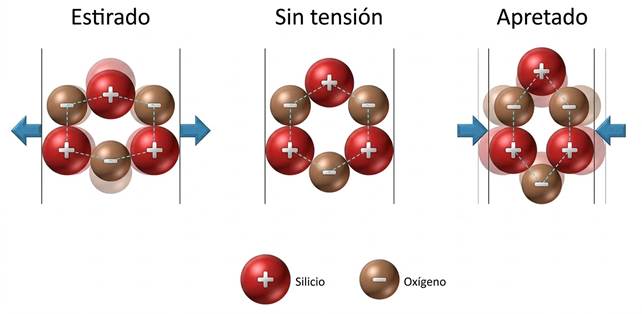
Deformation in a quartz crystal due to the direct or reverse piezoelectric effect.
The process also works in reverse. If the material receives an electric current, it changes shape slightly. This property is very useful in applications that require very precise movements, such as certain medical devices, ultrasonic systems or industrial components.
The technological key is that the amount of energy produced in each event is usually small. Its value appears when it is repeated thousands or millions of times, or when it is integrated into environments where movement is constant. This is where piezoelectricity begins to have a real impact.
Main types of piezoelectric materials
Natural materials
Some materials have piezoelectric properties naturally. The best known example is quartz, although there are also minerals such as tourmaline or topaz with similar behaviors.
These materials were fundamental in early applications of piezoelectricity and remain a reference for understanding the phenomenon. Their stability and predictable behavior made them especially valuable in early technological developments.
Synthetic materials
Most of today’s innovation is concentrated in materials designed in the laboratory. These include piezoelectric ceramics, such as PZT, and flexible polymers such as PVDF.
These materials allow specific properties to be adjusted, such as sensitivity, strength, flexibility or the ability to integrate into soft surfaces or textiles. As a result, their use is expanding to sectors where classical electronics were more limited.
This evolution is making possible a new generation of devices that are lighter, more distributed and more connected to the physical environment.
Classic applications
Piezoelectricity has been present in widespread technologies for some time. Its classic use has been linked above all to the detection of physical changes or the generation of small electrical signals.
Among the best-known applications are pressure sensors, microphones, loudspeakers, electric lighters and ultrasonic transducers. In all these cases, the material’s ability to respond to vibrations or deformations is particularly useful.
For years, this was the most common image of piezoelectric materials: a solid, functional technology associated with specific devices. Today that vision is expanding. The focus is no longer just on detecting or activating. It is also on generating energy.
The future: energy harvesting and sustainable battery-free wearables
The big trend that is revitalising interest in these materials is energy harvesting.
The idea is simple: take advantage of vibrations, steps, body movements or mechanical friction to generate electricity and power small devices. Instead of relying entirely on batteries or external recharging, the system obtains energy from its own use.
This is where piezoelectricity finds a new opportunity.
Smart infrastructures that generate energy
In smart cities, piezoelectric materials are beginning to be seen as a functional layer integrated into the urban space. Tiles that produce electricity when stepped on, interactive floors in stations or public venues, and roads capable of taking advantage of traffic vibration are all part of this conversation.
The energy obtained is still limited compared to other sources, although its value lies elsewhere: powering sensors, signalling systems, spot lighting or distributed monitoring nodes.
In a smart city context, this capacity is very relevant. Each point of the infrastructure can become a complementary energy source and, at the same time, a generator of data.
IoT and autonomous energy: sensors that are powered by the environment
This is where the Internet of Things, or IoT, comes into play. Cities, factories, hospitals and buildings are increasingly deploying sensors to measure variables such as temperature, vibration, traffic, air quality, humidity or structural condition in real time.
The challenge is in powering those devices. When a network includes thousands or millions of sensors, relying on batteries means maintenance, periodic replacements, and a significant footprint.
Piezoelectric materials offer a very promising way to solve some of that problem. By integrating into surfaces, structures, or devices, they allow those sensors to draw power from the very environment in which they operate.
A bridge can incorporate sensors that feed on its vibrations. A road can activate measurement nodes as vehicles pass by. An industrial machine can monitor its condition using the energy generated by its own movement.
The combination of piezoelectricity and IoT thus drives a new generation of sensor networks: more autonomous, with less maintenance and with greater deployment capacity. It is an important step towards truly intelligent infrastructures, where each node can capture information and sustain part of its own energy consumption.
Wearables and biosensors
The same logic is being transferred to the human body. In the field of wearables, piezoelectricity makes it possible to capture energy from movement when walking, running or flexing a joint. In digital health, it is also promoting biosensors that take advantage of physiological signals such as breathing, pulse or heartbeat.
This opens the door to devices that are lighter, more continuous, and less dependent on recharging. In some cases, the goal is to extend battery life. In others, to create devices that are virtually autonomous.
For medical and permanent monitoring applications, this capability is particularly valuable. The lower the external energy dependence, the greater the wearing comfort and the easier it is to integrate into everyday life.
Example of use: piezoelectric shoes to generate energy
One of the most striking examples is the development of footwear with piezoelectric materials integrated into the sole. Each step generates small amounts of electricity that can be stored or directed to low-power loads.

Source: Shoes that charge your mobile phone when walking: kinetic energy under your feet
The idea sums up the potential of this technology well: to transform an everyday gesture into usable energy. Charging a full mobile device while walking remains a technical and efficiency challenge, although the concept is useful for powering sensors, location systems or low-power electronics.
Beyond the specific case, this example helps to visualize a broader trend: energy is no longer understood only as something that is produced in large plants and is also beginning to be captured at the scale of the body, the object and the infrastructure.
Manufacturing and large-scale adoption challenges
The potential of piezoelectric materials is clear. Their mass deployment still requires overcoming several challenges.
The first is efficiency. The energy generated by each interaction is low, so the model works best in environments with frequent, repetitive or large-scale distributed movement.
The second challenge is in materials and manufacturing. Some advanced piezoelectric solutions require complex processes or materials that fit into a sustainability strategy and must be carefully reviewed.
Integration is also important. Incorporating these materials into flooring, textiles, medical devices, or industrial systems requires redesigning products and processes. That transition requires investment, technical validation, and clear business models.
Finally, there is the question of scale. Many applications work well as pilots. The next step is to demonstrate that they can be sustained over time, reduce operating costs and provide real value compared to alternative solutions.
A discrete technology with strategic potential
Piezoelectric materials are part of a silent innovation. Their visibility is low. Their potential is high.
They fit very well into a new technological logic: distributed, sensorized and more energy-autonomous systems. In this scenario, every vibration, every step and every movement counts.
Their current interest no longer depends on classic laboratory examples. It depends on their ability to power sensors, improve wearables, strengthen IoT networks and turn passive infrastructures into active environments.
Piezoelectricity is thus finding a new space on the innovation agenda. One where physics, electronics and sustainability are moving in the same direction.