
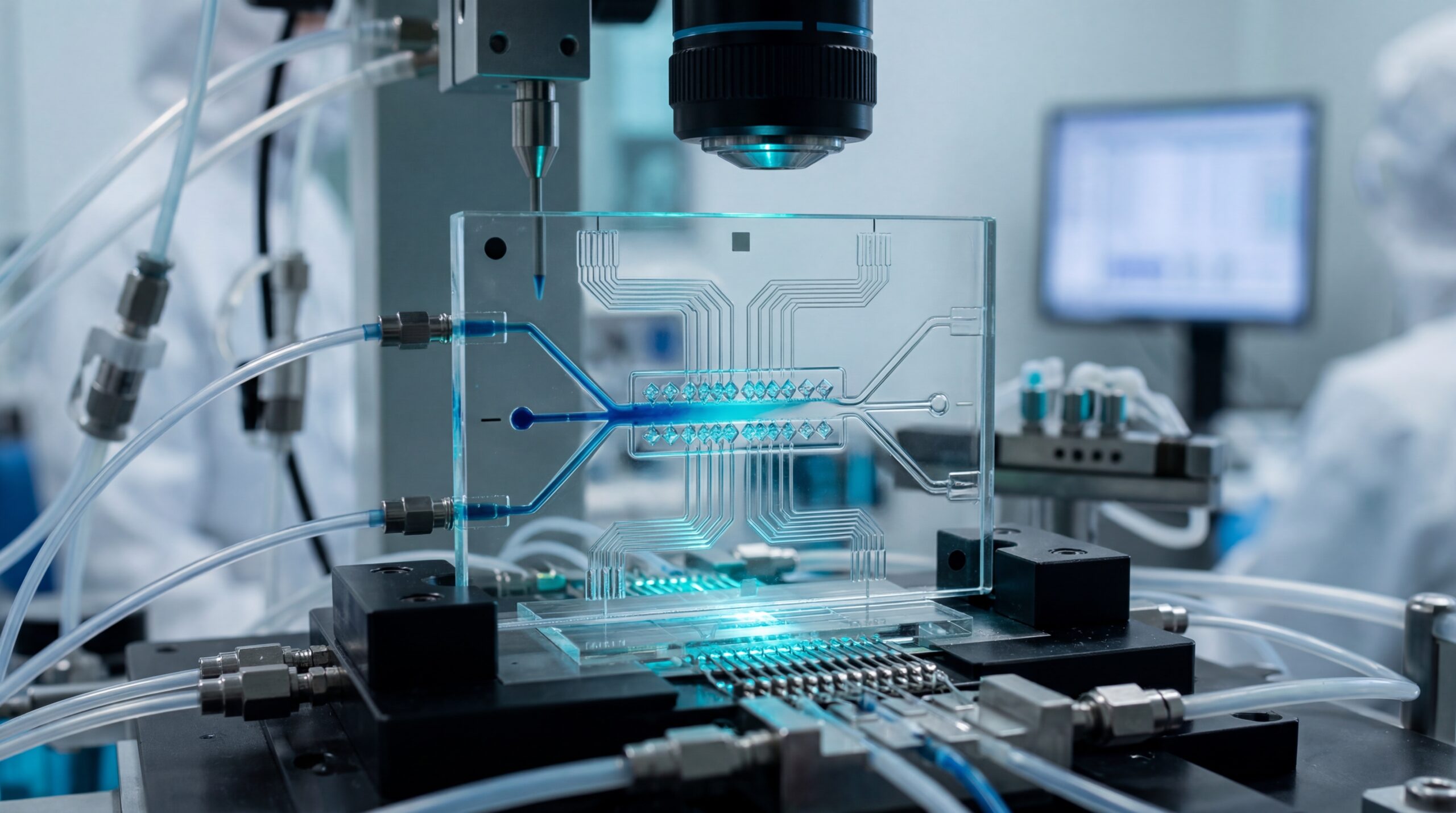
AI-generated summary
Pilot bioreactors are the essential bridge between laboratory discovery and industrial biotechnology. Operating at intermediate volumes (tens to a few hundred liters), they recreate production-like conditions so researchers can validate processes—vaccines, therapeutic proteins, bioplastics, enzymes, or precision-fermentation products—before full-scale manufacture. Unlike simply enlarging a lab vessel, scaling alters physical factors (oxygen transfer, mixing, temperature and nutrient gradients) that change cell metabolism and can sharply reduce yields. Pilot systems include controlled agitation, aeration, temperature and pH regulation, and extensive sensors to record dissolved oxygen, growth, nutrient use, foaming and other key variables for process optimization and regulatory documentation.
There is a variety of pilot bioreactor designs—stirred tanks, airlift, fixed-bed, perfusion or photobioreactors—chosen for the organism and product. Single-use bags and stainless steel systems each have trade-offs in cost, flexibility, contamination risk and suitability for long continuous runs. Beyond equipment price, total cost of ownership includes installation, energy, consumables, validation, maintenance and training. Ultimately, pilot plants generate the data and operational knowledge that de-risk scale-up, enable reproducible industrial production, and are central to translating advances in synthetic biology, precision fermentation and sustainable biomaterial production into viable commercial processes.
Pilot bioreactors make it possible to turn a biotech innovation into a reliable industrial process. Find out how they work, what applications they have, and why they are essential for scaling up medicines, food, and biomaterials.
Great advances in biotechnology do not come directly from the laboratory to the factory. Between the two there is a critical stage: the pilot plant. Here, pilot bioreactors make it possible to check whether a process is working reliably before producing medicines, food, biomaterials or new ingredients on an industrial scale. They are an essential piece in turning research into innovation.
A vaccine, a therapeutic protein, a bioplastic or a new industrial enzyme have something in common. Before being manufactured on a large scale, they have all gone through a validation process in pilot bioreactors.
In biotechnology, discovering a solution is just the beginning. The real challenge is to reproduce that result thousands of times, with the same quality, safety and efficiency. This process is known as scale-up and represents one of the greatest challenges of biotechnological innovation.
Pilot bioreactors are the tool that makes this transition possible. They make it possible to study how microorganisms, cells or tissues behave when the process begins to approach real production conditions.
Its role will become increasingly important as disciplines such as synthetic biology accelerate the development of new microorganisms capable of producing medicines, food, materials or chemical compounds in a sustainable way. In the report Synthetic Biology, the Bankinter Innovation Foundation analyses how this discipline is transforming the way biological processes are designed and opening up new opportunities for industry.
What is a pilot bioreactor?
A pilot bioreactor is an intermediate-sized system designed to grow microorganisms, cells, or tissues under carefully controlled conditions before taking a process to industrial scale.
It usually works with volumes ranging from several tens to a few hundred liters, although the capacity may vary depending on the application. Its objective is to generate reliable information to validate the process and prepare its scale-up.
To achieve this, it incorporates systems capable of controlling variables such as temperature, pH, dissolved oxygen concentration, aeration or stirring speed.
Thanks to this control, researchers can check whether a process developed in the laboratory will continue to work when the production volume increases.
Much more than a large laboratory
There is a widespread idea: to think that a pilot bioreactor is simply a larger version of the one used in a laboratory.
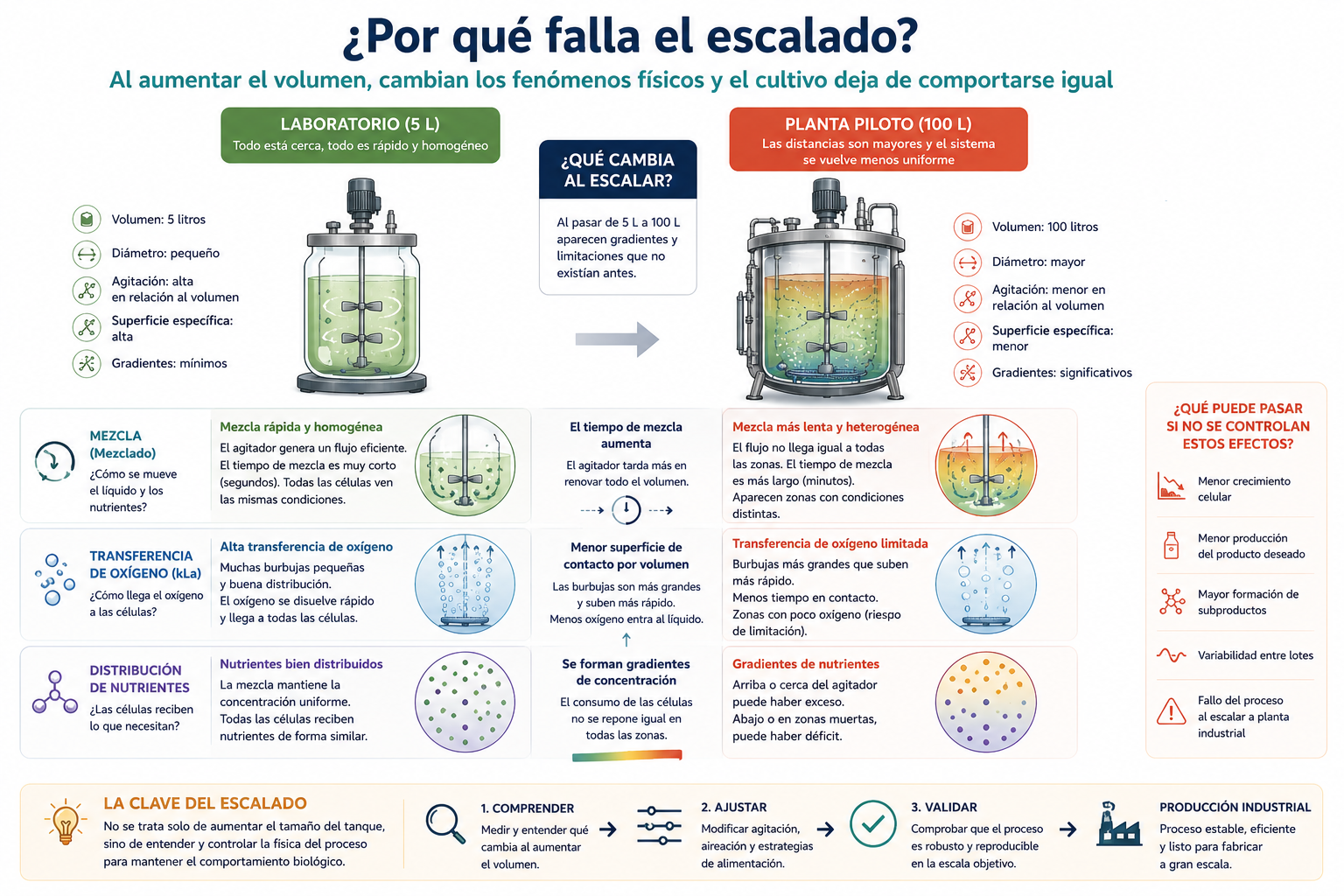
The reality is much more complex. When a culture goes from five liters to one hundred liters, physical phenomena that are essential for cell growth change. Oxygen takes longer to distribute, heat is distributed differently, the mixture is no longer homogeneous and nutrient gradients appear that did not exist before. In other words, increasing the size modifies the behavior of the biological system itself.
For this reason, the pilot plant is an independent step in the development of a bioprocess. Its function is precisely to identify these changes before problems appear during industrial production.
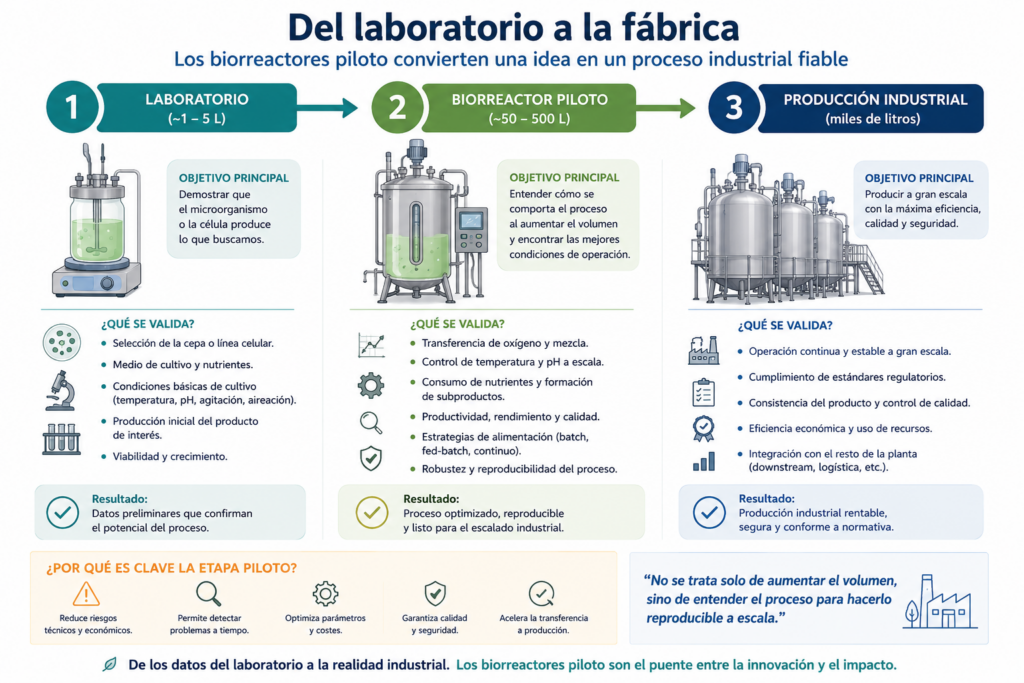
In many projects, this phase determines the success or failure of an innovation.
The Real Challenge: Why Scaling Fails
One of the biggest challenges in biotechnology is that an excellent process in the laboratory can stop working when the volume increases.
It’s a much more common situation than it seems: imagine that a bacterium produces an enzyme with excellent performance in a five-liter container. When you move that same culture to a hundred-liter pilot bioreactor, production drops unexpectedly.
The recipe remains exactly the same. So is the microorganism. What has changed is the physical environment. The distribution of oxygen is no longer the same. The time it takes for the medium to mix increases. The cells receive different concentrations of nutrients depending on the area where they are located and small variations in temperature appear that are difficult to detect in small containers.
All of this can alter cell metabolism and reduce productivity. For this reason, scaling is not only about increasing the size of the container. It is an engineering process that seeks to maintain biological behavior while the physical conditions of the system change.
How a pilot bioreactor works
Although there are different designs, all pilot bioreactors pursue the same goal: to provide a stable environment for cells or microorganisms to grow in the best possible conditions.
To achieve this, they integrate several systems that work in a coordinated way:
Agitation
The stirring system keeps the culture homogeneous. Its function is to distribute nutrients, prevent cell sedimentation and make it easier for all cells to have similar conditions during growth.
Insufficient agitation limits oxygen transport. Excessive agitation can damage particularly sensitive cells, such as those used to make certain biological medicines.
Finding this balance is one of the key tasks during the pilot phase.
Aeration and oxygen
Many microorganisms need oxygen to grow. Bioreactors incorporate aeration systems capable of introducing air or oxygen in a controlled manner through diffusers located at the bottom of the vessel.
The aim is to ensure that all cells have the necessary oxygen without generating turbulence that compromises the culture.
Temperature Control
Cells function within very specific temperature ranges: a variation of just a few degrees can alter their metabolism or reduce the production of the molecule of interest.
For this reason, bioreactors have cooling or heating jackets and sensors strategically distributed to maintain a constant temperature throughout the process.
pH Control
pH has a direct influence on the metabolic activity of microorganisms and cells. During culture, the metabolism itself continuously modifies the acidity of the medium.
Automatic systems add small amounts of acids or bases when necessary to maintain the programmed value. This continuous monitoring ensures the stability of the process for days or even weeks of operation.
What parameters does a pilot bioreactor control?
One of the great advantages of these systems is the enormous amount of information they generate.
Each crop becomes a continuous source of data that allows us to understand the behavior of the process and make informed decisions before industrial scaling.
Among the most important parameters are:
- Temperature.
- pH.
- Dissolved oxygen.
- Agitation rate.
- Aeration flow.
- Internal pressure.
- Foaming.
- Nutrient consumption.
- Cell or microbial growth.
All this information is recorded continuously. It is then used to optimize the process, ensure its reproducibility and facilitate technology transfer to industrial production.
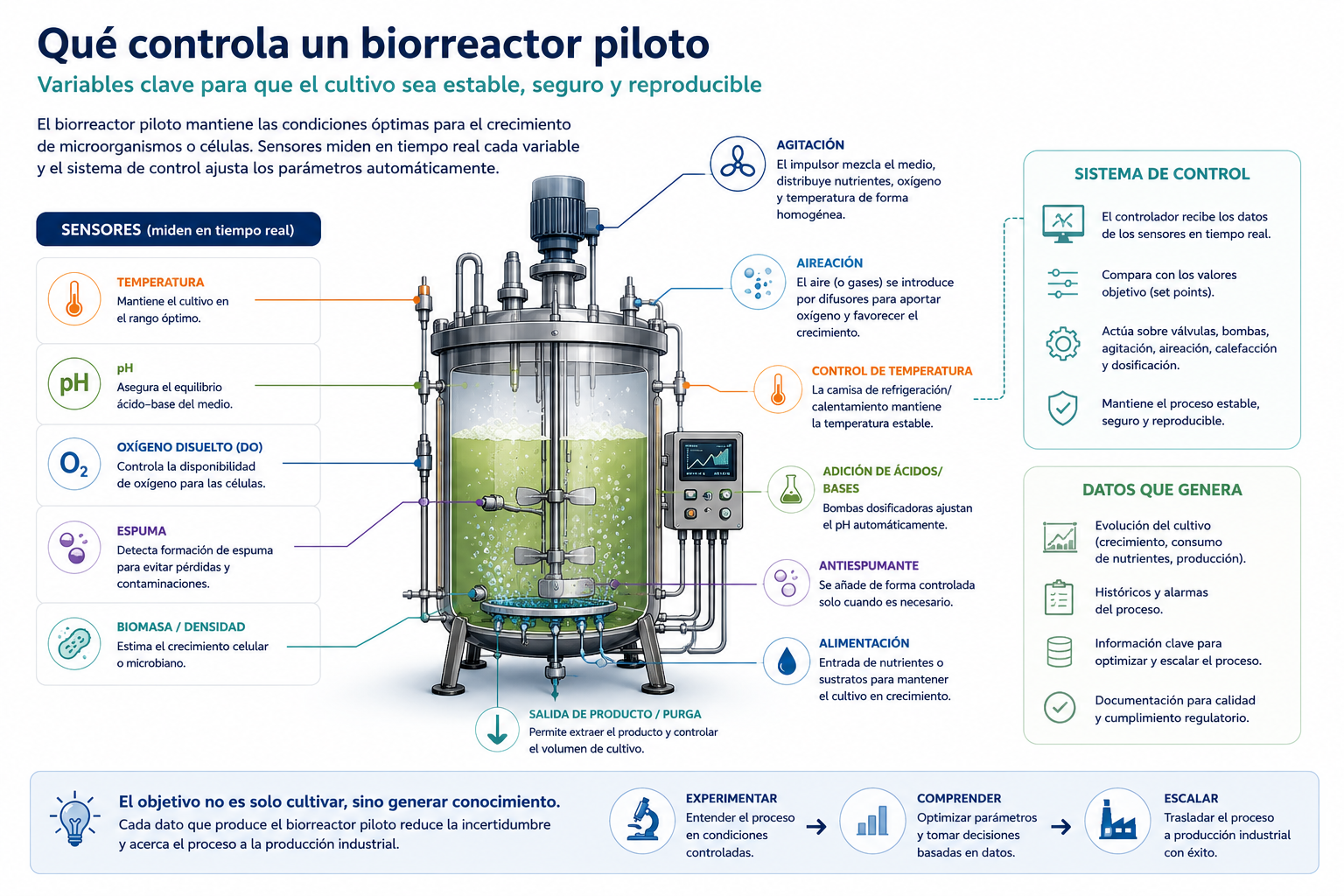
In highly regulated sectors, such as pharmaceuticals, this documentation is also part of the evidence needed to demonstrate that the process is robust, safe and capable of reproducing under the same conditions every time.
Types of pilot bioreactors
There is no single type of pilot bioreactor. The configuration depends on the type of organism, the product to be obtained and the characteristics of the process.
Stirred Tank: The Industry Standard
It is the most widely used design in biotechnology.
It consists of a cylindrical container equipped with a mechanical agitation system, sensors and aeration devices that allow all the variables of the crop to be precisely controlled.
Its versatility explains why it is used to produce everything from enzymes and fermented foods to vaccines, recombinant proteins or monoclonal antibodies.
Airlift bioreactors
In airlift bioreactors, culture circulation is achieved by air bubbles instead of a mechanical agitator.
This design reduces mechanical stress on the cells, an important advantage when working with particularly sensitive cultures.
Although they are not suitable for all applications, they offer excellent performance in certain microbiological and cellular processes.
Other configurations
Research continues to develop new architectures adapted to specific needs.
There are fixed-bed bioreactors for tissue engineering, perfusion systems for long-term cell cultures or photobioreactors for the cultivation of microalgae.
The choice always depends on the biological process and the objectives of the project.
Single-use or stainless steel: two different strategies
One of the most common debates in the biotech industry revolves around the type of facility.
For decades, stainless steel bioreactors were the only option for industrial production. However, single-use systems, made from disposable sterile bags, have gained prominence thanks to their flexibility.
| Feature | Single-use | Stainless steel |
| Initial investment | Lowest | Highest |
| Flexibility | Very high | Lower |
| risk of cross-contamination | Very low | Requires cleaning and sterilization processes |
| Cleaning (CIP/SIP) | Not necessary | Essential |
| Validation | Simpler | More complex |
| Continuous production of large volume | Less adequate | Very adequate |
| Waste generation | Higher | Less during operation |
There is no one-size-fits-all solution.
Companies that develop advanced therapies or produce small batches often value the flexibility of disposable systems. On the other hand, facilities destined to manufacture large volumes for years continue to rely on stainless steel.
The decision depends on the business model, the applicable regulation, and the type of product.
Applications: much more than fermentation
When we think of a bioreactor, we usually imagine fermentation to produce beer or yogurt.
The reality is much broader. Pilot bioreactors are involved in the development of some of the most innovative products in the biological economy:
Drug production
The pharmaceutical industry uses these systems to optimize the production of therapeutic proteins, vaccines, monoclonal antibodies, and cell therapies.
Before manufacturing thousands of doses, each process must demonstrate that it can be reproduced with the same quality over and over again.
Synthetic biology
Synthetic biology is greatly expanding the possibilities of these systems.
Today it is possible to design microorganisms capable of producing high value-added molecules, food ingredients, biomaterials or chemical compounds through biological processes that are much more sustainable than traditional ones.
However, designing the organism is only part of the job. The real challenge is getting that organism to maintain its performance when the process leaves the lab and begins to scale.
Pilot bioreactors are therefore at the heart of the development of synthetic biology. They are the environment where it is validated whether an innovation can become a viable industrial process.
Precision feeding and fermentation
Precision fermentation is experiencing a strong boost thanks to the development of microorganisms capable of manufacturing proteins, fats, aromas or functional ingredients.
These technologies make it possible to produce certain compounds without depending on agricultural crops or traditional livestock farming.
Pilot bioreactors make it possible to optimize these processes before expanding production.
Biomaterials and sustainability
Another line of development is to use microorganisms to manufacture bioplastics, industrial enzymes, biofuels or advanced materials with a smaller environmental footprint.
The circular economy and the decarbonisation of industry will drive many of these applications over the next decade.
How much does a pilot bioreactor cost? Beyond the price of the equipment
When an organization considers incorporating a pilot bioreactor, an immediate question often arises: how much does it cost?
The answer depends on the size, configuration, level of automation, and industry where it will be used.
However, the price of the equipment represents only a part of the investment. The concept of Total Cost of Ownership (TCO ), which incorporates all associated costs over the life of the system, is becoming increasingly important.
Among them are:
- Installation and integration.
- Energy consumption.
- Consumables and culture media.
- Cleaning and sterilisation.
- Maintenance.
- Regulatory validation.
- Operator training.
- Downtime due to maintenance or incidents.
Analysing these factors allows us to compare solutions with a perspective that is much closer to operational reality.
How to choose a good pilot bioreactor
Rather than looking for the equipment with the most features, it is advisable to identify which one best meets the needs of the project.
Some questions help guide this decision:
- What type of microorganism or cell will be cultured?
- What will be the target volume of production?
- Is it research or a process close to industrial manufacturing?
- Will specific regulatory requirements need to be met?
- What degree of automation does the laboratory need?
- How will the system integrate with the existing infrastructure?
- What data will need to be recorded to facilitate technology transfer?
Answering these questions is more useful than comparing technical specifications alone.
From the laboratory to industry: an investment in knowledge
The value of a pilot bioreactor goes far beyond its ability to grow cells or microorganisms. Its real function is to generate knowledge.
Each trial provides information on the behavior of the process, helps to reduce uncertainties and allows better decisions to be made before making much larger industrial investments.
In a context marked by the growth of synthetic biology, precision fermentation and new biological drugs, this ability to convert experimental data into reliable industrial processes will become increasingly strategic.
Basic Glossary – Bioreactor
| Term | Definition |
| Bioreactor | A system designed to grow organisms or cells under controlled conditions. |
| Pilot bioreactor | An intermediate-sized facility used to validate a process prior to industrial scale-up. |
| Scale-up The | adaptation of a process from the laboratory to industrial production. |
| Fermentation | The biological process by which microorganisms transform compounds to produce new substances. |
| Dissolved oxygen | The amount of oxygen available in the culture medium. |
| CIP/SIP | Automatic cleaning and sterilization systems used in industrial facilities. |
| Precision fermentation | The use of microorganisms designed to produce specific ingredients or molecules. |
Frequently Asked Questions About Pilot BioreactorsWhat
is the difference between a laboratory bioreactor and a pilot bioreactor?
The pilot bioreactor works with larger volumes and reproduces conditions much closer to industrial production. Its objective is to validate the process before scale-up.
What is a pilot bioreactor for?
It allows you to optimize crops, reduce risks, validate processes and obtain the data needed to manufacture medicines, food or biomaterials on an industrial scale.
What parameters do you control?
The main ones are temperature, pH, dissolved oxygen, agitation, aeration, pressure and foaming, as well as continuously recording the evolution of the crop.
Why is scaling so important?
Because a process that works in the laboratory can behave completely differently when the volume increases. The pilot phase allows these problems to be detected before industrial production.