
AI-generated summary
Photovoltaic energy has become the cheapest form of mass energy, second only to geothermal energy, which, despite significant upfront costs, is ultra-efficient and inexhaustible. This cost reduction is primarily due to increased investments and technological advancements. Initially, renewable energy technologies like solar panels were inefficient and costly; however, as production doubled repeatedly, costs dropped by about 20% each time—a trend known as Swanson’s Law. Over nearly five decades, the cost to produce photovoltaic energy fell to just 0.21% of its 1975 price, making solar energy cheaper than fossil fuels since 2014, even without subsidies.
Beyond price, the true advantage of renewables lies in their environmental cost savings. Fossil fuels contribute heavily to climate change and pollution, whereas photovoltaic panels offer multifunctional benefits, such as shading rooftops, protecting crops through agrivoltaics, and cooling livestock with solar grazing. Moreover, combining renewable energy with water harvesting technologies presents a promising synergy. Photovoltaic panels can shade water reservoirs to reduce evaporation, while wind turbines can power condensation systems continuously to collect atmospheric moisture in arid regions. Together with other renewable sources like wind, tidal, wave, and geothermal energy, photovoltaic energy represents a sustainable, endlessly replenishable future, offering vast potential for clean energy generation globally.
Photovoltaic energy is the cheapest mass energy that exists, commented energy expert Rosa María Sanz at the Future Trends Forum “Building a Net Zero World“, in which, among many topics, the challenges of energy efficiency were addressed. It could only be surpassed by the ultra-efficient and inexhaustible geothermal energy, with significant initial costs. How did […]
Photovoltaic energy is the cheapest mass energy that exists, commented energy expert Rosa María Sanz at the Future Trends Forum “Building a Net Zero World“, in which, among many topics, the challenges of energy efficiency were addressed. It could only be surpassed by the ultra-efficient and inexhaustible geothermal energy, with significant initial costs. How did you reach this milestone? How is it possible that photovoltaic energy is now much cheaper than other more consolidated sources? It is a matter of numbers and investments. The price of renewable energy sources falls the more investment has been made in them, while non-renewable energy sources rise with their scarcity.
Why is renewable energy now so efficient?
All technology, in its first version, is terribly inefficient. The prehistoric “mastery of fire” was an unprecedented milestone, but that technology has never been as bad as it was then. Over millennia, humans have been able to control the power of combustion with which we now move ships and planes, heat homes or plant fields.
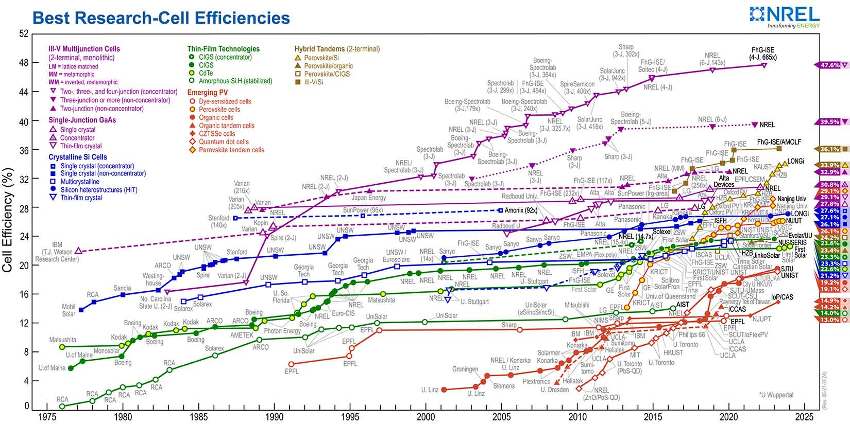
Something similar happened with photovoltaic capture in an infinitely shorter period. The first solar panels would now be considered little more than toys, the board above your calculator supplying much more electrical power. As can be seen in the According to NREL’s diagram, the efficiency of all types of photovoltaic panels is only increasing. But why?
At first, green premiums helped offset the price (price, not cost) of solar panels compared to fossil fuels. They closed the
This phenomenon, known as Swanson’s Law, has happened so many times that producing a photovoltaic watt cost in 2022 the 0.21% of what it cost in 1975. It is not a typo, the price dropped to one fifth hundred in less than 50 years. And it keeps going down as demand increases, which in turn lowers the price. Towards In 2014, photovoltaics became cheaper than burning fuels. Aid was no longer needed, although it is still appreciated to accelerate change.
When costs are measured, renewables win
The price, measured in euros, is the amount paid for energy of any kind. The cost includes the price, but also includes the negative impacts. The impacts of fossil fuels are well known. Its use for more than a century has put humanity in front of humanity’s greatest challenge, the climate crisis, and has accelerated multiple planetary boundaries.
That is why, although the price of photovoltaics is already much lower than the price of burning fuel, when the costs are measured, these notable differences become abysmal. While a diesel generator pollutes the air around the house that uses its energy, a photovoltaic panel protects the facades or roof from solar irradiance. We are talking about two very different ways of approaching energy.
Placed on ponds, the photovoltaic panels act as a solar umbrella. They are also used to protect crops using agrivoltaics, create urban shades or protect livestock: with solar grazing, the sheep are cooled while removing the weeds under the panels. This kind of integration with life is not possible with fossil fuels, and it makes solar more versatile.
Renewable energy and water harvesting systems, an unbeatable combo
When water vapor cools, it forms water droplets that precipitate as a liquid. This process can be controlled to some extent by using a cooling circuit that acts as a cold surface. Vapor from the atmosphere passes through the plate, cools, and millions of microdroplets combine as dew. But this process costs energy. Is it possible to combine renewables and water harvesting?
As Carlos García, Managing Director of GENAQ, explains at the Future Trends Forum dedicated to water, is perfectly possible. Not only that, but photovoltaic and wind technology are perfectly combined with mechanical condensation. Why? Imagine a warm country without bodies of fresh water.
During the day, the photovoltaic panels act as a shade on a reservoir of water captured from the atmosphere, protecting it from evaporation. The more radiation there is, the more water flows. At the same time, wind generators can operate 24/7 if there is wind, because when there is no electricity demand from direct human activities, the plant is dedicated to condensing water and refilling the tanks.
Photovoltaic energy is one of humanity’s futures along with other renewable sources such as wind or tidal and wave energy, or the technically non-renewable but virtually inexhaustible geothermal energy. All around us, in any direction, there are enormous amounts of energy waiting to be harvested, with the advantage that they are replenished again and again.