AI-generated summary
Synthetic biology blends biology, engineering, chemistry and computer science to design and build organisms, cells and biological systems that perform specific tasks. By treating cells as programmable platforms and applying an iterative engineering workflow—design, build, test, learn—researchers can create genetic circuits and metabolic pathways that produce medicines, food ingredients, biomaterials and industrial chemicals more efficiently and sustainably than many traditional methods. Recent advances that fuel this shift include vastly cheaper DNA sequencing and synthesis, accessible gene-editing tools like CRISPR, AI-driven protein and pathway design, and automated labs that accelerate experimentation and scale-up.
The technology is already transforming health, agriculture, industry and environmental management: engineered microbes produce insulin, precision fermentation makes alternative proteins, biomanufacturing yields bioplastics and enzymes, and bespoke organisms or biosensors promise pollution remediation and carbon capture. Alongside these opportunities come challenges in safety, regulation and public acceptance, requiring transparent science, robust governance and international cooperation. With strong research ecosystems and industrial capacity, regions that coordinate academia, startups, industry and policymakers—particularly in Europe—stand to gain significant economic and sustainability benefits from this emerging bioeconomy.
Synthetic biology makes it possible to design organisms with specific functions to develop more sustainable medicines, new materials or industrial processes. Find out how it works and why it will be a key technology for innovation.
Synthetic biology combines biology, engineering, chemistry and artificial intelligence to design organisms and biological systems with specific functions. Thanks to this discipline, it is now possible to develop microorganisms capable of producing medicines, new materials, food or fuels in a more efficient and sustainable way. Its impact reaches sectors as diverse as health, agriculture, industry and the environment.
Just a few decades ago, biology consisted of observing how living beings worked and trying to understand their mechanisms. Today the objective has changed: scientists are beginning to design biological systems capable of solving specific problems.
This change in focus has given rise to one of the disciplines with the greatest transformative potential in the coming decades: synthetic biology.
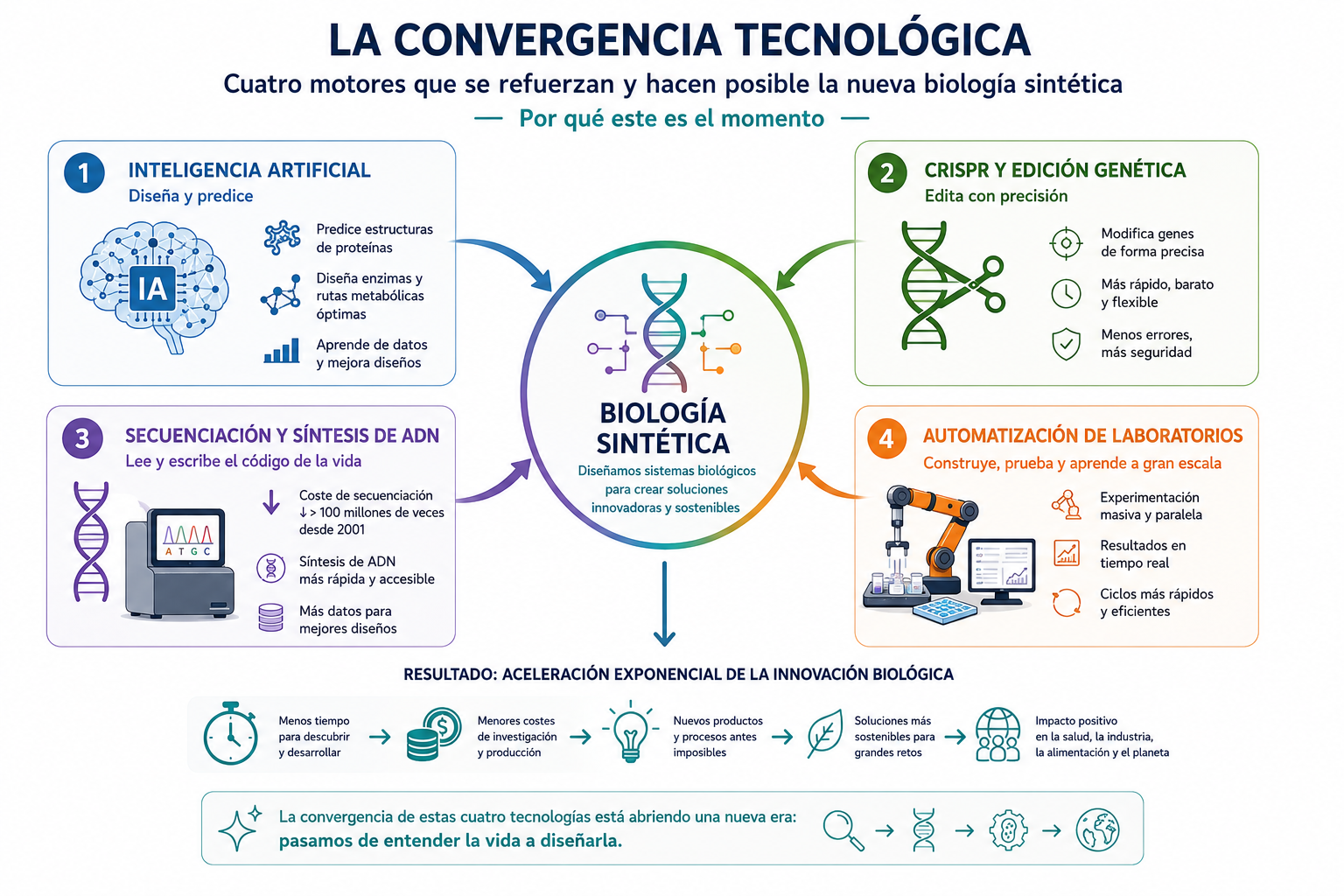
Its development coincides with a particularly favourable time. The cost of sequencing and synthesizing DNA has fallen dramatically, tools such as CRISPR have simplified gene editing, and artificial intelligence is accelerating the design of proteins, enzymes, and metabolic pathways. The combination of these advances is driving a new generation of solutions to manufacture medicines, produce food, develop sustainable materials, or reduce the environmental impact of industry.
The Future Trends Forum of the Bankinter Innovation Foundation has analysed this revolution in its report Synthetic Biology, where it explores how this discipline can become one of the great drivers of the bioeconomy and industrial competitiveness in the coming years.
What is synthetic biology?
Synthetic biology is a discipline that combines biology, engineering, chemistry, computer science, and other scientific areas to design and build organisms, cells, or biological systems with specific functions.
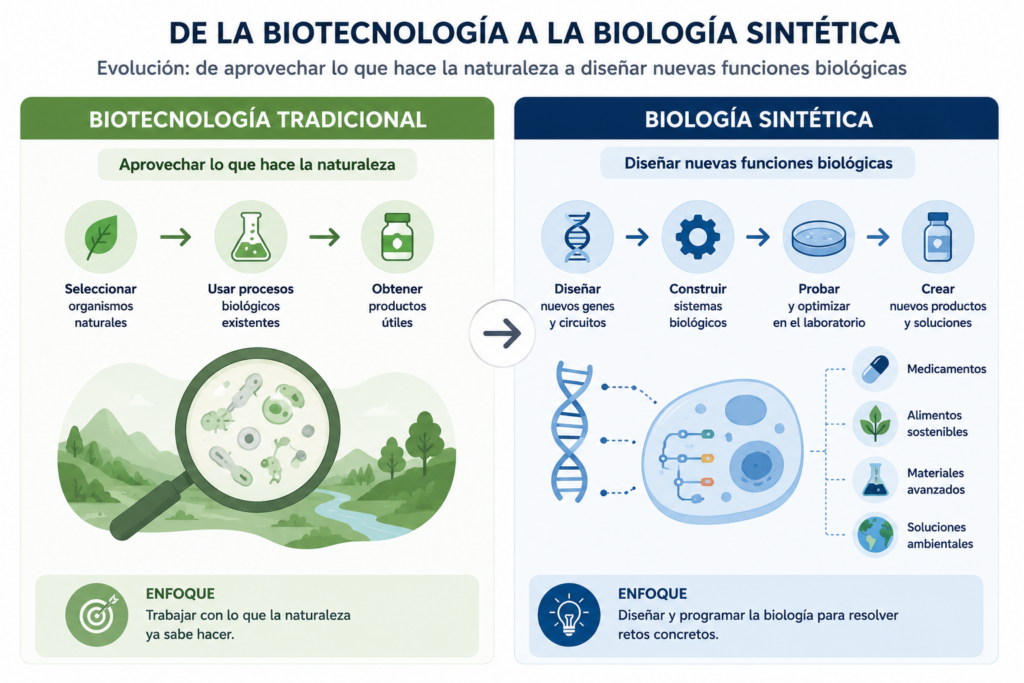
Unlike traditional biotechnology, which takes advantage of existing biological processes, synthetic biology applies engineering principles to create biological systems that are more predictable, controllable and reproducible. Its goal is to design solutions capable of producing medicines, food, materials or chemical compounds in a more efficient and sustainable way.
In other words, synthetic biology is about programming biology. Just as an engineer designs a bridge or a developer writes the code for an application, a synthetic biology team can design genetic circuits that tell a cell what function it should perform.
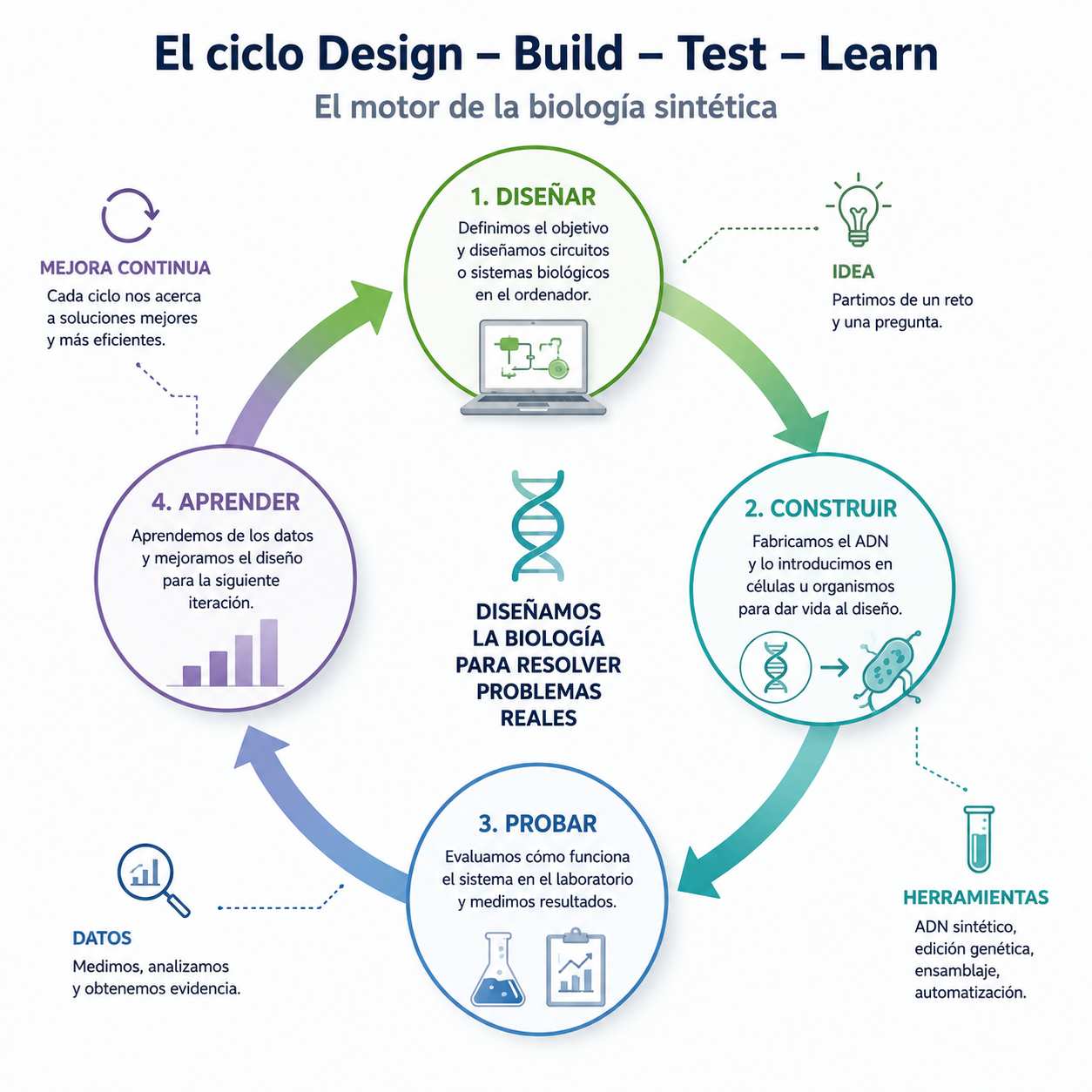
Naturally, living systems are much more complex than a computer. However, the approach to work is becoming more and more similar to that of other engineering disciplines: design, build, test, measure and improve.
Designing biology as a machine is designed
One of the ideas that best explains synthetic biology is to understand a cell as a programmable platform.
Each cell contains a set of instructions stored in DNA. These instructions determine what proteins it produces, how it obtains energy, or how it responds to the environment.
Synthetic biology seeks to modify these instructions or create new ones for the cell to perform specific tasks.
For example, a microorganism can be designed to make a protein used as a medicine, produce a food ingredient, or degrade a contaminant present in water.
The important thing is not only to modify an isolated gene. The discipline works with complete biological circuits, capable of coordinating multiple cellular functions in a controlled manner.
To achieve this, it combines tools from different areas:
- Genetic engineering and DNA editing.
- Molecular biology.
- Laboratory automation.
- Computational modelling.
- Artificial intelligence to design proteins and optimise processes.
- Bioprocesses and industrial scaling.
This integration makes synthetic biology a deeply interdisciplinary field.
How is it different from traditional biotechnology?
Biotechnology has been using microorganisms or cells to manufacture products of interest for decades. It produces fermented foods, antibiotics, industrial enzymes and vaccines.
Synthetic biology starts from the same base, but goes a step further. While traditional biotechnology takes advantage of capabilities that already exist in nature, synthetic biology seeks to design new functions using engineering principles.
A simple analogy helps to understand this difference: Traditional biotechnology is like selecting the right tool from an existing box, while synthetic biology allows you to make an entirely new tool to solve a particular problem. This paradigm shift greatly expands the possibilities for innovation.
Today it is already possible to develop microorganisms capable of making molecules that could previously only be obtained through complex chemical processes, producing materials with unprecedented properties or creating completely new metabolic pathways.
Why are we now experiencing the great impulse of synthetic biology?
The idea of designing organisms was not born yesterday, what has changed is the available technology.
For years, modifying DNA was slow, expensive and technically very complex. Today the scenario is different thanks to the convergence of several advances.
DNA sequencing and synthesis are becoming more accessible
Reading and writing DNA costs a fraction of what it cost just two decades ago.
This allows for much more ambitious projects to be developed and research cycles to be accelerated.
Tools like CRISPR make gene editing easier
Gene editing techniques have gained precision, speed and flexibility.
CRISPR has democratized many applications that were previously only available to a few specialized laboratories.
Artificial intelligence accelerates biological design
AI is transforming biological research.
Today it can help predict the structure of proteins, identify new enzymes, optimize microorganisms, or analyze huge volumes of experimental data in a matter of hours.
Each new advance reduces the time needed to develop biotechnology solutions.
Increasingly automated laboratories
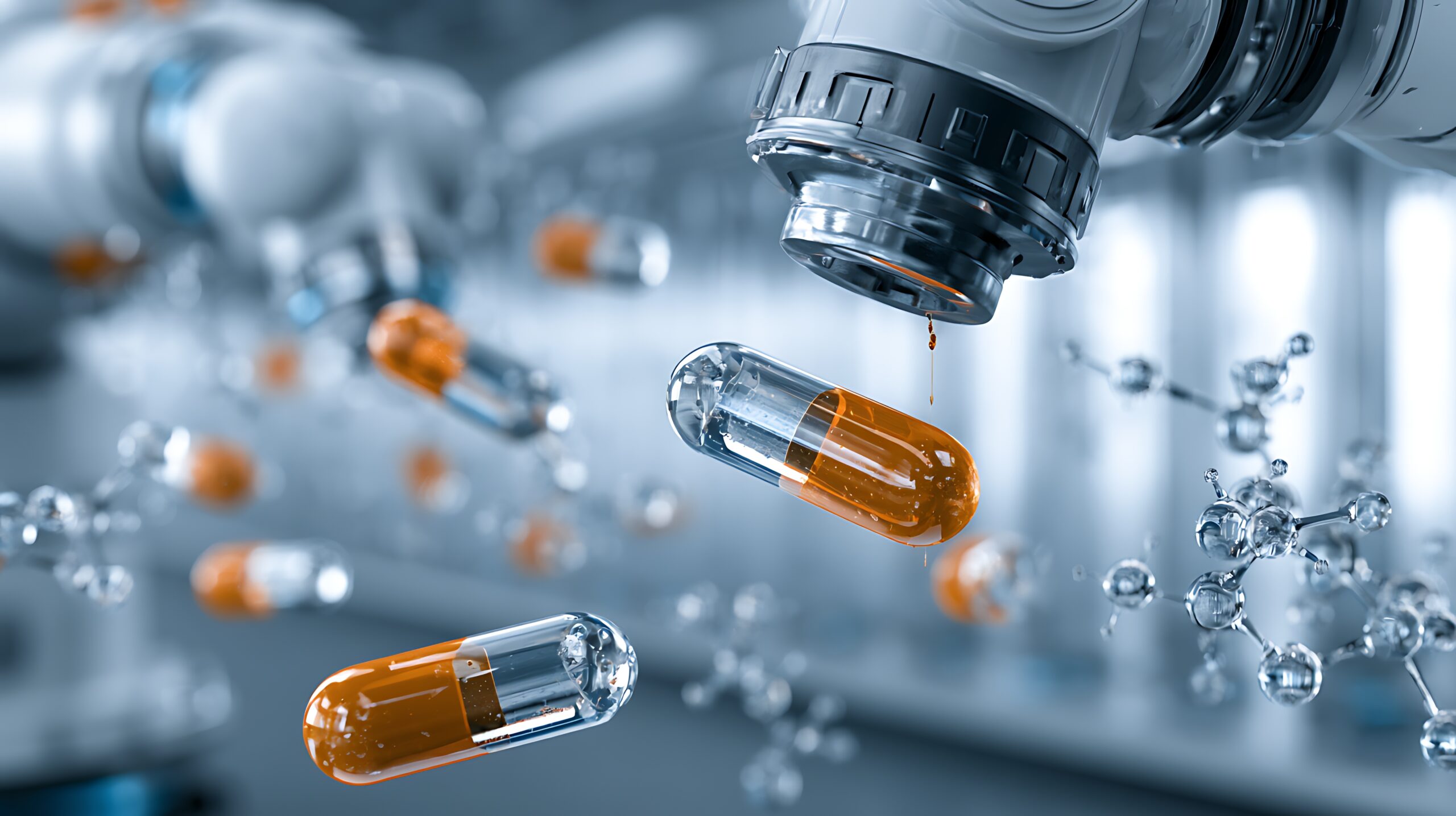
Automation makes it possible to run thousands of experiments simultaneously and quickly analyze the results.
This approach, known as Design-Build-Test-Learn, greatly accelerates innovation and brings biology closer to traditional engineering methods.
The combination of all these factors explains why many experts believe that synthetic biology can play a role similar to that played by the digital revolution several decades ago. Instead of programming computers, we are now starting to design biological systems capable of solving some of the great challenges of our society.
Applications of synthetic biology
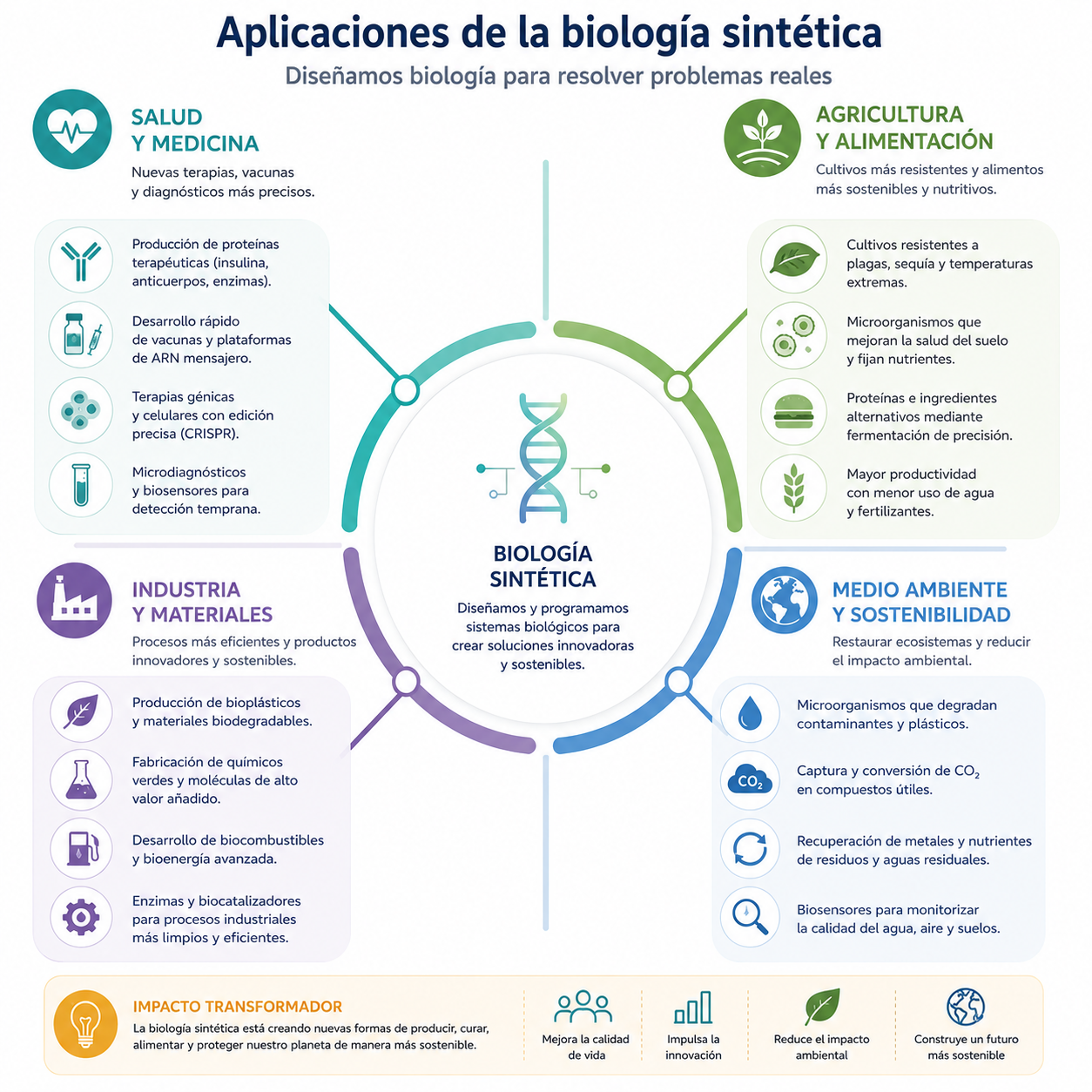
Synthetic biology is already having an impact on some of the sectors with the greatest capacity to transform the economy. Its main strength is to use biological systems as a new innovation platform to develop more efficient, sustainable and personalised products and processes.
Health and medicine: towards a new generation of therapies
Medicine is one of the fields where synthetic biology shows the greatest potential.
Thanks to the design of microorganisms and cells, it is possible to produce therapeutic proteins, vaccines, monoclonal antibodies or advanced therapies with greater precision and efficiency.
The development of messenger RNA vaccines during the COVID-19 pandemic marked a turning point. Although these vaccines are not an exclusive example of synthetic biology, they illustrate how the combination of molecular biology, computational design and flexible manufacturing platforms can accelerate the development of new healthcare solutions.
Another particularly promising area is that of cell and gene therapies, where tools such as CRISPR make it possible to correct mutations responsible for certain hereditary diseases.
As knowledge about how cells work increases, medicine is moving towards increasingly personalized treatments.
Agriculture: producing more with fewer resources
Agriculture also faces major challenges.
Population growth, climate change and pressure on natural resources make it necessary to produce food more efficiently.
Synthetic biology contributes to this goal by developing crops that are more resistant to diseases, droughts or extreme temperatures, as well as microorganisms that improve soil fertility or reduce the need for chemical fertilisers.
It also drives the development of new alternative proteins obtained through precision fermentation, a technology that uses microorganisms designed to produce specific food ingredients.
These solutions can complement traditional production systems and help strengthen food safety.
Industry: the factory of the future will be biological
For decades, numerous industrial processes have relied on petroleum derivatives or energy-intensive chemical reactions.
Synthetic biology proposes a different approach.
Instead of using conventional chemical processes, it makes it possible to design microorganisms capable of manufacturing complex molecules using renewable raw materials.
This strategy opens up new opportunities to produce:
- Bioplastics.
- Biofuels.
- Ingredients for cosmetics.
- Specialized chemical products.
- New biomaterials.
- Industrial enzymes.
In many cases, these processes consume less energy and generate less waste than traditional methods.
The so-called biomanufacturing is thus emerging as one of the pillars of the future low-carbon economy.
Environment: Using Biology to Restore Ecosystems
Synthetic biology can also help solve some of the world’s biggest environmental challenges.
Research teams are working on microorganisms that can degrade pollutants, capture carbon dioxide, or recover metals in e-waste and industrial water.
Others are developing biosensors that can detect pollutants quickly and accurately.
While many of these applications are still in the development phase, they represent a new way of approaching sustainability: using biological systems to restore the environment itself.
Real examples of synthetic biology
Although it may seem like a futuristic discipline, synthetic biology is already part of numerous industrial and scientific projects.
Some examples illustrate its scope well.
Insulin production. Modified microorganisms have been producing human insulin for the treatment of diabetes for years with high levels of quality and safety.
Vaccines and biological medicines. The design of flexible biotechnology platforms makes it possible to respond more quickly to new diseases and to develop increasingly personalised therapies.
Precision fermentation. Companies around the world use yeasts and other microorganisms designed to manufacture proteins present in foods such as milk or eggs without the need to resort to livestock farming.
Biomaterials. New materials obtained through biological processes offer more sustainable alternatives for sectors such as textiles, packaging or construction.
Industrial biomanufacturing. Programmed microorganisms produce enzymes, chemical ingredients or compounds with high added value through more efficient processes and with less environmental impact.
All these examples show a common trend: biology is no longer just an object of study but a platform for design and innovation.
Benefits of Synthetic Biology
The ability to design biological systems opens up opportunities that transcend the scientific field.
Its main advantages include:
- Faster development of new products.
- Reduction of costs in certain industrial processes.
- Greater precision in biological design.
- More sustainable production thanks to the use of renewable resources.
- Reduction of energy and raw material consumption.
- Development of solutions to major health and environmental challenges.
- Greater capacity to personalise treatments and production processes.
Its true potential lies in combining scientific innovation with industrial applications capable of generating economic and social impact.
The challenges: innovation, regulation and trust
As with any disruptive technology, synthetic biology also poses significant challenges.
One of these is to ensure that newly designed organisms can be used in complete safety for people and the environment.
There is also a need to establish regulatory frameworks that can keep pace with innovation.
Another fundamental aspect is social acceptance. Concepts such as gene editing, modified microorganisms or synthetic biology generate legitimate questions about their possible applications and limits.
For this reason, many experts agree that technological development must be accompanied by transparency, rigorous scientific evaluation and strong international governance.
The debate is no longer only about what technology can do, but also about how we want to use it.
A strategic opportunity for Europe
Synthetic biology has become a strategic area for international competitiveness.
The United States and China lead a large part of investments and business development in this field. Europe, for its part, has a solid scientific ecosystem, a powerful pharmaceutical industry and a growing commitment to the bioeconomy and sustainability. Taking advantage of this position will require strengthening collaboration between universities, technology centres, startups, large companies and public institutions.
The convergence between artificial intelligence, automation, biotechnology and industrial capabilities may become one of the great European innovation drivers over the next decade.
Basic Glossary of Synthetic Biology
| Term | Definition |
| Synthetic biology | A discipline that designs and builds biological systems with specific functions. |
| Biotechnology | The use of organisms or biological processes to develop products and services. |
| Genetic engineering | Techniques that allow the modification of an organism’s DNA. |
| CRISPR | A genetic editing tool that allows specific DNA sequences to be modified. |
| DNA | A molecule that contains the genetic information of living beings. |
| Genetic circuit | A set of genes designed to perform a specific function. |
| Precision fermentation: | The production of ingredients using microorganisms designed to synthesize specific molecules. |
| Biomanufacturing | : Industrial production based on living organisms or biological systems. |
| Bioeconomy | : An economic model based on the sustainable use of biological resources. |
Frequently Asked Questions About
Synthetic BiologyWhat is synthetic biology in a nutshell?
It is a discipline that combines biology, engineering, chemistry, and computer science to design organisms or biological systems capable of performing specific functions, such as making medicines, materials, or food.
What is the difference between synthetic biology and biotechnology?
Biotechnology takes advantage of existing biological processes. Synthetic biology goes a step further and designs new biological functions using engineering principles.
What are the applications of synthetic biology?
Its main applications are in health, agriculture, industry, and the environment. It allows the development of new drugs, the production of food through precision fermentation, the manufacture of sustainable biomaterials, or the design of microorganisms capable of degrading pollutants.
What is the relationship between CRISPR and synthetic biology?
CRISPR is one of the tools used by synthetic biology to edit genes with great precision. However, synthetic biology is a much broader field that integrates multiple technologies to design entire biological systems.
Why is it considered a strategic technology?
Because it can transform high value-added sectors such as health, food, chemicals, new materials or energy, promoting a more competitive and sustainable bioeconomy.