
AI-generated summary
Tanisha Bassan, a quantum computing developer, recently presented at the Future Trends Forum on the revolutionary potential of quantum computing and its interplay with artificial intelligence (AI). Quantum computing harnesses the principles of quantum mechanics—specifically superposition and entanglement—to achieve exponentially greater computational power than classical computers. Superposition allows particles to exist in multiple states simultaneously, while entanglement links particles so that the state of one instantly influences the other. These unique properties enable quantum computers to process vast and complex datasets far beyond the reach of traditional technologies.
Bassan highlighted the enormous challenges posed by global issues such as climate change, world hunger, the food crisis, real estate instability, and cancer. The data involved in these problems is massive and often unstructured, making it difficult to analyze and simulate accurately with current hardware and software. Quantum computing, combined with AI, offers promising avenues to tackle these intricate problems by efficiently handling and extracting insights from complex data. Her talk underscores the transformative role this synergy could play in developing innovative solutions for some of humanity’s most pressing challenges.
Find out what is the role of artificial intelligence and quantum computing in solving complex problems with Tanisha Bassan’s conference.
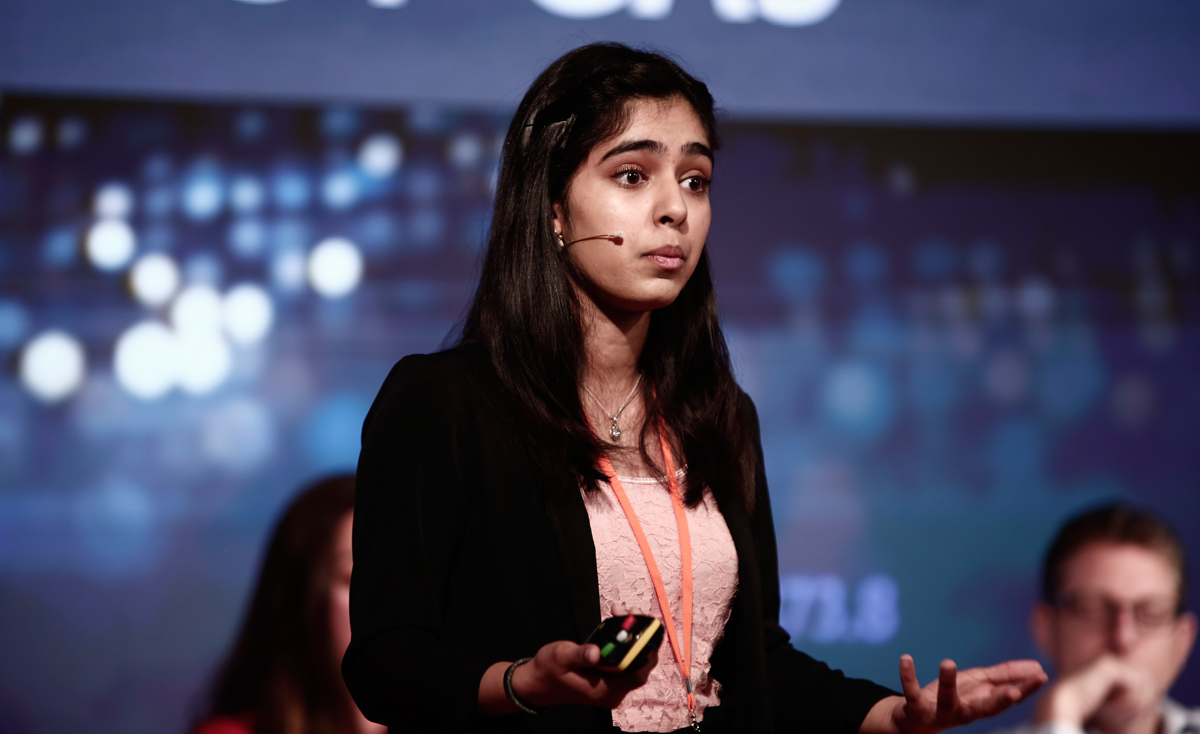
Tanisha Bassan, quantum computing developer, was part of the last Future trends Forum edition. She gave a talk about this technology and how it interacts with artificial intelligence.
Quantum computing is producing a technological revolution, as it enables an exponential computational power. This may help solve some of the most complex problems in the world.
As Tanisha explains, quantum computer leverages quantum mechanics, the rules, and the laws we use to understand how things work and how they interact at a tiny scale, at a nano scale: protons, electrons… things we cannot see, and how they interact with each other.
Two properties of quantum mechanics are very useful to understand quantum computing: superposition and entanglement. Superposition means that you can have a particle anywhere, exactly at the same time, without being seen. Entanglement means that two particles, two dots of information can be correlated: when one is affected, that affects the other one directly.
The sheer amount of data available to us at present—unstructured for the most part—makes for a very difficult analysis and insightful conclusions. Tanisha illustrates this point with problems such as climate change, hunger in the world, the food crisis, the real estate crisis, or cancer. The amount of data regarding these problems and the links between them are so complex that one could hardly make a mathematical simulation with our hardware or software programs.
Find out about the role of artificial intelligence and quantum computing to solve complex problems with Tanisha Bassan’s conference.
You may learn more about the potential of artificial intelligence by clicking here.