
AI-generated summary
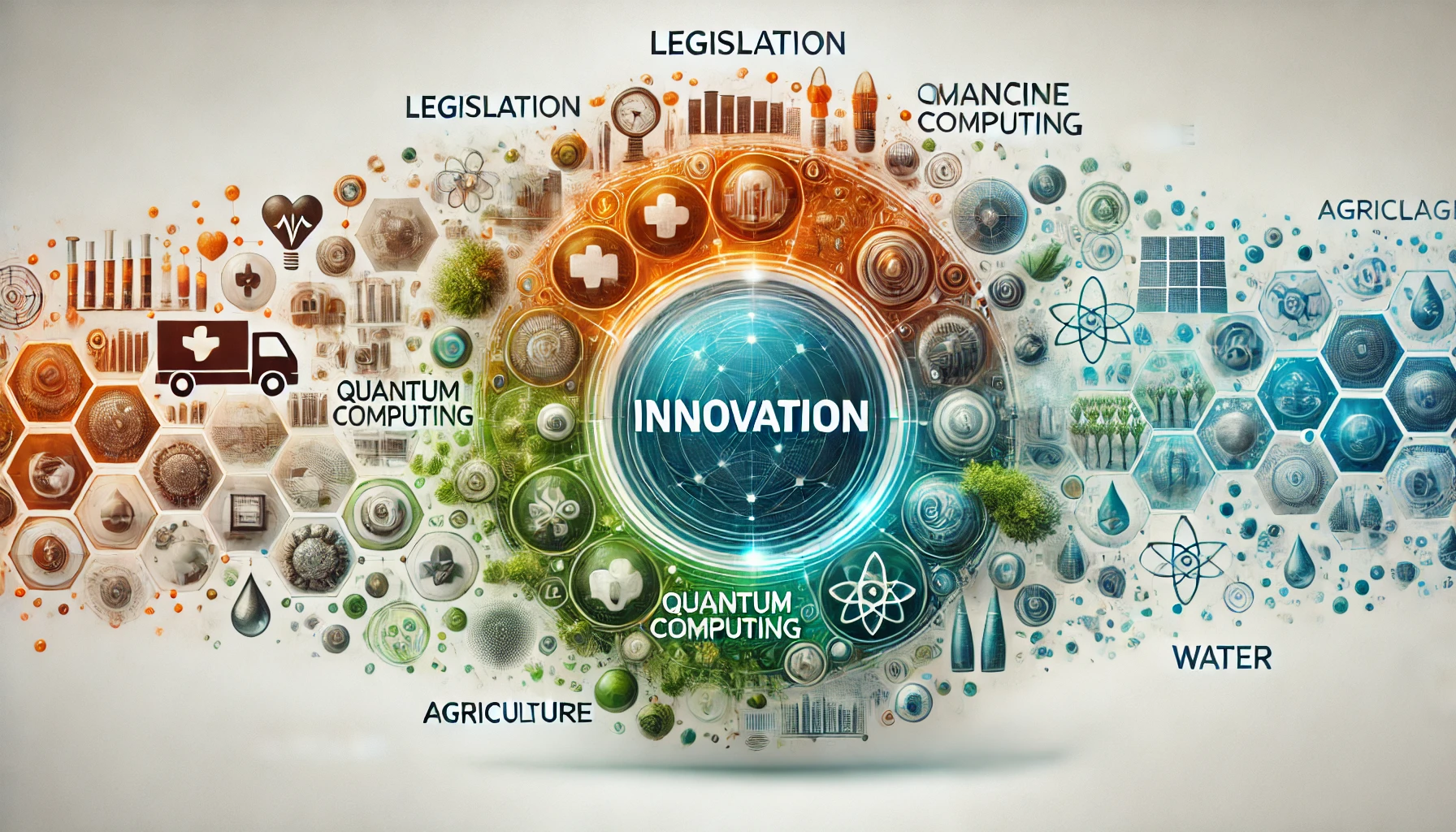
In 2024, innovation is marked not only by technological breakthroughs but also significant legislative advances aimed at safeguarding human rights amid rapid technological progress. A landmark development is the European Union’s approval of the AI Act, the first law by a supranational entity to regulate artificial intelligence with a strong focus on protecting citizens’ rights and privacy. Similarly, Spain is pioneering neurorights legislation to protect mental privacy against the ethical challenges posed by brain implants.
Technological progress is also transforming sustainable food production and healthcare. Smart greenhouses in Almeria exemplify advances in agriculture, improving crop yields and water efficiency. Startups like Notco and Brightseed leverage AI to create plant-based food alternatives and discover beneficial plant compounds, promoting healthier, sustainable diets. In medicine, AI applications at Madrid’s La Paz University Hospital enhance diagnostic accuracy and efficiency, revolutionizing patient care. Furthermore, the emerging fusion of quantum computing and AI promises to accelerate innovation across sectors including medicine, logistics, and space exploration, with IBM developing a 100,000-qubit quantum supercomputer expected in a decade.
Water management and space research are additional innovation frontiers in 2024. Technologies like IoT-enabled “sponge cities” help cities adapt to climate-induced water challenges, while space laboratories analyze biological responses to extreme environments, offering insights that may advance cancer therapies. Together, these innovations represent a multifaceted push toward a sustainable, ethical, and technologically advanced future for humanity.
Innovative megatrends are making their way this year with new developments in fields ranging from legislation to space.
Advances in legislation, cutting-edge technologies that step on the accelerator, intelligent resource management or experiments in space. All this is what is happening in 2024 in innovation.
The great trends of the future are progressing hand in hand with scientists, technologists, legislators and other professionals who are constantly looking for a new great step for humanity. Below, we will see a small sample of what 2024 has brought in innovation.
Legislation: technology at the service of humans
One of the major evolution-related milestones of 2024 is not a disruptive technology or a great scientific finding. It is rather a step forward in the protection of people’s rights in the face of the unstoppable advance of technology.
This year’s approval of the AI Act made the European Union (EU) the first supranational entity with a law to regulate artificial intelligence. Last May, the Council of the EU gave the final green light to the text, which focuses on the protection of citizens’ rights and privacy.
It was precisely with this last aspect that the other great milestone that took place in the Spanish Parliament had a lot to do. This year, for the first time, the deputies heard a neuroscientist such as Rafael Yuste, an expert from the think tank Future Trends Forum, advocate for what are known as neurorights.
Rafael Yuste seeks to promote in Spain a regulation that protects the privacy of citizens’ thoughts in the face of the expansion of brain implants. A technology that can improve our human capabilities, but that also poses ethical dilemmas.
The food of the future is making its way
The use of new technologies in agriculture to respond to the great challenge of sustainable food is another of the major trends that are inexorably advancing.
The progress is striking. An example of this is the use of smart greenhouses, capable of increasing crop yields, saving water and adapting to climatic conditions. It is not science fiction: they are being used now, in 2024, in Almeria.
The union of technology and cooking also brings us closer and closer to the healthy and sustainable food we need.
It does this through startups like Notco, which uses artificial intelligence to find combinations of ingredients that mimic the taste, texture, and functionality of animal products. The goal is to create vegan alternatives that are appealing. For its part, Brightseed uses this same technology to discover new functional compounds from plants that improve the preservation and nutritional value of food.
A co-pilot for our health
The applications of artificial intelligence are also set to revolutionize medicine. In fact, they are already doing so: not long ago we were talking right here about how the La Paz University Hospital in Madrid uses it to automate routine processes and improve efficiency in patient care.
This Madrid health project uses artificial intelligence for certain tasks. For example, to generate pre-reports of CT scans or reduce the time to diagnose rare diseases with an accuracy of 80-90%. It is also used in diagnostic imaging, personalized medicine, advanced genomics, neurotechnology, oncology or rehabilitation.
QC+AI, the silent revolution
The year 2024 also paves the way for the “quiet revolution” of the union between quantum computing and artificial intelligence (QC+AI). Significant progress is already being made both in the scalability of quantum technologies and in the design of new algorithms for QC+AI, as Brian Lenahan recalled at the Future Trends Forum on the subject.
These new approaches are known as quantum inspired and are called to transform all areas of our lives, from medicine to logistics, from finance to education or space exploration. Vertical ecosystems that will advance at a speed never seen before.
Meanwhile, laboratories and universities around the world are carrying out projects to perfect quantum computers. Earlier this year, IBM is working to create a 100,000-qubit quantum supercomputer. It is expected to be ready in about ten years and will help address some of humanity’s toughest challenges.
Taking care of water to take care of life
Water management is another of the macro trends that guide the course of innovation. It is so for two reasons: it is a scarce resource that should be preserved, but it is also a disruptive agent due to climate change and extreme weather events.
This is precisely why we owe the design of the so-called sponge cities, which have green areas capable of absorbing water in a matter of hours when torrential rain appears.
Also the use of IoT to monitor water management in urban environments. Water protection giants such as Aqualia are already using mobile telecommunications technology to monitor hotspots.
At the beginning of the year, the company signed a contract with Vodafone with 6.5 million active lines, that is, connection sending points, capable of each of them serving dozens of reading points. They allow access to valuable information for the manager, but also for citizens, who can learn more about their consumption in order to take water-saving measures.
Studying the Earth from space
Right now, a few miles above our heads, there are space laboratories that study the biology and chemistry of living systems thanks to omics data. They use advanced technologies such as DNA sequencing and proteomic analysis to better understand how life adapts to microgravity, cosmic radiation, and other extreme conditions in space.
These studies will not only allow us to know what our life would be like in space. Their results may also provide useful information about the body’s defense mechanisms that could be used to develop new cancer therapies.