Q3 2026 Startup Investment Report

Insights Q3 2026

  • Record volume with fewer operations. The ecosystem totals €3,827 million (+49%) up to September and already exceeds the entire 2025 financial year (€3,132 million), but closes 274 operations (–5%).
  • Mega-rounds explain the growth. Sixteen rounds of €50 million or more concentrate €2,560 million, two out of every three euros invested (67%), and double their volume (+113%).
  • The base market continues to normalize downwards. Without mega-rounds, investment fell by 8% to €1,267 million in 258 operations (–7%), and the median remained flat at €2.0 million.
  • Multiverse Computing signs the largest round in the history of the ecosystem. Its €500 million exceeds any operation recorded since 2019 and alone accounts for 13% of the year’s capital.
  • The phases are polarised. Seed grows by 22% (104 operations) and Growth by 33%, while Series C falls by 35%: there are already more mega-rounds (16) than Series C (15).
  • Barcelona and Madrid, in a technical tie. Barcelona adds €1,175 million (+14%) and Madrid €1,153 million (+37%): just €22 million difference. The Rest of Spain captures €490 million (+123%), driven by Multiverse (San Sebastián), PLD Space (Elche) and iPronics (Valencia).
  • Exits continue to fall. Thirty divestments (–35%). The most prominent is Marosa, acquired by Wolters Kluwer for €112 million.

Activity


The first nine months of 2026 ended with €3,827 million (+49%) in 274 operations (–5%). The volume is already 22% higher than the full end of 2025 (€3,132 million) with a quarter to go. But the headline hides a divergence: much more money is invested in fewer operations. The ecosystem is not gaining activity; it is gaining size at the top.

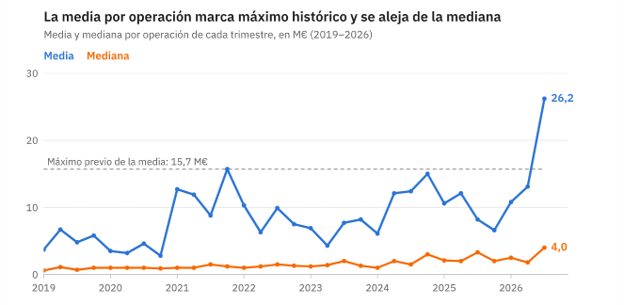
The average/median crossover confirms this. The average soars by 53% to €15.8 million, while the median does not move (€2.3 million, 0%). The typical operation remains at around €2 million, the same as a year ago. The average is already seven times higher than the median (6.9 times, compared to 4.5 times a year ago and 5.8 times in the first half of the year).

There are two possible readings. The optimistic one: the ecosystem demonstrates the ability to attract rounds of unprecedented size, a sign of more mature companies. The prudent one: the volume depends on a very small group of operations and is not transferred to the general fabric. Both are true at the same time, and the second weighs more heavily in measuring the health of the market: a strong year in volume and flat in activity is a concentrated year, not an expansive one.


Mega Rounds


Sixteen operations reach or exceed €50 million and concentrate €2,560 million, 67% of the total capital of the year. In the first half of the year there were eleven and they accounted for 58%. The third quarter added five more: Multiverse Computing (€500 million), Open Cosmos (€300 million), Fever (€217 million), HappyRobot (€130 million) and iPronics (€108 million). The rest is completed by PLD Space (€288 million), Twinco (€165 million), Factorial (€129 million), Preply (€128 million), EOS-X Space (€120 million), Xoople (€115 million), Citibox (€100 million), ONA Therapeutics (€74.2 million), Theker Robotics (€74 million), Universal DX (€62 million) and Attypics Photonics (€50 million).

The arithmetic of growth is unequivocal. Total investment rises by around €1,260 million compared to 2025; mega-rounds, around €1,360 million. In other words, large rounds account for more than 100% of the advance, and the rest of the market is subtracted. Multiverse and Open Cosmos alone account for €800 million: without these two operations, year-on-year growth would be around +18%, far from the +49% of the incumbent.

Concentration is also intensifying within the segment itself. The three largest rounds (Multiverse, Open Cosmos and PLD Space) bring together €1,088 million, 28% of all investment in the country. The median of the segment rises by 37%, to €120 million, and the average by 60%, to €160 million: the large rounds are not only more, but much larger. Multiverse’s becomes the largest in the historical series, above Clikalia (€460 million, 2021). The central reading of the period is one of dependence: the ecosystem has shown that it can close European-sized rounds, but its annual figure today depends on those rounds being repeated.

Activity without mega-waves


Excluding the sixteen mega-rounds, the fund market remains at €1,267 million (–8%) divided into 258 operations (–7%). Compared to +49% for the holder, the basic investment fabric is declining in volume and activity: without the large rounds, the year would be around €110 million behind 2025. The gap between the two portraits, shot aggregate and base downward, is the exact measure of what the mega-rounds hold.

The nuance with respect to the first half of the year is relevant. In June, the base lost volume (–9%) but gained operations (+3%). In September it lost both. The third quarter has not brought additional traction to the ordinary market: the summer has been a quarter of large operations, not of generalized activity.

The average (€5.6 million, –3%) and the median (€2.0 million, 0%) remain practically flat. The usual ticket is not deteriorating, but neither is it improving: in June, the median of the base market grew by 25%, and that momentum has been exhausted in the third quarter. What is missing is not round size, but the mass of operations.

For this reason, the image without mega-rounds is the one that best describes the reality of the ecosystem: a market stabilized in ticket, selective in number and still without structural recovery. The growth of 2026 is not baseline; it is extraordinary and concentrated.

Temporal evolution of the ecosystem


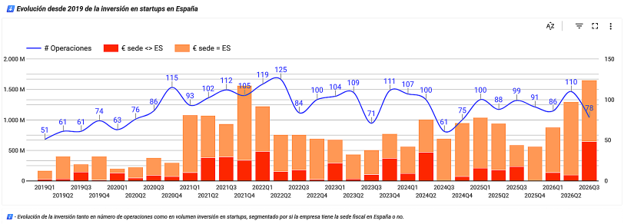
The quarterly series draws two curves that are separated. In volume, the third quarter of 2026 is the largest of the entire series since 2019, even above the fourth quarter of 2021. In terms of activity, the same quarter recorded 78 operations, the lowest figure since the end of 2024.

In cumulative terms, the 274 operations from January to September are below 2025 (287), 2023 (284), 2022 (328) and 2021 (307); only 2024 (268) registers less. In volume, on the other hand, 2026 has already exceeded the annual close of 2025 and, with the fourth quarter remaining, it is shaping up to be the best year since 2021. The ecosystem is thus in an unprecedented position: high-cycle volume with low-cycle activity.


The evolution of the ticket explains the phenomenon. The quarterly average jumps to €26.2 million in the third quarter, the highest in the series, and the median rises to €4.0 million, also a record. Between 2019 and 2022, the quarterly median was around €1.0 million (€0.6–€1.5 million); from 2025, it was €1.8–€3.3 million. There is, therefore, an upward normalisation of the typical ticket, consistent with a more mature ecosystem and higher valuations. But this quarter’s jump is mainly due to composition: few and very large transactions. It should be read as a peak, not as the new reference level.

Phased investment

Seed is consolidated as the epicentre of the ecosystem: 104 operations (+22%), 38% of the total. PreSeed, on the other hand, falls by 29% to 55. Together they account for 159 operations, 58% of the total, compared to two out of three in the first half of the year.

In the scaling phases, the third quarter brings good news and bad news. The good news: Series A goes from 15 to 26 operations in three months (+4% year-on-year) and Series B recovers to the level of the previous year (0%, compared to –24% in June). The bad: Series C sinks by 35%, to 15 operations, and there are already more Growth rounds (16) than Series C, when a year ago the ratio was 12 to 23.

The bottom line is that of a polarized funnel: many seed rounds, a handful of giant rounds and a gap in the intermediate-high section. This band is the one that usually covers international capital specialized in early growth, and it is where the ecosystem is currently showing its greatest fragility. Regarding Growth (+33%), it is worth remembering that these are the same 16 mega-rounds already analyzed: four more operations are enough to move the variation.

Methodological note, Ranges: PreSeed up to €1 million; Seed €1–€5 million; Series A €5–€10 million; Series B €10–€20 million; Series C €20–€50 million; Growth above €50 million.

Investment by Source of Funds


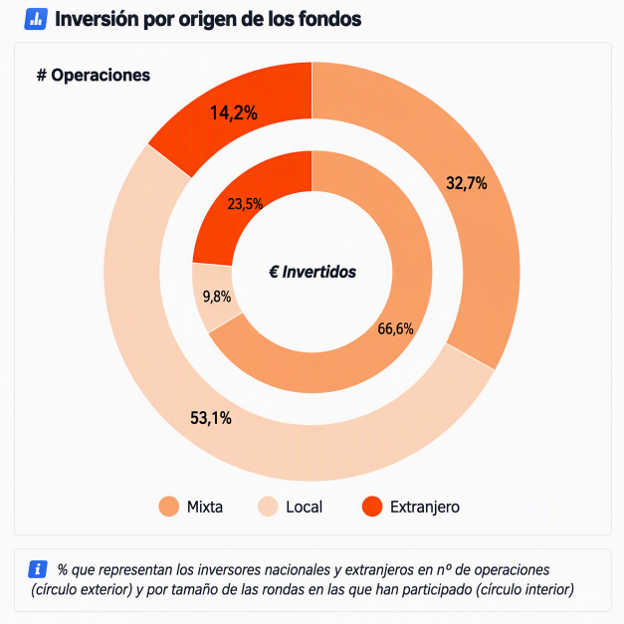
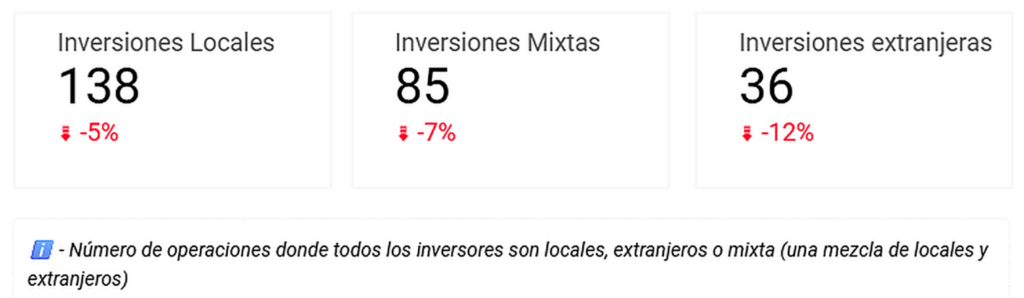
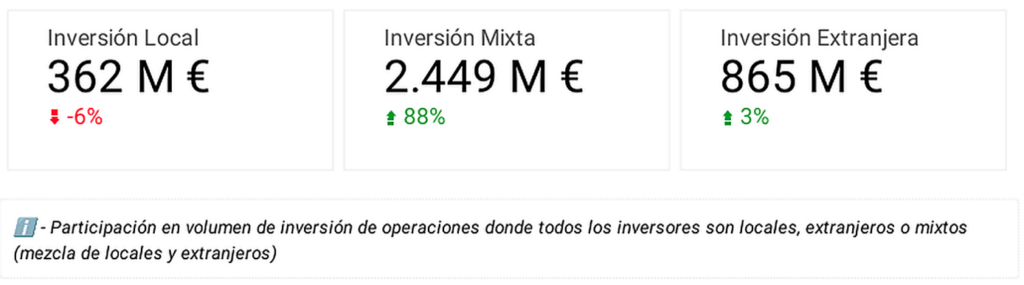
Mixed co-investment, which combines local and international capital, is once again the main protagonist in terms of volume. With 85 operations (–7%), it accounts for €2,449 million, two out of every three euros, and almost doubles its figure (+88%). Purely local investment offers the opposite portrait: it leads in activity with 138 operations, more than half of the total, but barely contributes €362 million (–6%), 10% of the capital. It is the money of the small ticket, and its flat tone explains much of the sluggishness of the base market.

Purely foreign investment deserves its own reading. It closes 12% fewer operations (36) but maintains its capital (€865 million, +3%). International funds that enter alone are more selective and bet more heavily on each company. Overall, 121 operations, 47% of those of known origin, have a foreign investor.

International investors, alone or in co-investment, are present in almost half of the operations. Local money builds the base of the ecosystem; international money is almost a necessary condition to close large rounds. The trade-off is obvious: the size of the good years depends to a large extent on investment decisions made outside Spain.

Most active investors


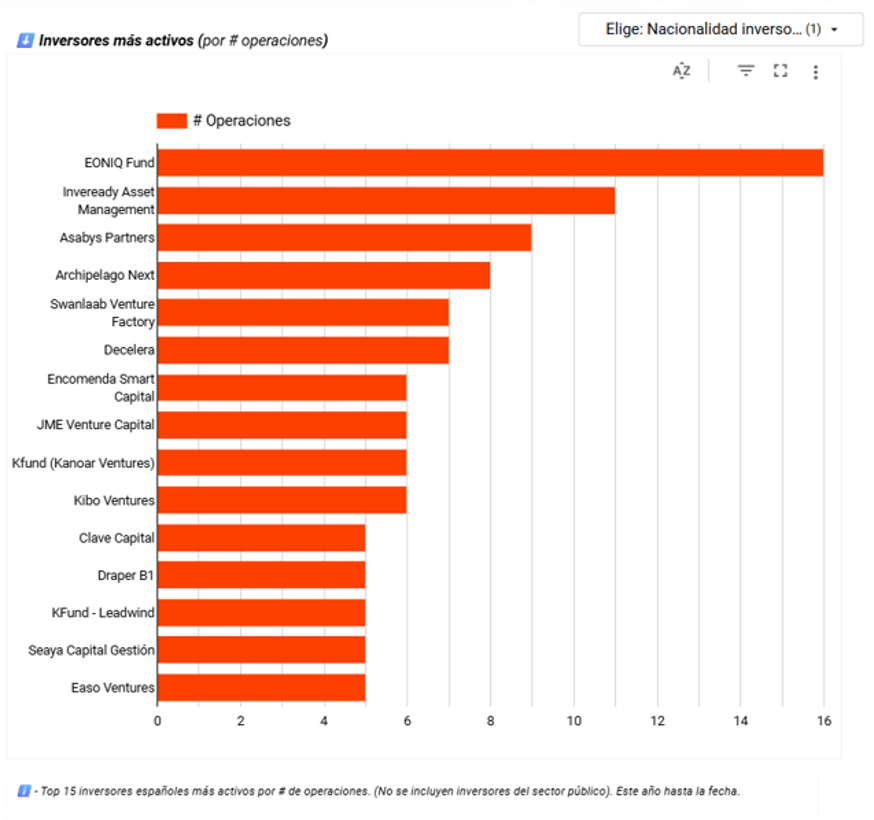
National (by number of operations, excluding the public sector). EONIQ Fund stands out as the most active investor of the year, with 16 operations, after adding eleven in the third quarter. It is followed by Inveready Asset Management (11), Asabys Partners (9) and Archipelago Next (8). This is followed by Swanlaab Venture Factory and Decelera (7 each), and a group with 6: Encomenda Smart Capital, JME Venture Capital, Kfund (Kanoar Ventures) and Kibo Ventures. The Top 15 closes, with 5 operations, by Clave Capital, Draper B1, KFund – Leadwind, Seaya Capital Gestión and Easo Ventures.

The pattern is clear. The most active are early-stage managers, with reduced tickets and large portfolios: they feed the Seed, which is the phase that grows. The emergence of EONIQ (Seville) and the presence of Archipelago Next (Las Palmas), Decelera (Menorca) or Easo Ventures (San Sebastián) confirm that seed capital is decentralised from the large capitals.


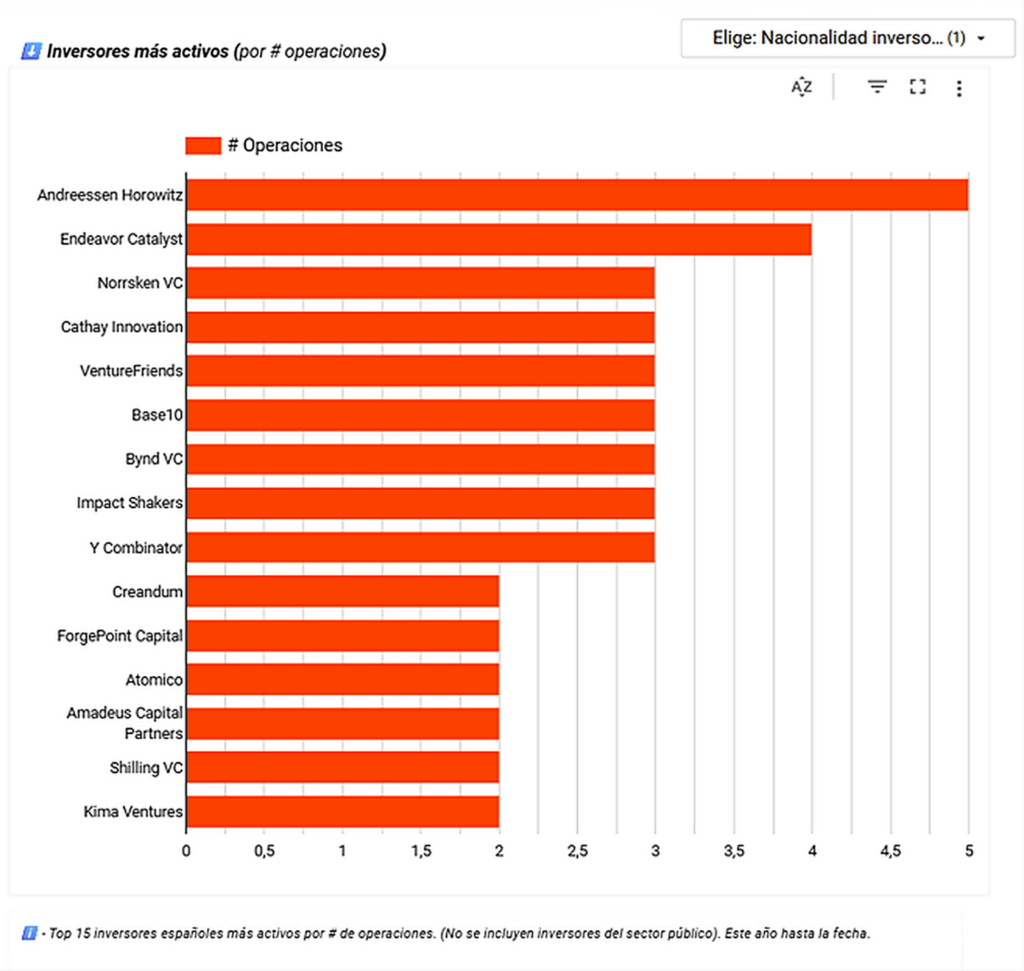
International (by number of operations). Andreessen Horowitz (a16z) repeats as the most active foreign investor, with 5 operations (4 in June. It is followed by Endeavor Catalyst, which goes from 1 to 4 operations in the quarter, and a large group with 3: Norrsken VC, Cathay Innovation, VentureFriends, Base10, Bynd VC, Impact Shakers and Y Combinator. Completing the Top 15, with 2 operations, are Creandum, ForgePoint Capital, Atomico, Amadeus Capital Partners, Shilling VC and Kima Ventures.

The international pattern is the opposite of the national one. No foreign fund exceeds five operations, compared to the 16 of the local leader: international capital is large but fragmented, with many funds that enter on a one-off basis and few that act as a recurring anchor. There are big US names (a16z, Y Combinator, Base10), leading European managers (Atomico, Creandum, Norrsken, Cathay Innovation) and specialised funds. Endeavor Catalyst is the only one that clearly accelerates in the quarter, consistent with the boom in scaling rounds. With 121 operations with a foreign investor, international capital is present in almost half of the market, but its commitment per fund is limited. In the historical history, the United States (688 operations), the United Kingdom (346), France (170) and Germany (154) are the countries that invest the most in Spanish startups.


Sectors with the highest activity


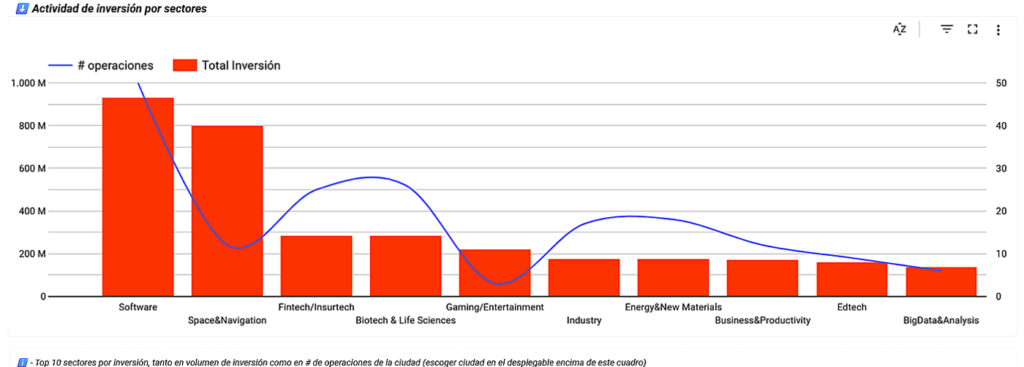
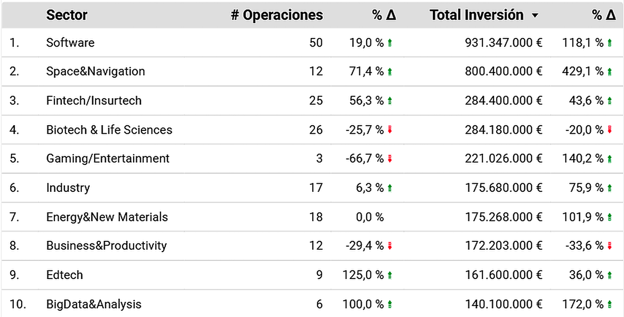
The aggregate podium is occupied by Software (€931 million), Space&Navigation (€800 million) and Fintech/Insurtech (€284 million), with Biotech practically tied. But a large part of this volume responds to singular operations. Space&Navigation, with only 12 operations, builds its figure on three rounds: Open Cosmos, PLD Space and EOS-X Space. In Gaming/Entertainment, Fever’s round is practically the entire sector, and the pattern is repeated in BigData (Xoople), Edtech (Preply) and Business&Productivity (Factorial).

Software is a mixed case. It leads in volume by three mega-rounds totalling €738 million, but it is also the sector with the most recurring activity: 50 operations (+19%). It is followed in number by Biotech (26), Fintech (25), Energy (18) and Industry (17). Biotech is the only large vertical to fall back in both metrics, a warning for a capital-intensive sector with long cycles.

Energy & New Materials is the vertical whose strength is most genuine: it doubled its volume (+102%), up to €175 million in 18 operations, without any round of €50 million or more. Fintech (+56% in operations), Edtech (+125%) and BigData (+100%) gained activity, while Business & Productivity and Gaming lost it. The spatial brilliance, on the other hand, responds to three unique companies and not to a generalized strength of the sector.

Geographical distribution of investment


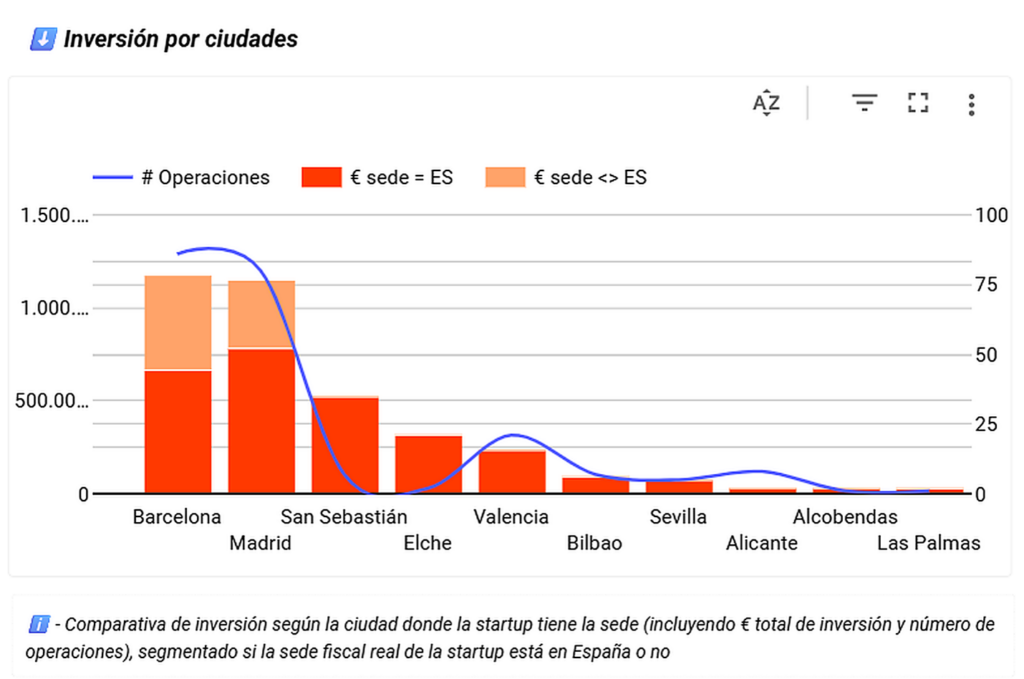
Barcelona and Madrid enter September in a technical tie. Barcelona has a technical tie. Barcelona has a total of €1,175 million (+14%) and Madrid, €1,153 million (+37%): a difference of just €22 million. The advantage that Madrid had in June has been diluted by the Open Cosmos round (€300 million), but Madrid is growing at more than twice the rate, driven in the quarter by Fever (€217 million) and HappyRobot (€130 million), which join Twinco, EOS-X Space, Xoople and Citibox. With such a narrow distance, the annual leadership between the two markets will be decided by a single operation.

The two capitals also differ in the profile of their investment. In Barcelona, more than 40% of the capital goes to startups with tax headquarters outside Spain; in Madrid, around a third. There are two possible readings: Barcelona is a more internationalised community, whose companies are structured abroad to access global capital, but also a place where a significant part of the value generated is domiciled abroad.

The most striking figure is another: the Rest of Spain captures around €1,500 million, more than double that of a year ago, and exceeds each of the two large capitals. It is driven by four mega-rounds totalling €958 million: Multiverse in San Sebastian (€500 million), PLD Space in Elche (€288 million), iPronics in Valencia (€108 million) and Universal DX in Seville (€62 million).

Beyond the major rounds, the map shows emerging hubs. San Sebastián, Elche, Valencia and Seville close large operations, and Seville, Las Palmas and Menorca are home to some of the most active managers in the country (EONIQ, Archipelago Next, Decelera). The reading is constructive, but prudent: the consolidation of these poles still depends on very few companies, and the leadership between markets can change with a single operation, as shown by the swing between Barcelona and Madrid in just one quarter.

Exits — Divestitures

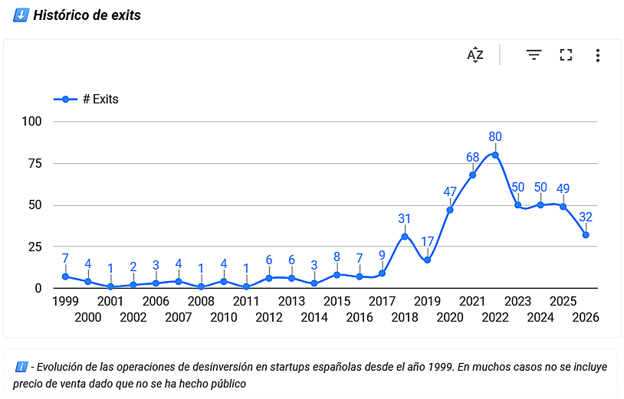
Divestments fell by 30% to 32 operations at the end of September: thirteen more than in June, compared to about 46 in the same period of 2025. The pace remains below the previous year’s record, which closed with 49 exits, and a far cry from the peak of 2022. The exit market does not accompany the euphoria of investment.

The sale of Marosa to Wolters Kluwer for €112 million is the first divestment of the year with a reported amount, after a semester of total opacity. Opacity is not new: in the historical record, 70% of Spanish exits never make their amount public.

The buyer’s profile confirms the structural pattern. Marosa joins a list of European industrial and strategic acquirers and US technology buyers. Historically, M&A accounts for 91% of exits and industrial or strategic buyers, 63%; IPOs continue to be the exception. The bottom line is mismatched: the ecosystem finances rounds of record size, but it has not yet generated exits at the same rate. This gap is the main maturity challenge, because without exits, capital is not recycled towards new rounds.

Source: data published in specialized media and the economic press, compiled by Fundación Innovación’s Startup Observatory

Note: this report has been generated with the support of artificial intelligence and reviewed by the Bankinter Innovation Foundation team.

Startup Observatory

Remember that you can consult all the data in the Observatory freely.

Startup Observatory

What do you need?

We're here to help

Do you have any questions?

Contact us and we will try to resolve it as soon as possible.

Contact us

Do you want to always be up to date?

Subscribe to our newsletter and don't miss any news

Subscribe

Do you have any questions?

In the press center you can find everything you need.

Press room
Secret Link