AI-generated summary
Synthetic biology enables the design of microorganisms to produce medicines, materials, and ingredients sustainably. Artificial intelligence (AI) is amplifying this potential by predicting how genes, proteins, and metabolic pathways will behave before laboratory work begins. Advances such as cheaper DNA sequencing and synthesis, CRISPR editing, automated labs, and vast biological datasets allow AI models to learn complex biological patterns, simulate thousands of design options in minutes, and prioritize the most promising candidates. This in silico approach reduces trial-and-error, shortens development times, lowers costs, and increases the likelihood of experimental success, while keeping laboratory validation essential.
AI-driven synthetic biology is already transforming medicine, industry, and environmental solutions. In healthcare, AI helps identify therapeutic targets, design drugs faster, and enable personalized treatments. In industry, it optimizes microorganisms for biomanufacturing—producing enzymes, bioplastics, and high-value compounds more efficiently. For the environment, AI aids the design of organisms that degrade pollutants, capture carbon, or convert waste into valuable products. Notable examples include protein-structure prediction models and AI-guided antibiotic discovery. By integrating Design–Build–Test–Learn cycles with machine learning and automation, this convergence creates a faster, more engineering-like innovation process that continuously improves as models absorb new experimental data.
Artificial intelligence is accelerating synthetic biology by predicting the behavior of genes and proteins before they reach the lab. Learn how this convergence is driving a new generation of innovations in health, industry, and sustainability.
Synthetic biology already makes it possible to design microorganisms capable of producing sustainable medicines, new materials or ingredients. Now, artificial intelligence is multiplying its potential. By predicting the behaviour of genes, proteins and metabolic pathways before they enter the laboratory, AI reduces trial and error, accelerates research and opens up new opportunities for innovation in health, industry and the environment.
Synthetic biology is experiencing one of the most exciting moments in its history. The possibility of designing organisms with specific functions is already transforming sectors such as medicine, food or industry.
However, the real change is not only that today we can program biological systems. The great revolution is that we begin to predict which designs will work before building them.
This leap is being made possible thanks to artificial intelligence.
If you want to understand in depth what synthetic biology is and why it has become one of the technologies with the greatest potential for transformation, you can read our article What is synthetic biology?, where we explain its fundamentals, applications and main challenges. You can also delve into the Synthetic Biology report of the Future Trends Forum of the Bankinter Innovation Foundation, which analyzes how this discipline will drive a new generation of innovations in health, industry and sustainability.
In this article, we will focus on a different question: what does artificial intelligence bring to synthetic biology that was previously impossible?
The answer is simple. AI turns a process based on thousands of experiments into a much more predictive, faster, and more efficient one.
Why are AI and synthetic biology needed now?
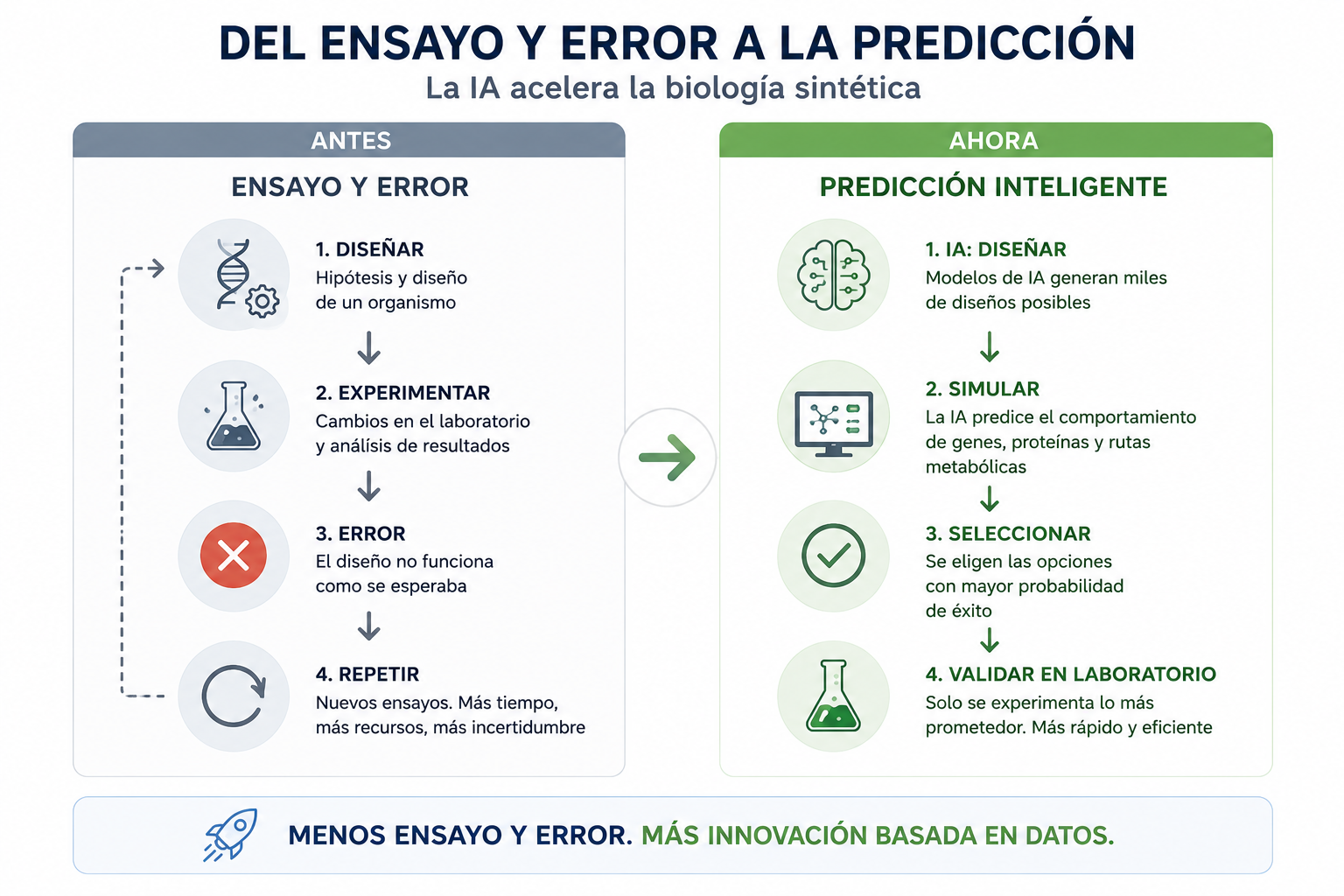
For decades, developing a new microorganism or protein with a certain function was a long process based on trial and error: researchers formulated a hypothesis, modified the DNA, conducted experiments, analyzed the results, and started over if the design didn’t work.
That method is still essential. The difference is that artificial intelligence can now anticipate which options are most likely to succeed before they reach the lab. This convergence occurs because several technological advances coincide:
On the one hand, the cost of sequencing and synthesizing DNA has been reduced dramatically.
At the same time, tools such as CRISPR have simplified gene editing, and automated laboratories are capable of running thousands of experiments simultaneously.
Added to all this is a decisive factor: the enormous amount of biological data generated over the past few decades.
Artificial intelligence can analyze that volume of information, identify patterns invisible to researchers, and generate predictions that greatly speed up the design process.
Rather than replacing experimental work, AI helps decide what is worth experimenting with.
The role of AI in synthetic biology
The main contribution of artificial intelligence is to transform the way biological systems are designed.
Previously, many decisions depended on the experience accumulated by scientific teams and a long process of experimental validation. Today, AI models make it possible to simulate thousands of possibilities in a matter of minutes.
This allows you to select the alternatives with the highest probability of success before investing time and resources in the laboratory.
The consequence is faster, more accurate and more efficient research.
How does AI predict the behavior of genes and proteins?
Genes, proteins, and metabolic pathways form an extraordinarily complex network. Modifying a single gene can alter the functioning of many other cellular processes. Artificial intelligence helps to understand this complexity through models capable of learning from millions of biological data.
Instead of studying each interaction in isolation, these algorithms identify relationships, anticipate behaviors, and propose new combinations that researchers can later validate.
One of the most important advances has been the ability to predict the three-dimensional structure of proteins. Knowing this structure is essential because it determines how they interact with other molecules and what function they play within a cell.
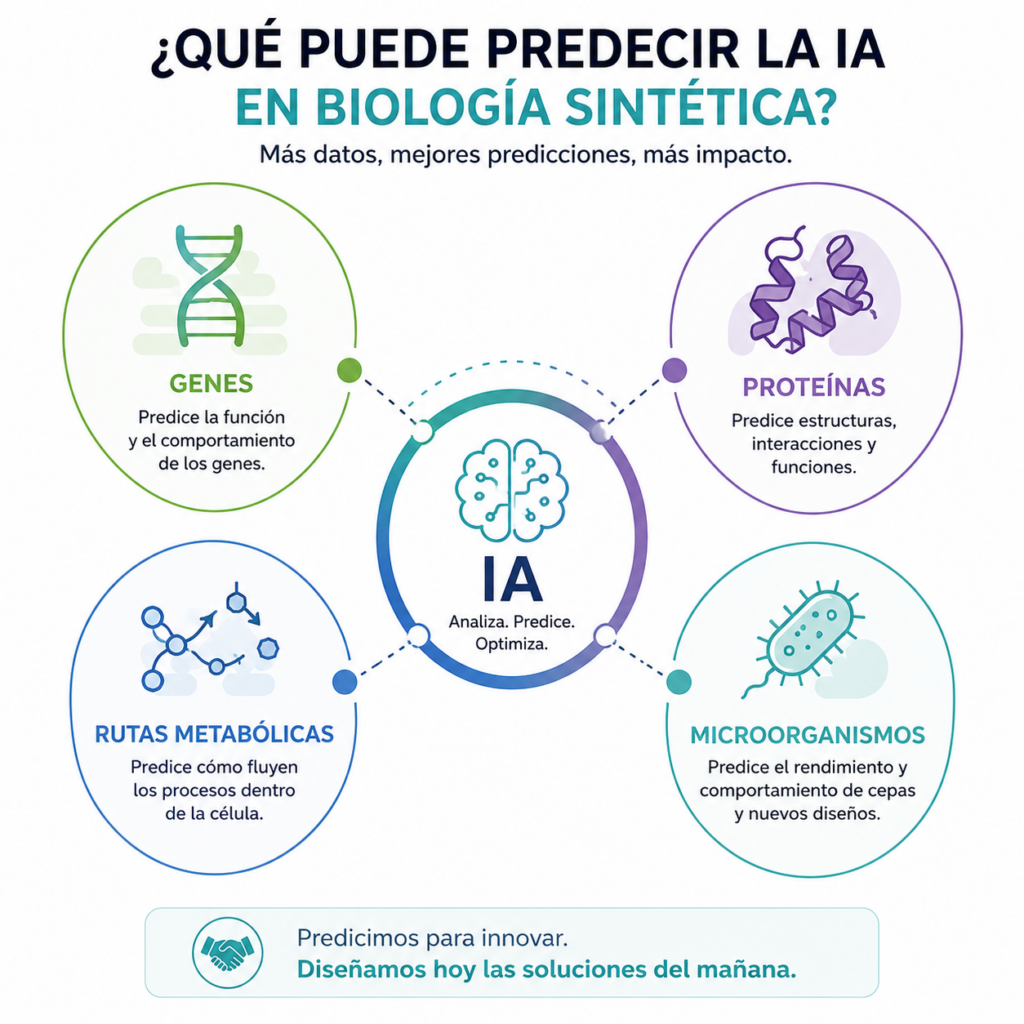
For decades, obtaining this information required years of experimental work. Today it can be achieved in much less time thanks to artificial intelligence models trained specifically for this type of problem.
Less trial and error: reduce experimentation time
Biological research will always need experimental validation. The difference is that many experiments can now be discarded before they even begin. AI acts as a smart filter: it analyzes thousands of possibilities, identifies the most promising ones, and reduces the number of trials needed to reach a result.
This change has a direct impact on development time, the cost of research, and the ability to explore solutions that would have been unfeasible before.
It doesn’t eliminate the uncertainty inherent in living systems, but it allows it to be managed much better.
From in silico design to the laboratory
One of the expressions that are most used today in synthetic biology is in silico, which refers to all those experiments that are carried out using computational models before moving on to the laboratory.
Instead of immediately building a microorganism or modifying a protein, researchers first design multiple virtual scenarios.
Artificial intelligence evaluates which ones have the highest chance of success and only then does experimental work begin.
This approach accelerates one of the most important processes in synthetic biology: the Design-Build-Test-Learn cycle.
Each new iteration generates data that feeds back into the AI models, making the following predictions even more accurate. The result is an innovation process that continuously improves as it learns.
The combination of artificial intelligence, automation and biological experimentation is significantly reducing the time needed to develop new solutions and brings biology closer to an innovation model that is increasingly similar to that of engineering or software development.
Applications of artificial intelligence in synthetic biology
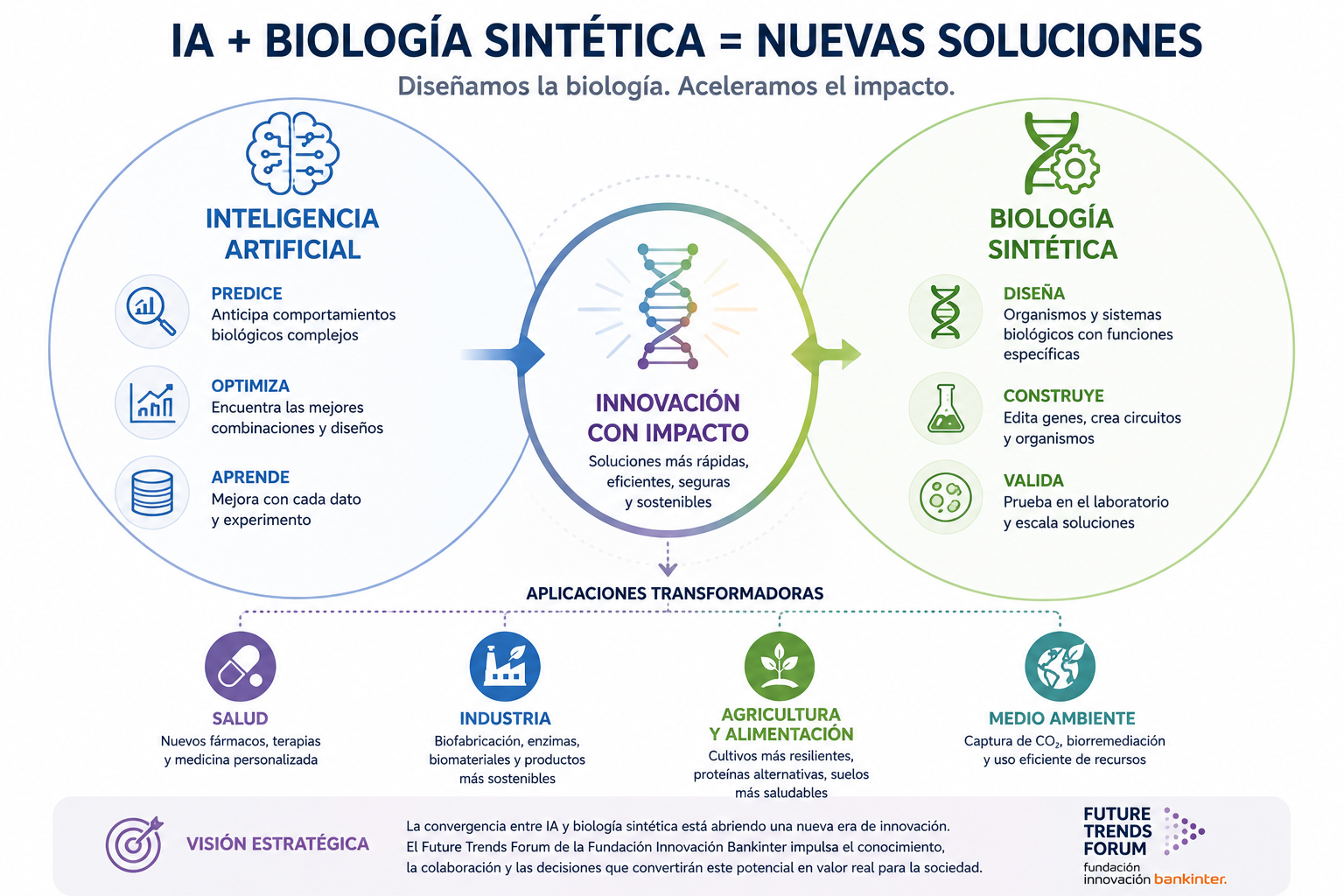
The combination of artificial intelligence and synthetic biology is already giving rise to a new generation of solutions with an impact on health, industry, and sustainability.
AI allows you to explore a virtually unlimited number of possibilities before conducting a single experiment. That ability accelerates innovation and reduces the time needed to turn an idea into a real application.
Medicine: designing new treatments faster
Developing a drug can require more than a decade of research.
Artificial intelligence helps reduce that time by identifying proteins of interest, proposing new therapeutic molecules, or predicting how certain biological systems will respond.
This allows experimental work to be focused on the options most likely to succeed.
Personalized medicine also benefits from this approach. The combination of genomic data, predictive models, and synthetic biology opens the door to treatments tailored to each patient’s characteristics.
Industry: microorganisms designed to manufacture new products
Biomanufacturing is one of the areas where this convergence can have the greatest impact.
Researchers use artificial intelligence to optimize microorganisms capable of producing enzymes, bioplastics, food ingredients, or high value-added chemical compounds.
Instead of modifying organisms through successive trials, AI models help identify which changes can improve process performance.
This accelerates industrial development and reduces resource consumption during the research phase.
Environment: more efficient and sustainable solutions
Synthetic biology also plays a growing role in the transition to a more sustainable economy.
Artificial intelligence facilitates the design of microorganisms capable of degrading pollutants, capturing carbon dioxide or transforming waste into new valuable products.
Its ability to simulate metabolic pathways allows for more efficient solutions to be developed and the number of experiments required before a process is validated.
The key benefits: faster, more accurate and less uncertainty
The contribution of artificial intelligence is not only about automating tasks. Its real value is in improving decision-making throughout the research process.
Among its main benefits are:
- Reduce the number of experiments needed.
- Shorten development times.
- Optimize the design of genes, proteins and microorganisms.
- Improve the efficiency of industrial processes.
- Reduce research costs.
- Increase the probability of success before reaching the laboratory.
Experimentation is still essential, but AI allows each experiment to bring much more knowledge.
Case Studies: When AI Is Already Accelerating Synthetic Biology
Just a few years ago, designing a protein or discovering a new therapeutic compound required analyzing an immense number of possibilities through experimentation.
Today, artificial intelligence is changing this paradigm.
One of the best-known advances has been the development of models capable of predicting the three-dimensional structure of proteins, a fundamental step in understanding their function and accelerating the design of new treatments.
But AI is also demonstrating its potential in other areas. One of the most prominent examples is the work of César de la Fuente, a researcher at the University of Pennsylvania and an expert at the Bankinter Innovation Foundation’s Future Trends Forum. His team uses artificial intelligence to search for new antibiotics in huge biological databases. Instead of analysing millions of sequences one by one using traditional methods, the algorithms identify those with the greatest antimicrobial potential and prioritise which ones need to be validated experimentally.
This approach makes it possible to discover antibiotic candidates in much less time and opens up new possibilities to address one of the greatest challenges in global health: antimicrobial resistance.
As César de la Fuente explains, artificial intelligence is not a substitute for scientific work. It multiplies the ability of researchers to formulate hypotheses and explore solutions that were previously unapproachable.
His research represents a good example of how the convergence between AI and synthetic biology is accelerating the discovery of new biomedical solutions.
Basic Glossary
| Term | Definition |
| Synthetic biology | A discipline that designs organisms and biological systems with specific functions. |
| Artificial intelligence A | set of technologies capable of learning from data and making predictions. |
| In silico | Simulation carried out using computational models before laboratory experimentation. |
| Metabolic pathway | A set of chemical reactions that take place in a cell to produce or transform molecules. |
| Biomanufacturing | Industrial production based on microorganisms or biological systems. |
| Design – Build – Test – Learn | Iterative cycle used in synthetic biology to design, build, test, and improve biological systems. |
Frequently Asked
QuestionsHow does artificial intelligence help synthetic biology?
AI makes it possible to model, simulate and predict the behaviour of genes, proteins and microorganisms before conducting experiments, accelerating the development of new solutions.
Can AI design living organisms?
AI does not create organisms on its own. It helps to identify the designs with the highest probability of success, which must then be validated experimentally.
What advantages does it bring compared to traditional methods? It
reduces trial and error, reduces costs, accelerates research and improves accuracy during the design of biological systems.
Which sectors benefit from this convergence?
Mainly health, industry, food and the environment, although its impact will extend to many other areas of the bioeconomy.
Why is it considered a strategic trend? Because it
combines two of the most transformative technologies of the moment. AI accelerates biological design and synthetic biology converts that knowledge into new products, processes and industrial models.