
AI-generated summary
Edge computing moves data processing closer to where data is generated—on devices, sensors, or nearby nodes—instead of sending everything to distant cloud data centers. This decentralization reduces latency, lowers bandwidth use, and lessens dependency on continuous connectivity. A typical edge architecture has three layers: the data-generating devices, local edge nodes that do immediate processing, and the central cloud for large-scale storage and heavy AI training. The hybrid cloud-edge model combines cloud power with local speed.
Several trends drive edge adoption: the explosive growth of IoT devices, the low-latency promise of 5G/6G, and advances in specialized chips that enable Edge AI. Real-world uses include autonomous vehicles and robots that must make millisecond decisions, smart cities and Industry 4.0 applications that process sensor data locally, and healthcare scenarios—wearables, remote monitoring, and on-device medical imaging—where speed and privacy are critical. Benefits include ultra-low latency, bandwidth savings, improved privacy and resilience, and potential energy and sustainability gains by reducing long-distance data transfer. Market forecasts show rapid growth in edge spending and a shift toward distributed intelligence. The future will be hybrid: cloud for scale and training, edge for immediate, localized intelligence that enables the next wave of connected, real-time applications.
Find out what edge computing is, how it differs from cloud computing, and why its combination with AI and 5G networks is transforming industries such as mobility, health, and smart cities.
What is Edge Computing?
Edge computing is a technology model that proposes processing data close to its source – devices, sensors or local infrastructure – rather than sending it directly to remote data centers or the cloud.
In the traditional cloud computing model, information generated by connected devices is transmitted to large data centers where it is stored, processed, and analyzed. This approach has allowed computing to scale globally, but it also introduces latencies, bandwidth consumption, and connectivity dependencies.
Edge computing modifies that architecture. Some of the processing is done on the device itself or at nearby intermediate nodes, allowing information to be analyzed locally and only relevant data sent to the cloud.
In simple terms, edge computing decentralizes computing.
How Edge Computing Works
Edge computing works on a distributed architecture made up of three main layers:
- Devices or sensors: They generate data continuously. They can be cameras, industrial robots, temperature sensors, vehicles, or medical devices.
- Edge computing nodes: These are small processing centers located near devices. They can be in factories, telecommunications base stations, or urban infrastructures.
- Central cloud: Used for mass storage, large-scale data analysis, and artificial intelligence model training.
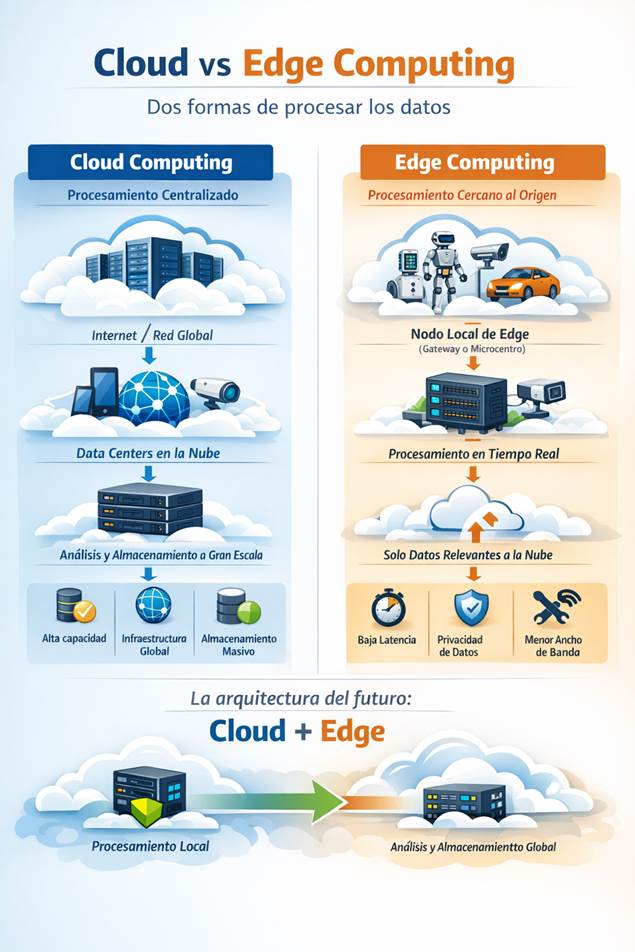
This hybrid model combines the best of both worlds: the power of the cloud and the speed of local processing.
Cloud Computing vs. Edge Computing: Key Differences
While edge computing is not a replacement for cloud computing, it does redefine the balance between the two models.
| Feature | Cloud Computing | Edge Computing |
| Processing Location | Centralized Data Centers | Close to Data Source |
| Higher | Latency Very Low | |
| Bandwidth Usage | High | Optimized |
| Connectivity dependency | High | Lower |
| Use cases | data analytics | Real-time decisions |
Cloud computing remains critical for large-scale storage, training AI models, or analyzing large volumes of historical data. However, when an application requires millisecond responses, processing at the edge becomes essential.
Source: Authors’ elaboration
For this reason, the future of digital infrastructure points towards hybrid cloud-edge architectures.
Why is it so important now?
Interest in edge computing does not arise by chance. Several technological trends are converging to drive this model.
1. Explosion of the Internet of Things
Billions of connected devices continuously generate data. Traffic cameras, industrial sensors, or home devices produce information that, in many cases, needs to be analyzed immediately.
Sending all that data to the cloud is costly and inefficient.
Edge computing allows information to be filtered and processed locally, reducing the load on networks and optimizing the flow of data.
2. The arrival of 5G and the future of 6G
New generations of mobile networks introduce much higher speeds and extremely low latencies. These networks are designed to work in tandem with edge computing infrastructures.
Telecom base stations are beginning to incorporate processing power at the edge, allowing applications to run close to the end user.
This opens the door to services such as:
- Real-time augmented reality.
- Connected vehicles.
- Streaming video games with low latency.
3. Edge AI: Artificial Intelligence at the Edge
One of the most relevant evolutions is the so-called Edge AI (or AIoT), which consists of running artificial intelligence models directly on local devices or nodes.
For years, AI depended on large cloud infrastructures. Today, advances in specialized chips allow cameras, robots, or sensors to run AI models locally.
This approach is especially relevant in applications where speed of response is critical or where data privacy is a key factor.
In the field of physical artificial intelligence – the so-called Embodied AI – intelligent systems interact with the real world through sensors and actuators. Robots, drones or autonomous vehicles must interpret their environment and make decisions in real time, something that requires processing capacity close to the device.
Edge computing thus becomes the infrastructure that enables this new generation of intelligent systems to operate efficiently. IDC estimates that more than 60% of organizations will leverage Edge Analytics by 2027.
Use cases and real examples of Edge Computing
Edge computing is already transforming multiple industrial sectors. Its ability to process data locally allows the development of applications that require immediate responses, greater efficiency in the use of networks and more secure information management.
Autonomous vehicles and robotics
Autonomous vehicles represent one of the clearest examples of the potential of edge computing.
An autonomous car generates large volumes of data from cameras, radars and sensors. The interpretation of this information must occur in milliseconds to detect pedestrians, interpret traffic signs or react to changes in the environment.
Sending all this data to the cloud for processing would be unfeasible due to latency and bandwidth consumption. For this reason, autonomous driving systems integrate powerful processing units into the vehicle itself, capable of analyzing the environment in real time.
The same principle applies to industrial robots, drones or autonomous machinery, which use sensors and artificial intelligence to interpret their environment and make immediate decisions.
Smart Cities and Industry 4.0
Smart cities use thousands of sensors to monitor traffic, energy consumption, air quality or waste management.
Edge computing allows this data to be processed directly in the urban infrastructure, reducing the volume of information sent to the cloud and allowing immediate responses.
Some examples include:
- Smart traffic lights that adapt traffic in real time.
- Video surveillance systems capable of detecting incidents automatically.
- Optimised energy management in connected buildings.
In industry, edge computing is integrated into smart factories within the Industry 4.0 paradigm. Sensors installed in machinery make it possible to detect anomalies, anticipate failures or adjust production processes automatically.
This approach enables so-called predictive maintenance, where systems identify problems before they cause interruptions in production.
Wearables and telemedicine
The healthcare sector is one of the areas where edge computing has the greatest potential for impact.
The digitalisation of healthcare has driven the use of connected devices capable of monitoring vital signs in real time. Smart watches, medical sensors or wearable devices generate biometric data continuously.
Edge computing makes it possible to analyse this information directly on the device or in nearby infrastructures, making it easier to detect anomalies immediately.
The most relevant applications include:
Continuous cardiac monitoring
Wearable devices can detect irregularities in the heart rhythm, such as arrhythmias, and generate alerts in real time. Local analysis of the data allows you to react quickly and reduces dependence on connectivity.
Remote monitoring of chronic patients
Patients with cardiovascular disease, diabetes, or respiratory diseases can be monitored from their homes using connected sensors. Edge computing systems analyze data locally and only send relevant information to hospital systems.
This approach reduces unnecessary hospitalizations and improves preventive care.
Early detection of medical emergencies
Connected devices can detect falls, sudden changes in vital signs, or risky situations in elderly people or vulnerable patients. When the system identifies an anomaly, it can send immediate alerts to family members or healthcare services.
Real-time medical image processing
Edge computing is also starting to be used in medical diagnostic equipment. Imaging systems such as portable ultrasound scanners or radiology devices can analyze images locally using artificial intelligence algorithms, facilitating faster diagnoses in hospitals or even remote environments.
Smart hospitals
In highly digitized hospitals, sensors and connected devices make it possible to monitor patients, medical equipment, and hospital resources. Local data processing helps optimize workflows, improve patient safety, and reduce response times in critical situations.
Real examples of Edge Computing in health
The use of edge computing in healthcare is already being driven by large technology companies and medical equipment manufacturers. These projects show how local data processing can improve the speed of diagnosis, patient monitoring and hospital efficiency.
Apple and health monitoring from wearables
Wearable devices have become one of the first massive applications of edge computing in health. The Apple Watch, for example, incorporates sensors capable of analyzing vital signs such as heart rate or oxygen saturation directly into the device.
Much of the processing of this data is done locally on the watch, which makes it possible to detect possible anomalies – such as arrhythmias – in real time and generate immediate alerts for the user or for connected medical applications.
This model demonstrates how edge computing can transfer part of the clinical analysis from the hospital to the patient himself, facilitating more preventive and personalized medicine.
NVIDIA and medical AI at the edge
NVIDIA is driving accelerated computing platforms designed to run AI models directly on medical devices.
Through solutions such as NVIDIA Clara, hospitals and equipment manufacturers can integrate AI capabilities into diagnostic imaging systems. This allows medical images – such as MRIs or CT scans – to be analyzed on the device itself or in local hospital infrastructures, reducing analysis times and improving diagnostic efficiency.
Edge computing is especially relevant in this context, as it allows large volumes of medical data to be processed without the need to continuously send it to the cloud.
Philips and connected hospitals
Philips, one of the world’s largest healthcare technology manufacturers, is developing smart hospital solutions based on edge computing.
Its patient monitoring platforms integrate sensors, medical devices, and analytics systems that process information into local infrastructures within the hospital. This allows changes in patient status to be detected immediately and critical care management to be optimized.
In addition, local processing improves the security and privacy of clinical data, a key aspect in hospital environments.
Key benefits: latency, security, bandwidth, and sustainability
Edge computing brings clear benefits compared to fully centralized architectures.
1. Ultra-low latency
The main advantage is the reduction in latency.
By processing data close to its source, systems can react in milliseconds, which is essential in applications such as autonomous vehicles, industrial robots or medical systems.
2. Bandwidth optimization
Edge computing allows data to be processed and filtered locally. Only relevant information is sent to the cloud.
This significantly reduces network traffic and optimizes bandwidth usage.
3. Increased privacy and security
Processing data at the edge reduces the need to transfer sensitive information to remote infrastructures.
This approach is especially relevant in sectors such as healthcare, industry, or critical infrastructure.
4. Resilience and autonomy
Applications that rely exclusively on the cloud require always-on connectivity.
Edge computing allows systems to continue operating even with limited connectivity, which is essential in industrial, rural, or mobile environments.
5. Sustainability and energy efficiency
An angle of increasing competitive importance is the contribution of edge computing to energy sustainability. The hybrid cloud-edge model offers a pathway to a more efficient digital infrastructure. By filtering, processing, and compressing data locally at the edge, the volume of information that needs to be transmitted over the global network is drastically reduced.
This “thinning” of data traffic optimizes bandwidth, significantly reducing the energy consumed in transporting data over long distances and reducing the processing load in large, centralized data centers. The latter, while efficient on a large scale, consume massive amounts of energy for compute and cooling. Distributing processing and optimizing what data reaches the central cloud contributes to a more balanced and manageable digital carbon footprint.
An expanding market: figures that support the change
Edge computing has cemented its position as a critical technology for the next decade. Recent market data reflects accelerated adoption globally. According to IDC estimates (March 2025), global spending on edge computing will reach nearly $261 billion by 2025, and is projected to grow steadily by 13.8% annually to reach $380 billion by 2028.
This investment responds to a structural need in information management. For its part, Gartner projects that by 2025, 75% of the data generated by companies will be processed at the edge, marking a historic and definitive transition from “centralized intelligence” to “distributed intelligence”.
The future: a hybrid cloud-edge architecture
Edge computing will not replace cloud computing. Both models are part of a complementary architecture.
The cloud will continue to be essential for:
- data storage.
- training of artificial intelligence models.
- global analysis of information.
The edge, on the other hand, will be responsible for processing data in real time.
This hybrid model will become the basis of digital infrastructure for the next decade. The convergence between AI, edge computing and 5G/6G networks will make it possible to deploy intelligent systems capable of interacting with the physical world with unprecedented speed and efficiency.
From autonomous factories to smart cities to connected medical devices, edge computing is emerging as one of the technological pillars that will enable the next generation of digital innovation.