
AI-generated summary
Proteins are the molecular machines that make life possible—acting as enzymes, antibodies, hormones and structural elements. For billions of years evolution alone produced them, but advances in computational protein design and artificial intelligence now let scientists design or rework proteins with specific functions before making them in the lab. By predicting how an amino acid sequence will fold and interact, computational tools speed discovery, enabling creation of therapeutic proteins, industrial enzymes that cut energy use, and new sustainable biomaterials inspired by nature. AI accelerates and refines this process by learning patterns from millions of known proteins, generating and prioritizing candidate designs for experimental validation.
The approach shifts innovation from searching nature for useful proteins to designing them intentionally: define a desired function, generate and evaluate designs computationally, then synthesize and test the best candidates. Applications range from personalized medicines and antimicrobial peptides to more efficient biomanufacturing and novel high-performance materials, and the technology also helps reveal how misfolding causes diseases like Alzheimer’s. Challenges remain—cells are complex, and predictions require experimental confirmation and rigorous safety testing—but as models, automation and data improve, computational protein design promises transformative gains across medicine, industry and the bioeconomy.
Computational protein design combines artificial intelligence, synthetic biology, and advanced simulations to create new proteins with applications in medicine, industry, and sustainability. Learn how this technology is transforming biotechnology innovation.
Proteins are the molecules that make life possible. They act as enzymes, antibodies, hormones or structures that allow our cells to function. For billions of years, evolution has been the only one capable of designing them. Today, thanks to the computational design of proteins and artificial intelligence, scientists are beginning to create proteins with completely new functions to develop medicines, optimize industrial processes or manufacture sustainable materials.
If the Industrial Revolution made it possible to design machines and the digital revolution made it possible to program software, the next great technological transformation could be to design the molecules with which life works.
That is precisely the promise of computational protein design.
Until very recently, discovering a useful protein depended almost exclusively on nature. Researchers analyzed organisms, studied how their proteins worked, and tried to adapt them to new applications through a long process of experimentation.
Today the approach is starting to be different: instead of looking for a suitable protein, scientists can first design it on a computer, predict how it will behave, and only then produce and validate it in the laboratory.
This change represents one of the most important advances in synthetic biology. If you want to know how this discipline is transforming innovation, you can consult our article What is synthetic biology?, where we explain its foundations and applications, as well as the Synthetic Biology report of the Future Trends Forum of the Bankinter Innovation Foundation, which analyzes the impact of this technology on health, industry and the bioeconomy.
Computational protein design is one of the tools that is making this transformation possible.
What is computational protein design?
Computational protein design is a discipline that combines molecular biology, biochemistry, computer science, and artificial intelligence to design or modify proteins with specific functions before producing them in the laboratory.
To do this, it uses mathematical models and algorithms capable of predicting how a protein will fold from its amino acid sequence and how it will interact with other molecules.
Thanks to these tools, researchers can improve existing proteins or create completely new ones, adapted to specific needs.
The result is a much faster innovation process than one based solely on trial and error.
Proteins: the tools with which life works
To understand the importance of this technology, it is worth taking a moment to look at the protagonists of the story: proteins are present in practically all biological processes. Some accelerate chemical reactions that are essential to keep us alive. These are enzymes. Others act as chemical messengers, transport oxygen, detect microorganisms or allow our immune system to recognise viruses and bacteria. Even structures such as hair, skin or muscles depend on specialised proteins.
We can imagine a cell as a big factory. DNA would be the instruction book and proteins would be the machines that do the work. If we can design new machines, we can also develop new biological functions.
Therein lies the enormous potential of computational protein design.
From the genetic code to a three-dimensional structure
Designing a protein is much more complex than modifying a simple DNA sequence.
Each protein is made up of a chain of amino acids. However, its function depends mainly on the three-dimensional shape that this chain takes when folded.
That process, known as protein folding, determines whether a protein will be able to bind to a virus, accelerate a chemical reaction, or recognize a tumor cell.
For decades, predicting this structure was one of the greatest challenges in biology. Solving it required years of experimentation using very sophisticated techniques.
Today the situation has changed thanks to the development of increasingly accurate computational models. Artificial intelligence has demonstrated an extraordinary ability to learn the rules that govern this folding and anticipate what the final structure of a protein will be like based on its sequence.
This breakthrough has greatly reduced the time needed to design new molecules and opened up possibilities that just a few years ago seemed unattainable.
How does computational protein design work?
Although there is enormous scientific complexity behind it, the process can be understood by following four stages.
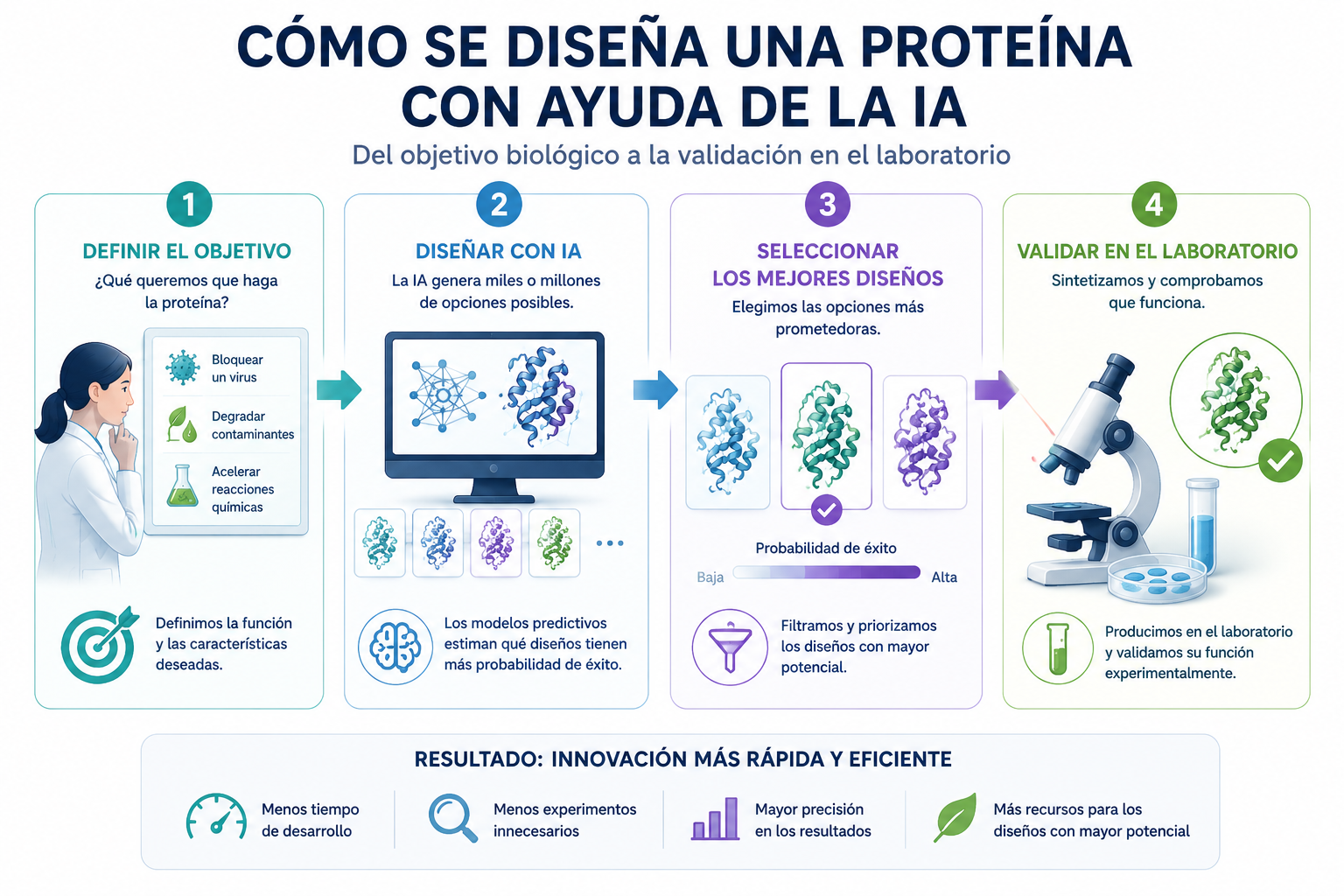
First, researchers define the function they want to achieve. It can be a protein that can recognize a virus, degrade a pollutant, or speed up a particular chemical reaction.
Then, computational models generate different possible designs and predict which one is most likely to work. Artificial intelligence analyzes thousands or even millions of combinations that would be impossible to evaluate manually.
The most promising options are then selected. Only then does experimental work begin: the proteins are synthesized in the laboratory and it is checked whether they actually behave as the models had anticipated.
This approach allows resources to be concentrated on the designs with the greatest potential and to significantly reduce the number of experiments required.
Artificial intelligence is a game-changer
Computational protein design existed before artificial intelligence. What has changed in recent years is the ability to make much faster and more accurate predictions.
Instead of calculating all the possibilities using traditional simulations, AI models learn from millions of known proteins and identify patterns that help anticipate what the most likely structures will be.
This greatly speeds up the design process.
But AI does much more than predict folding. It also helps optimize existing proteins, identify mutations that improve their stability, design new enzymes, or propose molecules that have never existed in nature.
In other words, artificial intelligence makes it possible to go from discovering proteins to starting to design them.
It’s the same paradigm shift we discussed in our article on how artificial intelligence is accelerating synthetic biology. AI is not a substitute for experimentation, but it helps formulate better hypotheses, explore many more possibilities, and reduce the time needed to turn an idea into a real application.
Applications of Computational Protein Design
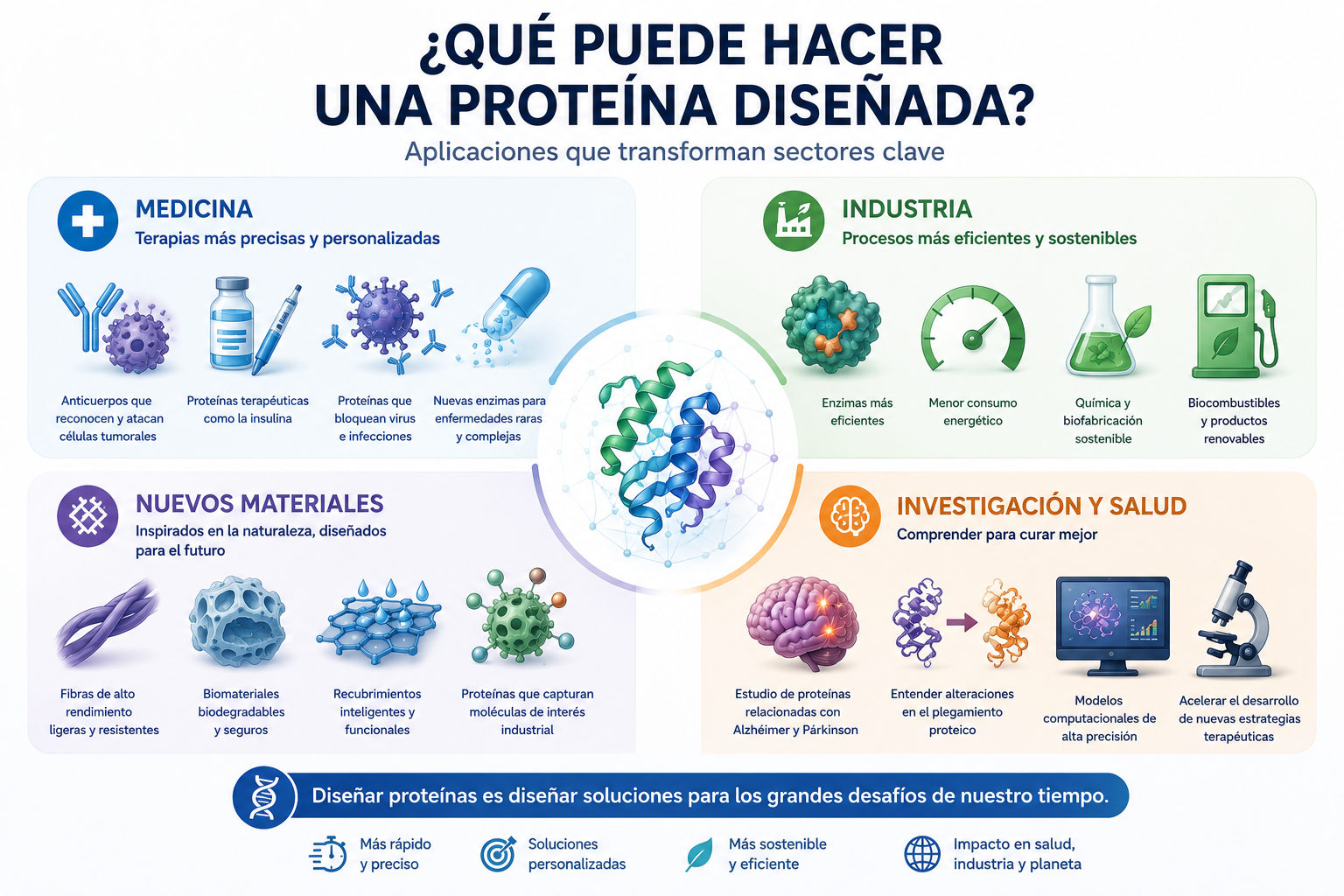
The ability to design proteins with specific functions is transforming some of the sectors with the greatest potential for innovation. From the development of new drugs to the creation of sustainable materials, computational design is expanding the repertoire of solutions that biology can offer.
Medicine: Proteins Designed to Fight Disease
Health is one of the areas where this technology can have the greatest impact.
Many current therapies already use proteins. Monoclonal antibodies used against certain types of cancer, insulin to treat diabetes or some biological therapies are just a few examples.
Computational design allows us to go one step further: instead of simply using existing proteins, researchers can modify them to more accurately recognize a tumor cell, increase its stability within the body, or improve its ability to block a virus.
It also facilitates the development of new therapeutic enzymes and proteins capable of acting on rare diseases or pathologies for which there are still no effective treatments.
Each advance brings closer the possibility of designing increasingly personalized therapies.
Industry: enzymes that make processes more efficient
Proteins also play an essential role in the industry.
Many factories use enzymes to produce food, detergents, chemicals, biofuels, or pharmaceutical ingredients. Designing more efficient enzymes can reduce working temperatures, reduce energy consumption, and make better use of raw materials.
In many cases, a small modification to the structure of a protein is enough to significantly increase the throughput of an entire industrial process. For this reason, computational design is becoming a key tool for biomanufacturing and sustainable chemistry.
New materials inspired by nature
Nature has been developing extraordinary materials for millions of years:
- Spider silk combines lightness and strength.
- Seashells withstand enormous mechanical stresses.
- Some organisms produce adhesives capable of working underwater.
Computational protein design allows us to take inspiration from these solutions and create completely new materials.
Research is being carried out on high-performance fibres, biodegradable biomaterials, smart coatings and proteins capable of capturing certain molecules of industrial interest.
Many of these applications are still under development, but they illustrate the extent to which biology can become a platform for innovation for very different sectors.
Better understanding of diseases
Not all applications consist of creating new proteins. In many cases, understanding how the structure of a protein changes allows us to better understand the origin of certain diseases.
Neurodegenerative pathologies such as Alzheimer’s or Parkinson’s are related to alterations in the folding of certain proteins. Computational models help to study these processes with a level of detail that was unthinkable a few years ago and can accelerate the development of future therapeutic strategies.
Real cases: when engineered proteins are already changing research
Computational protein design is no longer a promise for the future but a common tool in many laboratories.
One of the best-known advances has been the use of artificial intelligence to predict the three-dimensional structure of proteins with unprecedented speed and precision. This type of model has accelerated research in molecular biology, pharmacology and medicine, by allowing us to better understand how thousands of proteins whose structure was unknown work.
But the potential of this discipline goes far beyond predicting structures.
A particularly relevant example is the work of César de la Fuente, Presidential Assistant Professor at the University of Pennsylvania and expert at the Future Trends Forum of the Bankinter Innovation Foundation.
His team uses artificial intelligence to identify and engineer new antimicrobial peptides, small proteins capable of fighting antibiotic-resistant bacteria.
Instead of analyzing millions of biological sequences one by one, algorithms identify which ones are most likely to be turned into new treatments. Those molecules are then synthesized and validated experimentally.
This approach dramatically reduces the time needed to discover new candidates and represents an example of how artificial intelligence and computational design can accelerate biomedical innovation.
The challenges: biology remains extraordinarily complex
Despite advances, designing proteins remains one of the greatest scientific challenges since a protein does not act in isolation. It interacts with thousands of different molecules, changes behavior according to the cellular environment, and responds to very diverse physical and chemical conditions. For this reason, no computational prediction can replace experimental validation.
In addition, medical applications must go through lengthy evaluation processes to ensure their safety and efficacy. Artificial intelligence reduces uncertainty, but it still does not eliminate the complexity inherent in living systems.
The future: learning to design life’s tools
For much of the 20th century, biology focused on understanding how living things work. The great achievement of the 21st century may be learning to design some of its fundamental pieces.
The combination of artificial intelligence, synthetic biology, and laboratory automation is accelerating a paradigm shift.
Each new protein designed generates data that improves computational models and each experiment makes the following predictions more accurate. This creates a virtuous circle of learning that multiplies the capacity for innovation.
As the Future Trends Forum’s Synthetic Biology report points out, this technological convergence can drive a new generation of sustainable medicines, biomaterials, industrial processes and solutions.
For millions of years, evolution was the only one capable of designing proteins. Today we are beginning to develop that capacity. We are still taking the first steps, but its implications for medicine, industry and the bioeconomy will be difficult to exaggerate.
Basic Glossary
| Term | Definition |
| A | protein molecule made up of amino acids that performs essential functions in all living things. |
| Protein folding | The process by which a protein acquires its three-dimensional structure and, with it, its biological function. |
| Computational protein design | The use of mathematical models and artificial intelligence to design or modify proteins before they are produced in the laboratory. |
| De novodesign | The creation of completely new proteins, without starting from proteins existing in nature. |
| Enzyme | A protein that accelerates chemical reactions within an organism or an industrial process. |
| Antimicrobial peptide A | small protein capable of eliminating or inhibiting the growth of microorganisms. |
Frequently asked questions
What is computational protein design?
It is a discipline that uses computational models and artificial intelligence to design or modify proteins with specific functions before validating them experimentally.
How does artificial intelligence help?
AI makes it possible to predict how a protein will fold, identify modifications that improve its functioning, and select the designs with the highest probability of success.
What applications does it have?
It is used in medicine to develop new therapies, in industry to optimize enzymes, in biomedical research to understand diseases, and in the development of innovative biomaterials.
Can a protein be created that has never existed?
Yes. The so-called de novo design allows completely new proteins to be developed to perform specific functions.
Does the computer replace the laboratory?
No. Computational models speed up design and reduce the number of experiments, but all proteins must be synthesized and subsequently validated under real-world conditions.