
AI-generated summary
Artificial intelligence faces a hardware bottleneck: increasing compute drives rising energy use and heat, which are hard to manage—especially in small, mobile devices at the edge. Ivan Schuller, a physics professor at UC San Diego, leads Q‑MEEN‑C to explore quantum and complex materials that could perform computing functions through their intrinsic physics. Rather than assembling hundreds of transistors to mimic a neuron, these materials—such as vanadium dioxide—can change properties abruptly with temperature or voltage, enabling memory, spiking behavior, and synapse-like dynamics directly within the material. Structuring materials into nanostructures, heterostructures, and superlattices can produce emergent behaviours not present in the parts, opening routes to compact, low‑energy neuromorphic elements.
Schuller’s team has built small experimental networks that show lower energy use and reduced area compared with equivalent CMOS circuits, pointing to promising edge applications—sensors, drones, glasses, and robots that need local, real‑time processing with limited power and cooling. He urges careful benchmarking and interdisciplinary work across physics, materials science, engineering, and neuroscience. The future of AI hardware may shift from adding raw compute toward designing materials whose physics do part of the computation, changing how machines are built and cooled.
Iván Schuller is researching how to take advantage of the physical properties of new materials to build more efficient neuromorphic hardware. A way to reduce energy and heat and bring artificial intelligence closer to the edge.
Artificial intelligence has a problem that starts long before algorithms. It’s in the hardware. The
more computing power grows, the more energy we need and the more heat we generate, both on a global scale and within each device. That heat needs to be managed. And cooling introduces another critical variable: water.
The challenge increases when we want to take AI out of the data center and into robots, sensors, vehicles, medical devices, or autonomous systems that need to process information locally and in real time.
Ivan Schuller has been looking at this problem from a different place for years: materials.
A professor of physics at the University of California, San Diego, Schuller directs Q-MEEN-C, Quantum Materials for Energy Efficient Neuromorphic Computing, a research center exploring how the properties of quantum materials can drive energy-efficient neuromorphic computing.
In a recent conversation with Marce Cancho, director of the Future Trends Forum of the Bankinter Innovation Foundation, she puts forward an idea capable of changing the way we think about the future of AI: perhaps the next big leap in hardware will come when we stop asking hundreds of components to reproduce a function that a material could perform through its own physics.
What is neuromorphic computing and why does it matter
? Neuromorphic computing seeks to build computer systems inspired by some principles of brain functioning.
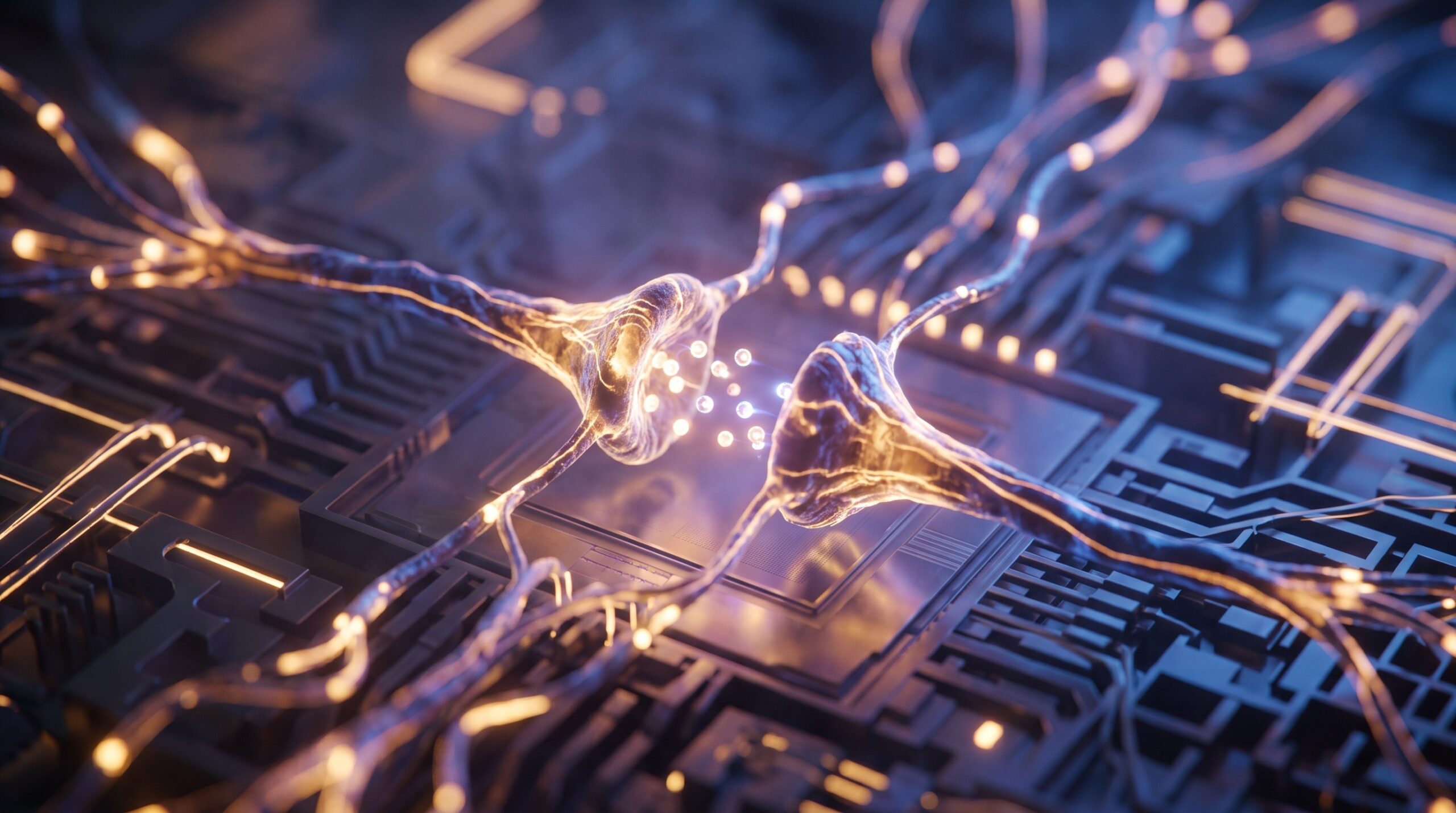
It uses elements that reproduce functions of neurons and synapses and can process information through events or impulses, known as spikes. This approach makes it possible to bring memory and processing closer together, reduce the movement of data and activate certain operations when something relevant actually happens.
The idea of neural networks has also gained extraordinary scientific recognition. The 2024 Nobel Prize in Physics was awarded to John J. HopfieldandGeoffrey Hinton for fundamental discoveries and inventions that made machine learning possible using artificial neural networks.
The award is about the development of neural networks and machine learning, not specifically neuromorphic hardware. But it reflects the extent to which architectures inspired by neural systems have become one of the great ideas of contemporary computing.
At the Foundation we have already analysed in depth what neuromorphic computing is, how it works and what its main applications are. Schuller’s research takes the question a step further: what happens if we also change the materials with which we build that hardware?
His starting point is very specific: “The problem of today’s computing is energy consumption.” And he distinguishes two scales: the first is global. It includes data centers, electrical infrastructures and all the energy necessary to sustain an increasingly compute-intensive economy. The second appears within the device itself. Each operation generates heat and that heat is concentrated in smaller and smaller spaces. That’s where the physical limits begin.
Hundreds of transistors to imitate a neuron
Neuromorphic computing can now be developed with conventional semiconductor technology.
IBM opened an important line of research with TrueNorth and later developed NorthPole, a processor inspired by some principles of brain computing that brings memory and calculation closer together. Intel develops Loihi 2, a research processor specifically designed for spike neural networks.
At the Foundation, we have already explored these avenues within the analysis of quantum and neuromorphic computing in the new frontier of semiconductors.
For Schuller, the problem arises when scaling. As he explains, implementing certain neurons and artificial synapses using conventional electronics can require hundreds of transistors. When we multiply these units to build larger networks, the components, consumption, heat, and surface area needed inside the chip increase.
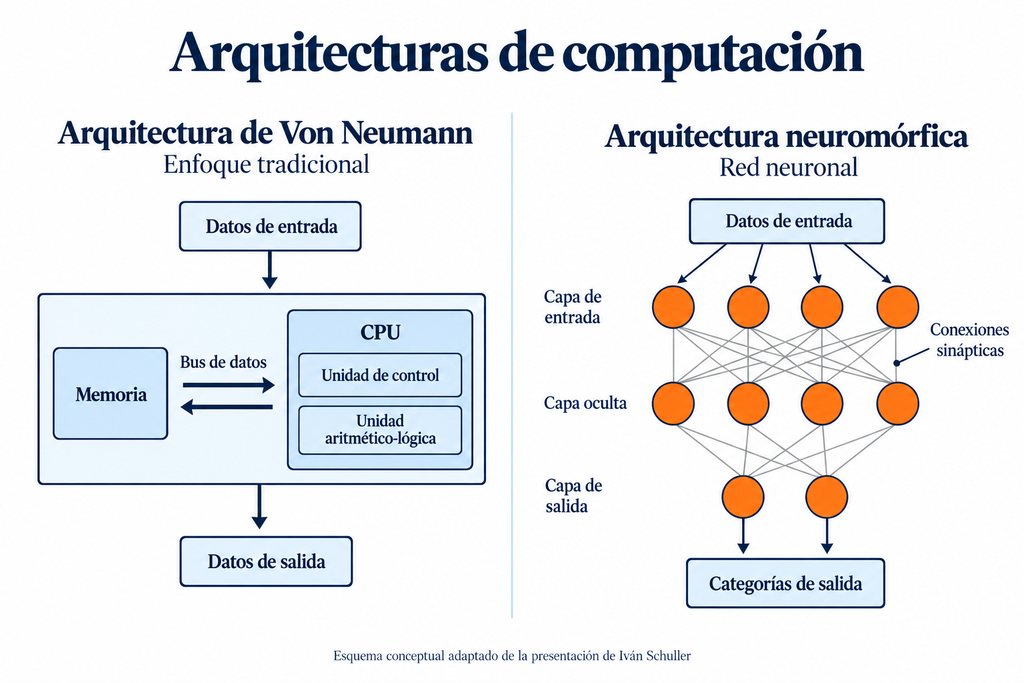
Source: Authors’ elaboration based on material provided by Iván Schuller
Generating more electricity can help power a gigantic infrastructure. Solving consumption inside a tiny device requires another strategy.
Schuller sums it up during the interview with a particularly graphic image: we can build more power plants, but “you can’t put a nuclear reactor in your pocket”.
And therein lies one of the great challenges of AI at the edge. A sensor, a drone, smart glasses or an autonomous robot have little space, a limited amount of energy and little capacity to evacuate heat. To bring more intelligence to these devices we need much more efficient hardware.
Computing of the 21st century, cooling of the 19th
Schuller points out a technological paradox with a lot of humor: we have developed an extraordinary semiconductor technology, the result of decades of investment, miniaturization and scientific advances. However, much of thermal management continues to rely on a principle that we have known since the nineteenth century: moving air to evacuate heat.
The contrast is striking. Twenty-first century computing accompanied, in many cases, by cooling technologies whose basic principle is more than a century old. And the problem is growing.
The heat generated by computing must be extracted from chips and data centers. This requires cooling systems and directly connects the expansion of AI with another critical resource: water.
The Foundation has already analysed this relationship in the Future Trends Forum report Water: our vital resource in check, which studies the link between water and energy and devotes specific attention to data centres.
Reducing computational consumption can thus produce a double benefit: less energy used and less heat to manage.
Schuller also proposes to broaden the question. Perhaps the future lies in something more ambitious than better evacuating heat. Can we take advantage of it?
Recycling part of this thermal energy or designing new devices that actively use heat flows would open up another line of innovation. Thermal management would cease to act only at the end of the process and would become a variable in the hardware design itself.
What if the material itself is part of the calculation?
This is where materials science comes in. Schuller works with so-called quantum materials. He himself warns that the term can be confusing because, strictly speaking, all matter responds to quantum mechanics.
In his research, he is particularly interested in one type of behavior: materials capable of responding drastically to small changes in temperature, voltage or other variables.
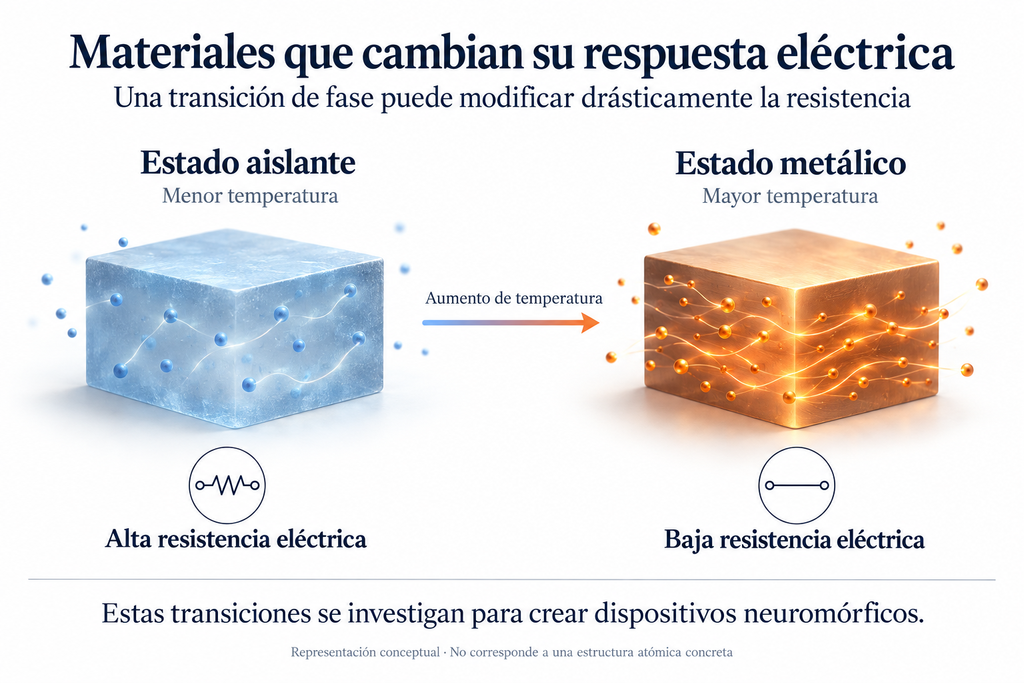
Conceptual representation of an insulating-metal transition, one of the behaviors investigated to develop neuromorphic devices. Authors’ elaboration based on the presentation by Iván Schuller.
An example is vanadium dioxide, VO₂, which Schuller has been researching for years.
In conventional materials, many properties evolve relatively gradually when we modify the conditions. In certain quantum materials, something much more abrupt happens. In VO₂, for example, the electrical resistance can change by many orders of magnitude.
This answer opens up a fascinating possibility: to directly harness this physical behavior to build devices capable of performing functions associated with neuromorphic processing.
The logic is simple to propose and very difficult to execute: instead of using a long combination of components to produce a certain response, we can try to find a material whose own physics generate that behavior. The material participates in the calculation.
Emergent properties: when combining materials creates something unexpected
Schuller’s research introduces another particularly interesting idea: emergent properties.
A material can behave in a certain way when we study it in isolation. The situation can change when it is placed in new geometries or combined with other materials.
Nanostructures, heterostructures, hybrid systems or superlattices allow matter to be organized at extremely small scales. In these configurations, behaviors that the original materials did not show separately can appear.
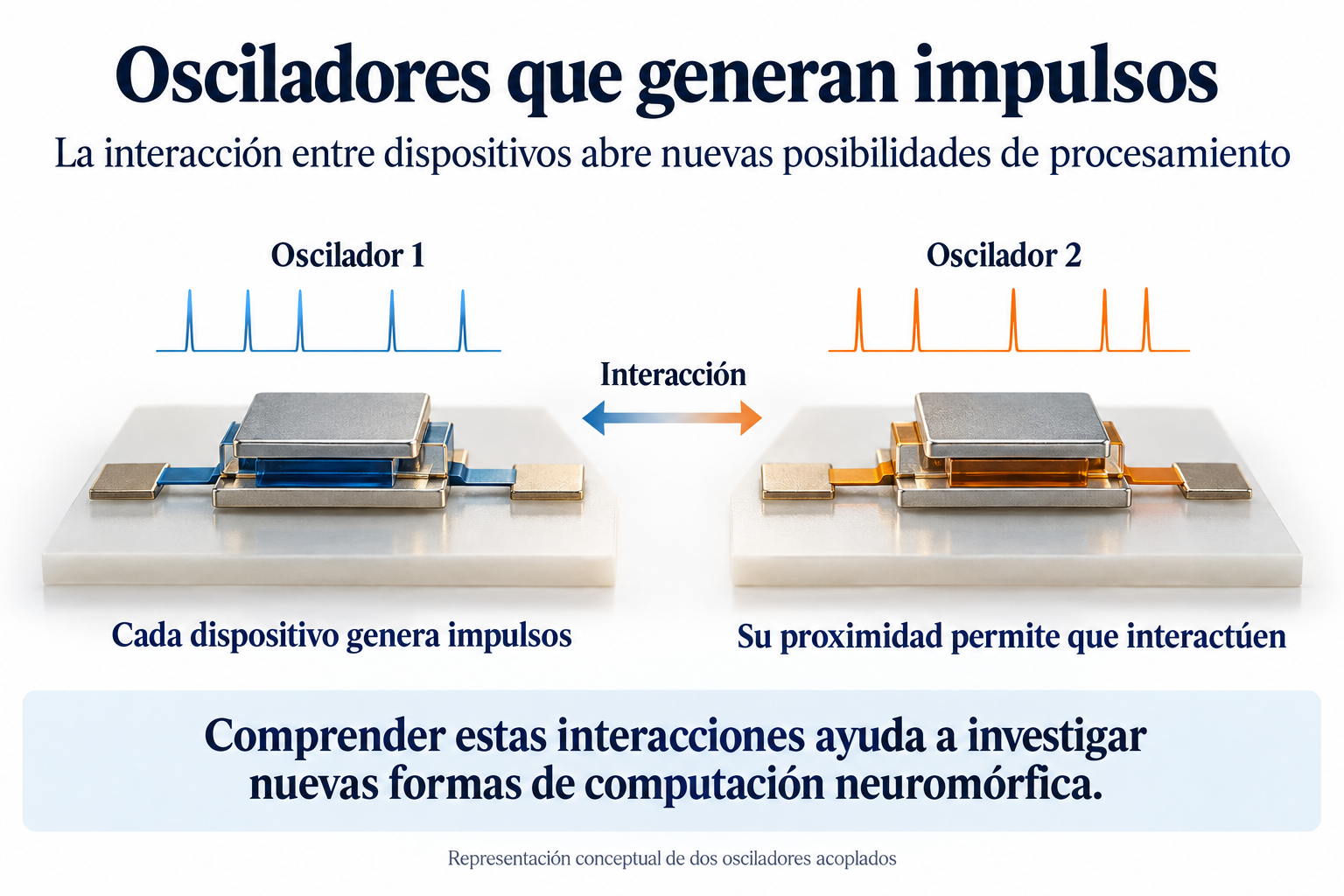
Conceptual representation of two oscillators that generate impulses and interact with each other. Own elaboration based on the presentation by Iván Schuller.
And here arises one of the most fascinating parts of the research: some of these properties had not even been predicted a priori.
Schuller’s nanoscience group at UC San Diego has spent decades studying precisely the relationship between structure and physical properties in superlattices, heterostructures, nanostructured materials and complex oxides. This also changes the way we look for the hardware of the future.
The question is no longer limited to which known material has the property we need. We can ask what happens when we build new geometries, interfaces or combinations of materials. Innovation can emerge from the structure itself.
From 16 neurons to a possible new generation of hardware
The research is still in a basic science phase, although there are already experiments that allow us to study its potential.
Schuller explains that his center has built a system with 16 neurons and 256 artificial synapses and compared it with an equivalent CMOS neuromorphic circuit.
In that particular experimental case, the system developed with new materials showed lower energy consumption. The team also analyzed another critical variable: the space occupied.
As the number of conventional devices needed to reproduce a neuromorphic network increases, the area required inside the chip may become another bottleneck. Power, heat, and miniaturization appear connected again.
The group also took their research to an experimental image recognition system. They used devices based on their materials to recognize a landmark building at UC San Diego and then compared the behavior with an equivalent system built with CMOS.
These experiments seek to demonstrate a principle: the physics of new materials can offer a viable route to build neuromorphic elements.
Schuller compares the current moment to an early stage of the semiconductor revolution. Computers with vacuum tubes were already working before the transistor. The emergence of new materials and devices later changed the scale, consumption, and possibilities of computing. The question is whether we may be at the beginning of another similar transition.
Beware of energy efficiency comparisonsHow
much better can a neuromorphic system be? Schuller’s answer is cautious.
The industry still needs sufficiently well-defined metrics to make homogeneous comparisons between architectures.
It is tempting to summarize the progress with a figure: how many times less energy does a device consume compared to a GPU, a CPU or a CMOS circuit.
The comparison depends on what we are measuring: Energy per operation? Energy needed to solve a task? Accuracy? Latency? Footprint? Data movement? Consumption of the entire system?
For Schuller, defining these metrics is part of the research itself.
Caution matters because neuromorphic computing generates enormous expectations around its efficiency. A result obtained in a specific experimental device cannot automatically become a universal statement about an entire architecture.
The potential is there. Demonstrating where a real advantage appears requires rigorous comparisons.
Edge computing: where neuromorphic can go firstWhere
can we first see neuromorphic systems capable of taking advantage of these advantages?
Schuller points to edge computing.
The idea is to process information close to where it is generated, rather than continuously sending all the data to a central infrastructure. This move is also driving Edge AI: artificial intelligence running directly on cameras, sensors, robots, vehicles, and other devices.
The best analogy is back in our body: the retina. Our eyes receive an enormous amount of visual information. Some of the processing happens before those signals reach other areas of the brain. The sensory system itself filters and transforms information near its source.
That logic is very attractive to the edge: a small device has little power and must react quickly. In some cases, it also works with a limited or no connection to the cloud. Processing locally only what matters can reduce communications, latency, and consumption.
Schuller places limited neuromorphic applications of this type within an approximate horizon of the next decade, although he insists on the uncertainty that accompanies any long-term technological prediction.
To explain this, he turns to another biological example: bees. Their nervous system can solve sophisticated navigation tasks using extremely compact neural circuits. That efficiency invites us to think of specialized devices that need relatively few artificial neurons to perform a very specific function.
The immediate opportunity may be there: small, specialized, extraordinarily efficient machines.
Drawing inspiration from the brain without copying
it Schuller uses the history of aviation to explain how far we should imitate biology. Birds proved that flying was possible and helped discover fundamental principles. Airplanes ended up flying in a different way. Neuromorphic computing can follow a similar logic.
The brain offers powerful clues: distributed processing, enormous parallelism, communication through events, integration between memory and calculation, and extraordinary energy efficiency.
Engineering must decide which principles are worth translating to hardware. To achieve this, disciplines that have traditionally worked separately are needed. Physicists, materials scientists and engineers collaborate in Q-MEEN-C and there is a direct connection to problems posed by neuroscience.
The whole chain matters: discovering materials, understanding their properties, manufacturing devices, connecting them and finally checking what tasks they can perform.
AI to create materials. Materials to create AI
The conversation between Marce Cancho and Iván Schuller leads to a relationship that works in two directions:
Artificial intelligence already helps to search for new materials. It can explore large spaces of compositions, find patterns and propose candidates that must then be synthesized and tested in the laboratory.
Schuller urges caution in the idea that AI could replace that experimentation. A computational prediction needs physical validation.
But there is the reverse, much less visible path: using new materials to build new forms of artificial intelligence.
Materials with phase transitions, magnetic properties, collective behaviors, or unconventional electrical and thermal responses can become new pieces for processing information.
In this scenario, the future of AI will also depend on physicists and materials scientists.
For decades, the evolution of computing advanced through an extraordinarily efficient combination of silicon, miniaturization, architecture, and software.
The current expansion of artificial intelligence introduces new tensions. We want to compute more and do it in more places. We want real-time answers. We want to bring intelligence to sensors, robots, and autonomous systems. And we want to do so under ever-increasing constraints on energy, heat, space, and resources.
Neuromorphic computing proposes changing part of the rules.
Iván Schuller’s work adds another layer to this transformation: also changing the material with which we build machines.
The next big question for artificial intelligence may no longer be just how much computing power we can add.
It will also be what materials we are going to build it with.