

AI-generated summary
Predictive analytics turns historical data into foresight, using statistics, machine learning, and modern computing to estimate the likelihood of future events. In the era of Big Data, diverse and massive datasets (text, images, IoT, satellite feeds) are stored in data lakes and processed in real time, enabling organizations to forecast trends, customer behavior, failures, and natural events. This capability shifts decision-making from reactive reporting to proactive strategy, with models ranging from classification (categorizing risk or behavior) and regression (estimating quantities like demand or revenue) to time-series analysis for trend and seasonality detection.
Beyond models that extrapolate the past, a new generation of approaches aims to understand causality and system structure—causal inference, symbolic/knowledge-based AI, and model-based reinforcement learning using digital twins—so predictions remain robust under novel or disruptive conditions. Applications span climate resilience (early warnings for storms, floods, fires), Industry 4.0 predictive maintenance, fraud detection and credit risk in finance, and inventory optimization in retail. Accurate outcomes depend on high-quality data and expert oversight. The field is evolving toward “world models” and high-fidelity simulations that let organizations test interventions and explore multiple plausible futures rather than relying on single-line extrapolations.
The integration of historical data, advanced statistics, and machine learning allows organizations to move from reaction to proactivity, optimizing operations and strategic decisions, while offering crucial tools for risk management on a global scale.
The ability to anticipate future scenarios is today a strategic necessity. In an environment saturated with data, predictive analytics emerges as the discipline that allows historical information to be transformed into active intelligence. This technology applies mathematical rigor and current computing power to determine the probability of certain events occurring.
Traditionally, data analytics was limited to describing what had happened. Today, thanks to the maturity of Artificial Intelligence (AI) and access to powerful computing infrastructures, companies and institutions can forecast trends, customer behaviors, operational failures, and even natural phenomena with unprecedented accuracy. This paradigm shift is redefining decision-making in sectors ranging from manufacturing to climate crisis management.
What is predictive analytics in the context of Big Data?
Predictive analytics is a branch of advanced analytics that combines historical data, statistical algorithms, and machine learning techniques [a1] to identify the likelihood of future outcomes. Its essence lies in finding patterns in the past that have visibility into the present and projection into the future.
In the current context of Big Data, this discipline takes on a new dimension. Today’s technological capacity allows massive volumes of heterogeneous data (text, images, IoT sensor signals, web interactions, satellite data) to be processed and analyzed in real or near real time.
To manage this huge amount of raw information, organizations turn to infrastructures such as data lakes, which are essential for storing and preparing the data that will later feed predictive models.
The relationship between Big Data and predictive analytics is symbiotic: Big Data provides the raw material – the diversity and volume of information – while predictive analytics provides the tools to extract value from that mass of data, turning it into useful projections for business and society.
Beyond the Past: Differences Between Descriptive, Predictive, and Prescriptive
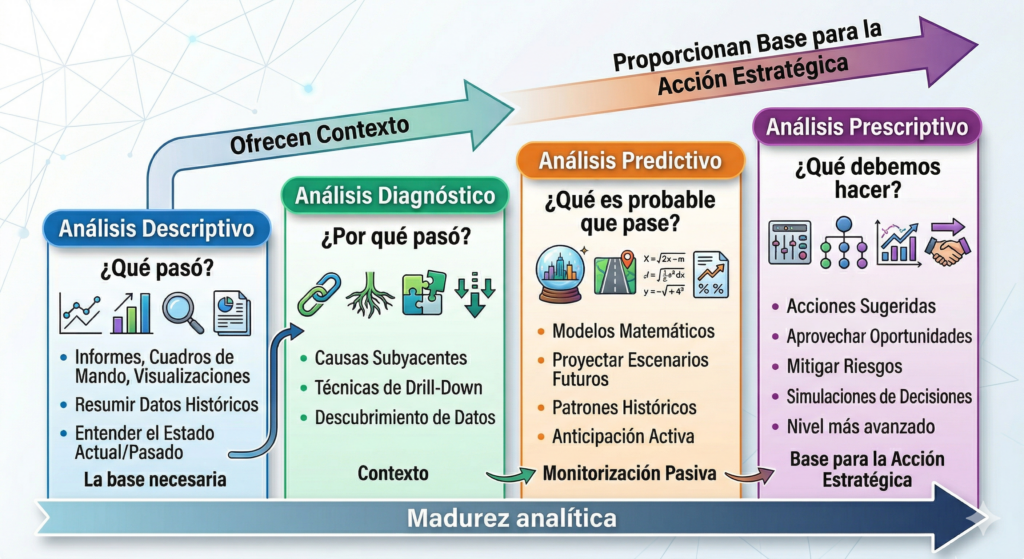
To understand the true scope of predictive analytics, it is useful to place it within the spectrum of analytical maturity. It is common to differentiate four levels, each providing greater value and complexity:
- Descriptive Analysis: It answers the question “What happened?”. It relies on reports, dashboards, and visualizations to summarize historical data and understand the current or past state of the business. It is the necessary foundation.
- Diagnostic Analysis: Focuses on “Why did it happen?” Looks for the underlying causes of a specific trend or event using drill-down techniques (dividing data into additional categories) and data discovery.
- Predictive Analytics: Addresses the question “What is likely to happen?” Uses mathematical models to project future scenarios based on patterns identified in historical data. Allows you to move from passive monitoring to active anticipation.
- Prescriptive Analysis: It answers “What should we do?”. It is the most advanced level. It predicts a possible future and suggests actions to take advantage of an opportunity or mitigate a risk, simulating the effects of different decisions.
Source: Authors’ elaboration with AI
While descriptive analysis and diagnosis provide context, predictive and prescriptive analytics provide the basis for strategic action.
How does it work? The symbiosis between statistics and Machine Learning
The operation of predictive analysis is based on an iterative process that combines the rigor of traditional statistics with the power of Machine Learning.
Statistics provides the mathematical foundations to understand the distribution of data, the correlations between variables and the significance of the patterns found. Classic models such as linear or logistic regression are still fundamental for well-defined problems.
Machine Learning is the engine that has accelerated the adoption and accuracy of predictive analytics. These algorithms are designed to learn from data automatically, identifying complex, non-linear relationships. As they are fed more data, machine learning models improve their accuracy, adapting to new patterns.
This symbiosis makes it possible to address problems of great complexity and scale, processing thousands of variables simultaneously to generate reliable predictions.
The analytical arsenal: typologies of models and their strategic impact
The choice of the predictive model is not a mere technical decision; it is a strategic decision that defines how the organization will interpret its future. Depending on the architecture of the business problem and the taxonomy of the available data, data scientists orchestrate different families of algorithms. Far from being watertight compartments, these typologies represent different approaches to extracting actionable intelligence. The most widely used models in the corporate and industrial environment fall into two large fundamental categories, to which the power of temporal analytics is added.
1. Classification Models: Intelligent Scenario Discrimination
This family of algorithms specializes in assigning probabilities of belonging to predefined categories or labels. It is the tool of choice when the strategic decision requires discriminating between discrete scenarios. These models not only respond to binary questions, but can manage multiple classes, segmenting reality into groups with differentiated behaviors.
From a strategic perspective, classification is crucial for:
- Proactive talent and customer base management: Anticipate critical decisions to optimize retention and lifetime value.
- Strategic example: Predict which customers are at high risk of unsubscribing in order to deploy hyper-segmented loyalty actions.
- Operational security and transactional integrity: Shield critical processes from anomalies and threats.
- Strategic example: Analyze financial transactions in milliseconds to determine whether their behavior is fraudulent or legitimate.
- Optimizing risk management: Allocate resources and capabilities based on probabilistic risk profiles.
- Strategic example: Automatically categorize credit applicants into risk segments (high, medium, low) to guide the granting policy.
2. Regression Models: the quantification of future uncertainty
When the strategic goal is not to label, but to accurately estimate a continuous numerical magnitude, regression is the right discipline. These models analyze the causal or correlational relationship between multiple independent variables to predict “how much” or “how many.” Their value lies in the ability to quantify uncertainty, providing, in addition to a core value, confidence intervals to guide operational and financial planning.
Their application is critical to:
- Advanced financial and budget planning: Overcome static models based on probabilistic market dynamics.
- Strategic example: Accurately estimate next quarter’s sales revenue by considering macroeconomic, marketing, and seasonal variables.
- Supply chain optimization and energy efficiency: Aligning capacity and resources with actual projected demand.
- Strategic example: Predict the demand for energy for the next week to optimize the purchase in the wholesale market or own generation.
- Operational resilience and climate adaptation: Quantify the impact of exogenous variables on physical activity.
- Strategic example: Estimate the temperature or rainfall that will be achieved in a specific area to adapt critical industrial or logistical processes.
Time Series Analytics: Deciphering the Chronological Dimension
Beyond classification and regression on cross-sectional data, Time Series represent a fundamental and specialized discipline in predictive analysis. Its power lies in the rigorous analysis of chronologically ordered data to decipher hidden trends, cycles, and seasonalities. These models are based on the premise that past behavior contains essential clues to predict future evolution over time.
This analytics is the basis for:
- High-precision stock forecasting (Demand Forecasting): Avoiding breakouts and logistical inefficiencies by anticipating peaks and troughs of demand with temporal resolution.
- Adaptation to environmental and market volatility: Modeling the evolution of the weather for agriculture and renewables, or price fluctuations in raw material markets.
The New Frontier: Models Beyond Historical Data
Exclusive dependence on the past presents a strategic risk: assuming that the future will be a linear extrapolation of yesterday. In highly volatile environments or in the face of disruptive events (“black swans”), traditional models can fail. As a result, the cutting edge of AI is developing technologies that do not learn from historical correlations, but seek to understand the underlying structure of reality.
This new wave of analytics includes:
- Causal Inference: While traditional AI correlates (X and Y occur together), causal inference seeks to understand why (X causes Y). This allows managers to simulate the impact of direct interventions or policy changes, even if they have never happened before, going beyond simple passive prediction.
- Symbolic AI and Knowledge-Based Models: These systems integrate business rules, physical laws, or expert knowledge directly into the algorithm. By combining data with pre-established principles, the model can make robust predictions in situations with very little historical data ( few-shot or zero-shot scenarios), based on the logic of the system rather than the repetition of patterns.
- Model-Based Reinforcement Learning (RL): Instead of learning from a static history, these AI agents [a2] learn by interacting with a dynamic simulation of the world (a digital twin). By building their own “internal model” of how the environment works, they can foresee the long-term consequences of novel actions, optimizing decisions in complex and changing scenarios that have no historical precedent.
Real-world examples of predictive analytics: from the enterprise to global resilience
The theory makes sense when applied to specific challenges. Predictive analytics is already transforming operations across multiple industries and even saving lives:
Climate resilience and disaster prevention
One of the fields where predictive analysis has the most vital impact is meteorology and climatology. Advanced predictive models, fed by data from satellites, ground stations and ocean buoys, analyse complex atmospheric patterns. This makes it possible to predict the formation and trajectory of hurricanes, the probability of floods or the risk of forest fires days in advance. This anticipation is crucial to activate emergency protocols, order evacuations and mobilise resources, avoiding human catastrophes and minimising economic damage. In Spain, for example, the AEMET and regional bodies use these models for the management of hydrological risks.
Industry 4.0: Predictive Maintenance
In the manufacturing sector, predictive analytics is the basis of predictive maintenance. IoT sensors installed in machinery capture constant data on vibration, temperature, and pressure. Algorithms analyze this flow of information and detect anomalous patterns that precede a technical failure. This allows maintenance to be scheduled just before the breakdown occurs, avoiding planned production stoppages.
Finance: fraud detection and risk management
Financial institutions use models to analyze transactions in real time. The algorithm evaluates each operation by comparing it with the customer’s usual behavior pattern and with known fraud typologies. In addition, predictive analysis is crucial to assess credit risk, projecting the probability of a requester’s default.
Retail and E-commerce: inventory optimization
E-commerce and department store platforms use predictive models to anticipate product demand. By analyzing historical sales data, search trends, and weather, they can adjust their stock levels, avoiding inventory run-outs and reducing storage costs.
Data quality (“Garbage In, Garbage Out”)
Despite the sophistication of machine learning algorithms, the success of predictive analytics critically depends on the quality of the input data. The “Garbage In, Garbage Out” principle is inescapable in this field.
A predictive model trained on incomplete, biased, or erroneous data will generate unreliable predictions. Therefore, the most critical phase of any project is the preparation of the data: collection of reliable sources, cleaning, transformation, and selection of the most influential variables.
Technological democratization has made these tools easier to access, but human supervision and expert judgment are still essential to validate models, interpret results, and ensure that predictions are translated into ethical and effective actions.
Future scaping: world models and high-fidelity simulations
The future of predictive analytics is evolving into what is known as future scaping. We are moving towards the creation of more sophisticated “World Models”.
These models, driven by the latest advances in deep AI, seek to understand the underlying causal relationships and physical laws that govern a system. By understanding how the world works (whether it’s a factory, a power grid, or the global climate), these systems can perform extremely accurate, high-fidelity simulations.
This will allow us to predict what a flood is likely and simulate how water will interact with a city’s specific infrastructure, testing the effectiveness of different mitigation measures before the event occurs.
In the enterprise arena, these simulations will allow managers to play with their own digital twins, virtual replicas of their organizations powered by this advanced analytics, testing market strategies or operational changes in a secure and ultra-realistic virtual environment. We are moving from predicting the most likely future to simulating and evaluating multiple possible futures.