
AI-generated summary
The Bankinter Innovation Foundation’s Startup Observatory has released its 2025 report on Spain’s entrepreneurial ecosystem, revealing a slight 3% decrease in total investment to €3.1 billion, yet with an 11% increase in the number of funding rounds to 376. This indicates more startups are receiving smaller average investments (€9.4 million per round, down 14%), but with a 34% rise in the median round size (€2.14 million), suggesting growth in intermediate-stage deals. Seed rounds have declined by 10% over three years, signaling challenges for early-stage startups, while Series A and C rounds grew significantly. Mega-rounds (€50 million+) stabilized but accounted for a smaller share of total investment. Venture capital remains dominant, participating in 70% of deals, with mixed funding rounds and public funds gaining traction. Local investors fund nearly half of rounds but contribute only 16% of total capital, while combined local and international investment surged nearly 200%, despite a 46% drop in purely foreign investment. Barcelona leads in funding raised, followed by Madrid and Valencia.
In a discussion with Miguel Arias of K Fund, key trends were highlighted: early-stage investment is shifting towards larger Series A and B rounds; international mega-funds create asymmetrical dynamics by investing broadly without deep involvement; capital is a crucial competitive tool, but startups must build defensible “moats” such as regulatory barriers, exclusive data, capital, user experience, and contextual knowledge. AI is accelerating startup growth and polarizing the ecosystem, favoring “clear winners” and causing a decline in middle-tier companies. Future AI developments include world models and intelligent robotics, with emerging trends in distributed AI (Edge AI), defense investment, and space sector technologies. Arias predicts AI agents’ corporate adoption, sophisticated cyberattacks, and increased market liquidity from forthcoming IPOs, emphasizing Europe’s need for coordinated efforts to remain competitive. The Observatory provides an interactive platform to explore these data and trends in detail.
An X-ray of the Spanish startup ecosystem in 2025: investment, AI, venture capital and strategic keys to the future, according to the Observatory's report.
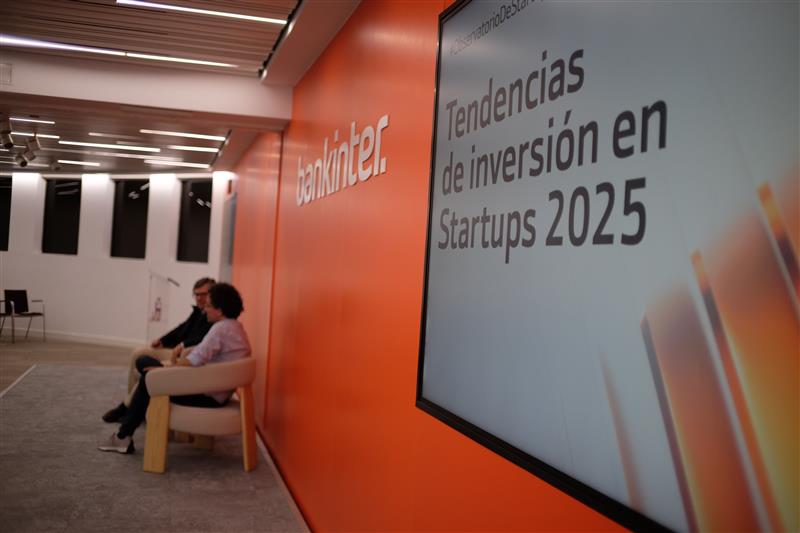
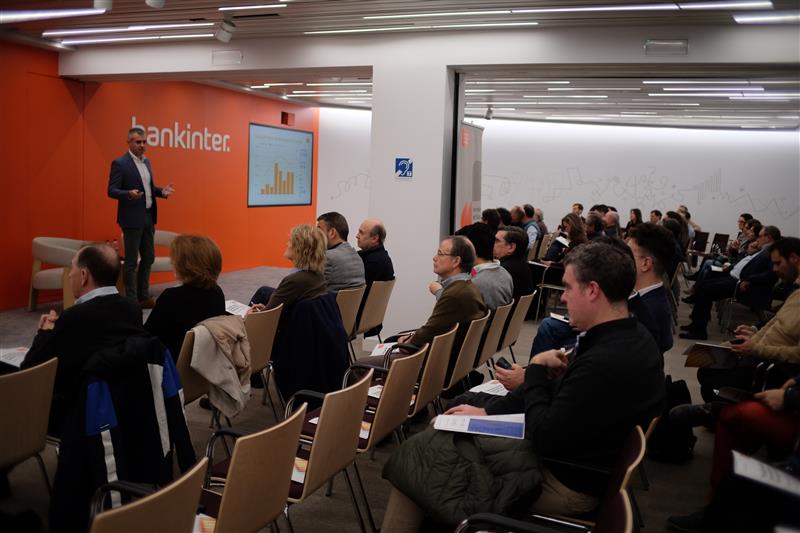
Once again this year, the Startup Observatory of the Bankinter Innovation Foundation takes the pulse of the Spanish entrepreneurial ecosystem. In this edition, the report Investment Trends in Startups 2025 was presented in Madrid by José Carlos Huerta, director of the Foundation’s Startups program, at an event led by Juan Moreno, CEO of the Foundation.
The 2025 report reflects a scenario of a slight correction in investment volume, but with signs of dynamism and consolidation. Below, we summarize the most relevant data.
Less volume, more trades
In 2025, 3,108 million euros were invested, which represents a slight drop of 3% compared to the previous year. However, the number of trades grew by 11%, reaching 376 rounds. This combination implies that the capital was distributed among more startups, reducing the average size of the rounds to 9.4 million (-14%), although the median increased by 34% to 2.14 million, suggesting an increase in intermediate operations.
Seed, on the downside. Intermediate series, on the rise
Seed rounds fell by 10%, with only 89 operations, the most worrying figure in the report. This is the third consecutive year of decline in the initial phases, confirming a negative trend for the start-up of new projects.
In contrast, Series A (€1-5M) and Series C (€20-50M) rounds grew by 34% and 65% respectively, while Series B remained practically flat with a slight drop of 3%.
Mega-rounds (greater than €50m) remained stable in 15 operations, which accounted for €1,354 million, i.e. 44% of the total invested. This figure represents a drop compared to 2024, when they represented 57% of the volume.
Financing: venture capital remains key
Venture capital participated in 70% of all operations, consolidating itself as the main driver of the ecosystem. The use of mixed rounds (equity + debt + public financing) is also growing, as is the weight of public funds and debt, although in a more residual way.
Who invests in Spanish startups?
49% of the rounds were financed exclusively with local investors, although their contribution to the total invested was only 16.2%. On the other hand, mixed investment (local + international) increased by almost 200%, to 1,317 million, reflecting greater collaboration between national and international funds.
Foreign investment alone fell by 46% to 1,091 million. Even so, international funds continue to be the majority in the most advanced rounds, especially from Series C onwards.
The most active funds
Among the most active national funds are Eoniq Fund, Draper B1, JME Ventures and K Fund Leadwind, the latter with 9 operations deployed in Spain in one year, despite being a $250M fund. At the international level, Shilling VC (Portugal) and Andreessen Horowitz (USA) lead, with 5 operations each.
Industries and geography
Software (+493% compared to 2024) leads sector investment, with €516 million, driven by the rise of artificial intelligence. It is followed by biotech and life sciences (+290% compared to 2024) and business & productivity. In terms of the number of operations, health & wellbeing also stands out, especially in the early stages.
Barcelona consolidates its position as the leader in the ecosystem, with €1,374 million raised in 140 operations. It is followed by Madrid (more than €800M), Valencia and San Sebastián, which stands out for the mega-round of Multiverse Computing.
Exits
In 2025, 49 exits were registered, a figure practically identical to the previous two years. Highlights include the IPO of Hotelbeds (valuation: €2,840 million), the sale of vLex (€850 million) and the acquisition of Wallapop by Naver (€377 million).
These data confirm that the Spanish startup ecosystem is moving towards greater maturity: there are more operations, more intermediate investment and a growing balance between local and international capital. Although challenges persist in the earliest stages, the professionalization of the sector, the consolidation of hubs such as Barcelona and Madrid, and the active involvement of foreign venture capital show an increasingly competitive and attractive market.
If you want to learn more about all the data, graphs and conclusions, you can download the full report of the Bankinter Innovation Foundation’s 2025 Startup Ecosystem Observatory here .
Startups, AI and international capital: keys to the market according to Juan Moreno and Miguel Arias
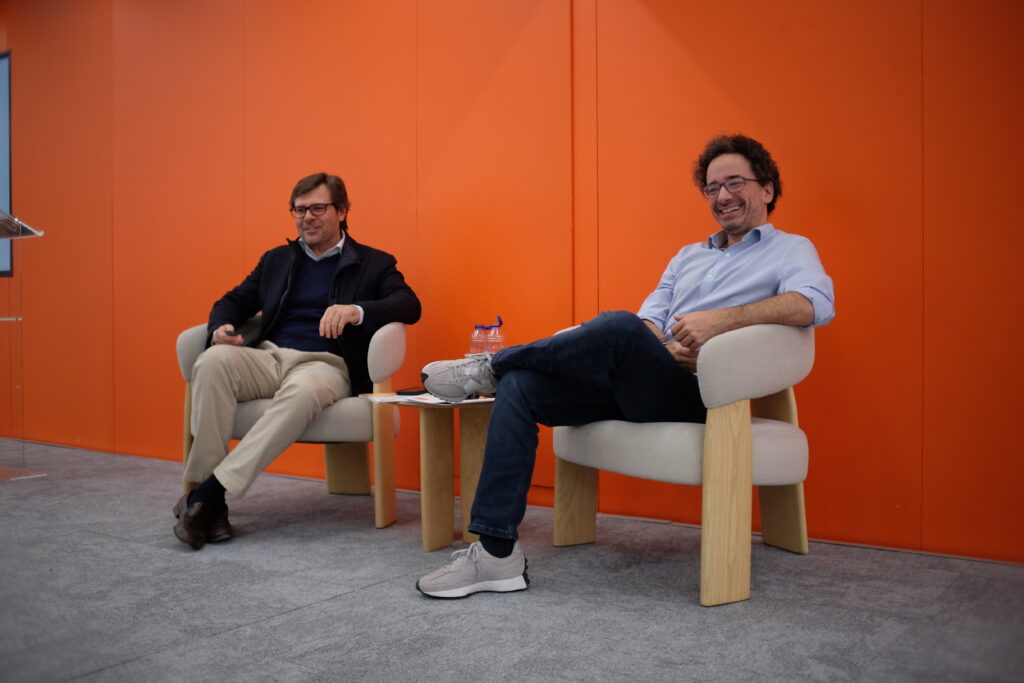
With this context on the table, Juan Moreno, director of the Bankinter Innovation Foundation, spoke with Miguel Arias, general partner at K Fund, where he leads Leadwind, to analyse the trends that are shaping the entrepreneurial ecosystem beyond data.
These are the six key ideas that marked the talk:
1. Is investment falling in early stages? Not exactly
Although the report shows a 10% drop in seed rounds, Miguel Arias qualifies: there is a shift towards Series A and B rounds with characteristics typical of initial phases. Startups founded by entrepreneurs in the second round, without a product yet, are raising between 1 and 5 million euros from the beginning. According to Arias, what used to be called pre-seed is now on the radar of funds such as Series A due to the profile of the team and its ability to execute.
2. Giant Bottoms and Asymmetrical Dynamics
The ecosystem is seeing the rise of international mega-funds such as Andreessen Horowitz, which has recently been able to raise 15,000 million dollars and enter companies without looking so much at the price, but at the percentage of participation. This generates distortions: large funds buy optionality, investing in many startups without necessarily accompanying them. “For them you are one more, for you it is your only chance,” Arias warned. Of course, he also recognized its positive role in imposing standards and speed in the market.
3. Capital as a competitive weapon (and how to protect yourself)
In an environment where creating technology is increasingly easier and faster, capital becomes one of the main competitive tools. Investors construct winning stories (“king making“): they decide who is going to lead a category and that story becomes reality through network effect, customer attraction and greater financing.
But Arias warns that money is not enough: in a market where foundational models (such as ChatGPT, Antropt or Claude) are advancing so quickly, startups must protect themselves with “defensive moats“, i.e. structural elements that are difficult to replicate and that secure their position.
Some of the most solid pits, according to Arias:
- Regulation: Sectors such as healthcare or biotechnology require official approval to operate. This creates a real barrier against the competition.
- Exclusive access to data: Having unique or hard-to-obtain datasets provides a critical advantage.
- Capital: raising a lot of money can be, in itself, a form of defense against competitors.
- Interface: the design of the user experience will be increasingly decisive. It’s not all about chatting with an AI – the way we interact will make key differences.
- Context: Understanding the specific environment where an AI operates – a company, an industry, a country – provides value that generalist models cannot match.
4. Extreme acceleration and disappearance of the startup middle class
The rise of artificial intelligence is causing an unprecedented acceleration in the growth of some startups. Miguel Arias mentioned cases that have gone from 0 to 10 million euros in turnover in just eight months, and from 10 to 100 million in less than two years, such as Lovable. These figures reflect a voracious market appetite for AI solutions… but also the lack of real barriers to entry: if you can grow so fast, others can too.
The result is a radicalized and polarized ecosystem: investors focus on a few “clear winners,” while many strong but more moderately growing companies — the former SaaS middle class — are left off the radar.
According to Arias, this new context leads to an increase in startup mortality and an early M&A boom: companies that have grown fast and raised capital can acquire others that have been left behind, absorbing their team, technology or revenue.
5. Robotics, world models, and agents: what’s next
Arias highlighted two major lines of evolution in AI:
- World Models: capable of simulating physical environments and real-world rules. Key for sectors such as climate, logistics or health.
- Intelligent robotics: Advances in zero-shot learning are accelerating the development of more capable robots. In his words: “the world is made for humans, that’s why humanoid robots make sense.”
6. Distributed AI, defense and new investment frontiers
Looking to the near future, Arias anticipates the coexistence of foundational models and small models, optimized to run on local devices (Edge AI). This orchestration will allow the use of models to be adapted according to need and cost, which is essential as the range of AI applications expands.
At the same time, a paradigm shift is taking place in investment in security and defence. Funds that were previously banned from investing in such companies have begun to do so actively, driven by geopolitical instability, global competition with China and the US and the urgency of building real European digital sovereignty.
Finally, he mentioned the rise of the space sector. Not so much in the launchers (rockets), but in the technologies that make it possible: “the shovels”, as he himself called them. Companies that offer data, sensors, processing or communications, and that can become key pieces of this new infrastructure.
Looking to the future: agents, exits and European sovereignty
In closing, Arias left three predictions for the next 18 months:
- Real take-off of AI agents in corporate environments.
- Rise of sophisticated cyberattacks based on deepfakes and personal data.
- More liquidity in the market after the expected wave of IPOs (they could be Stripe, OpenAI,…), which may cause a positive cascade effect in Spain as well.
He also warned of the urgent need for a more cohesive Europe if it wants to compete in the automation and robotics race. According to Arias, we still have time in that battle, but coordinated action, investment and a real single market are needed.
A free interactive tool
All these reflections do not remain in the air. For those who want to delve deeper into the data and validate these trends with real evidence, the Bankinter Innovation Foundation’s Startup Observatory is the best place to start. It is an interactive, free and open platform that allows you to explore all the investment rounds registered in Spain since 2018, apply filters by sector, city, round size, startup or type of investor, and analyze the evolution of the ecosystem in depth.
Access the Observatory and subscribe here: