AI-generated summary
Induced pluripotent stem cells (iPS) are adult cells—commonly from skin or blood—that have been reprogrammed to a pluripotent, embryonic-like state. Discovered by Shinya Yamanaka in 2006 (human cells in 2008), iPS cells can differentiate into almost any tissue type—neurons, cardiomyocytes, pancreatic beta cells—making them a versatile platform for studying disease, screening drugs, and developing regenerative therapies without using embryos.
Reprogramming changes which genes are active, not the DNA sequence, by introducing specific transcription factors (the Yamanaka factors). From a small patient sample, researchers produce iPS cells and guide them with chemical signals into desired cell types, enabling personalized disease models and drug tests on patient-derived tissues. Compared with embryonic stem cells, iPS cells avoid major ethical issues and reduce immune rejection risk when used autologously, though challenges remain: ensuring genetic stability, complete and safe differentiation, and improving reprogramming efficiency. iPS technologies gain power when combined with AI for data analysis, CRISPR gene editing to correct mutations, synthetic biology for design, and scalable biomanufacturing for clinical use. While many clinical applications are still under evaluation, iPS cells have already transformed biomedical research and are central to the future of personalized regenerative medicine.
Induced pluripotent stem (iPS) cells allow adult cells to be reprogrammed into almost any tissue in the body. Find out how they work, what applications they have in regenerative medicine and why they are considered one of the great revolutions in biomedicine.
Induced pluripotent stem cells (iPS) are adult cells that have been reprogrammed to regain the ability to become almost any cell type in the body. This discovery has opened up new possibilities for studying diseases, developing drugs and moving towards a more personalized regenerative medicine, while also avoiding the use of embryos.
Just two decades ago, the idea seemed like something out of science fiction: Would it be possible to take a cell from the skin of an adult person and make it behave like an embryonic cell again? For a long time, the answer was no. Cell differentiation was thought to be a path of no return.
Everything changed in 2006. Japanese researcher Shinya Yamanaka managed to reprogram adult mouse cells to return them to a pluripotent state. Two years later he repeated the process with human cells. His discovery completely transformed cell biology and earned him the Nobel Prize in Medicine in 2012, shared with John Gurdon.
Since then, the so-called induced pluripotent stem cells, known as iPS (induced Pluripotent Stem Cells), have become one of the most promising tools in regenerative medicine.
Their importance goes far beyond laboratories: today they allow us to study human diseases with a level of detail that was unthinkable a few years ago, to test drugs on tissues obtained from the patient himself and to bring the possibility of developing completely personalized therapies closer.
What are induced pluripotent stem cells?
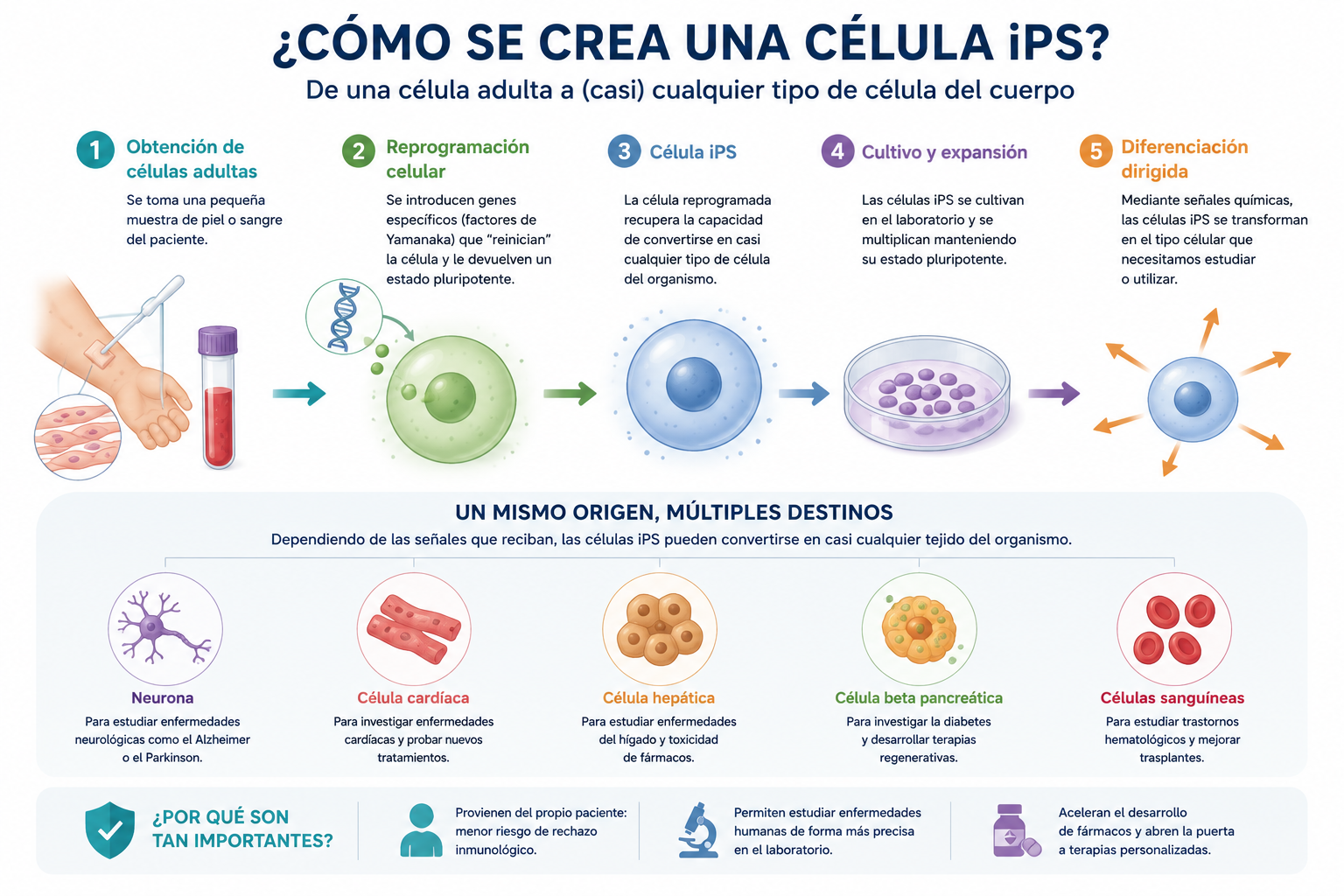
Induced pluripotent stem cells are adult cells – usually obtained from skin or blood – that have been reprogrammed to regain the ability to become almost any cell type in the body.
In other words, a specialized cell temporarily “forgets” what its function was and returns to a state very similar to that of an embryonic stem cell. From that moment on, it can differentiate into neurons, cells of the heart, liver, pancreas or many other tissues. This ability is called pluripotency.
It is precisely this versatility that makes iPS an extraordinary platform for researching diseases and developing new therapies.
Reprogrammed Adult Cells: Going Back in Development
All the cells in our body contain practically the same DNA. What differentiates a neuron from a muscle cell or a liver cell is not the genes they have, but which ones remain active and which ones remain silenced.
Cell reprogramming consists precisely of modifying this pattern of genetic expression. By activating a small set of transcription factors – known as Yamanaka factors – the cell recovers characteristics typical of the early stages of embryonic development. It does not change its DNA; what changes is the program it is executing.
A good analogy is to imagine a computer. The hardware remains exactly the same. What is modified is the operating system that is running.
How are iPS cells obtained?
The entire process is much easier to understand than it seems.
a small sample of adult cells is obtained. They usually come from a skin biopsy or a blood sample.
Then, the researchers introduce a combination of genes capable of activating the cell reprogramming process.
As the days go by, some of these cells begin to lose the characteristics of the tissue they came from and regain a pluripotent state.
From there, the process changes direction completely. Instead of letting them evolve spontaneously, researchers can guide them using chemical signals to transform them into the cell type they need to study:
- Neurons to investigate neurodegenerative diseases.
- Cardiomyocytes to analyse cardiovascular pathologies.
- Pancreatic beta cells to study diabetes.
- Whole tissues generated in the laboratory to test new treatments.
The ability to obtain virtually any tissue from a skin sample represents one of the greatest advances in regenerative medicine.
The big difference compared to embryonic stem cells
For many years, stem cell research was associated with intense ethical debate.
Embryonic stem cells have an enormous capacity for differentiation, but to obtain them it is necessary to use human embryos. iPS completely changed this scenario. As they come from the patient’s own adult cells, they eliminate a large part of the ethical dilemmas associated with embryonic cells and allow working with biological material obtained through minimally invasive procedures.
This does not mean that both cell types are identical. Embryonic stem cells are still the gold standard for much research, while iPS cells still present some challenges related to genetic stability or reprogramming efficiency.
However, for a large number of biomedical applications they represent an extraordinarily useful alternative.
Applications of induced pluripotent stem cells
The true value of iPS appears when they leave the basic research laboratory and begin to solve real problems.
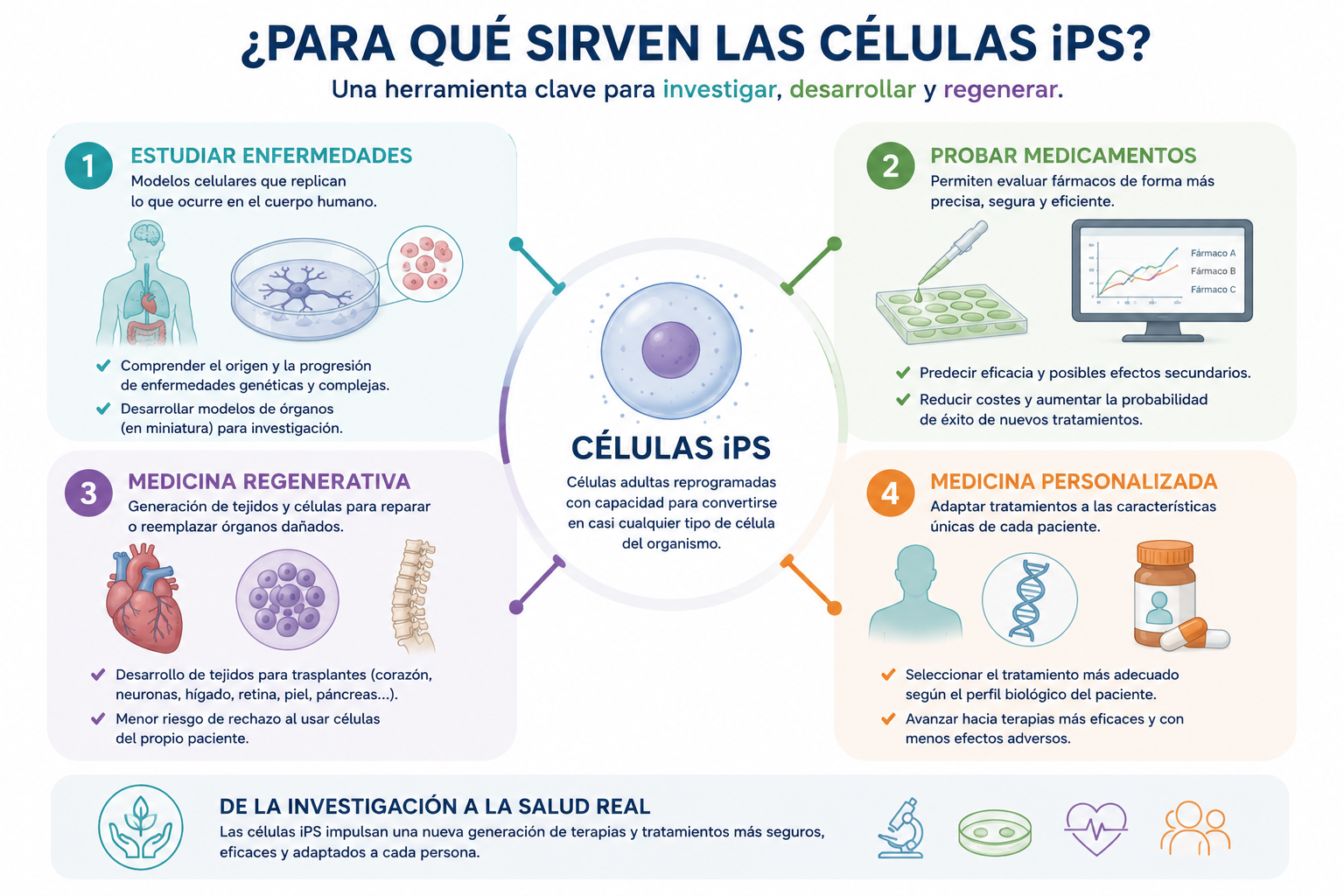
Today they are already used in multiple lines of work ranging from the discovery of new drugs to personalized medicine.
Studying diseases without intervening on patients
One of the biggest challenges in medical research is understanding how a disease evolves within human cells.
Many pathologies affect tissues that are very difficult to obtain. It is not easy to study living neurons from a Parkinson’s patient or cardiomyocytes from a person with hereditary heart disease.
iPS cells offer an elegant solution: researchers can obtain a small sample of the patient’s skin, reprogram it, and generate exactly the cell type affected by the disease in the laboratory.
This makes it possible to observe how cellular alterations appear from their early stages and to understand much better the biological mechanisms involved.
In neurodegenerative diseases such as Alzheimer’s or Parkinson’s, this approach is providing much more representative experimental models than those available until a few years ago.
Testing drugs before reaching clinical trials
Another major application is to evaluate new drugs: instead of testing a compound only on animal models or conventional cell lines, researchers can use cells obtained directly from specific patients.
This makes it possible to analyse how each tissue responds to treatment, identify potential side effects and select the molecules most likely to succeed before starting clinical trials.
In addition to accelerating pharmaceutical development, this approach can help reduce costs and increase the chances that a drug will eventually reach the market.
Regenerative medicine: repairing tissues with the patient’s own cells
The goal that generates the most expectations around iPS cells is regenerative medicine: if it is possible to obtain pluripotent cells from the patient himself, it could also be possible to generate healthy tissues to repair damaged organs.
There is still a long way to go, but there are already numerous clinical trials exploring this possibility. Its application in retinal diseases, spinal cord injuries, heart pathologies, diabetes or Parkinson’s disease, among others, is being investigated.
One of the great attractions of iPS is that the cells can come from the patient himself. This reduces the risk of immune rejection and brings closer the concept of personalized medicine, in which each treatment is adapted to the biological characteristics of each person.
The challenge is no longer just about obtaining the right cells, but about getting them to form functional, safe and stable tissues once implanted.
Are umbilical cord stem cells pluripotent or multipotent?
This is one of the most frequent questions when talking about regenerative medicine.
The answer is no. Umbilical cord stem cells are not pluripotent. Most are multipotent, which means that they can generate different cell types, but within a specific family of tissues.
For example, hematopoietic stem cells present in umbilical cord blood can produce different types of blood cells and have been successfully used in transplants for decades to treat diseases such as certain leukemias or lymphomas.
iPS cells go one step further. By regaining pluripotency, they can differentiate into almost any tissue in the body, greatly expanding their possibilities in research and regenerative medicine.
The challenges: a technology with enormous potential, but still in development
Induced pluripotent stem cells represent one of the great advances in modern biomedicine. However, there are still significant challenges before they can be routinely used in clinical practice.
Ensuring Safety
One of the main challenges is to ensure that the reprogrammed cells maintain adequate genetic stability, since alterations can occur during the reprogramming process that affect their subsequent behavior.
In addition, cells must differentiate in a complete and controlled manner before any therapeutic application. A cell that retains characteristics of the pluripotent state could proliferate in an unwanted way. For this reason, safety remains a top priority in all research.
Improve rescheduling efficiency
Although today’s techniques are much more effective than they were a decade ago, the process can still be optimized.
Researchers are working to increase the efficiency of reprogramming, reduce the time needed to obtain iPS cells, and develop increasingly accurate and reproducible methods. Each improvement brings these technologies closer to wider clinical use.
When Multiple Technologies Converge
One of the most interesting aspects of iPS cells is that they rarely act in isolation. Their true potential appears when combined with other emerging technologies.
Artificial intelligence, for example, already helps analyze millions of cell images, identify patterns invisible to the human eye, and select optimal conditions for cell differentiation. It also facilitates the analysis of large volumes of biological data and accelerates the discovery of new treatments.
Gene editing using CRISPR opens up another particularly promising possibility. Researchers can correct a mutation responsible for a disease in iPS cells before differentiating them into the tissue needed by the patient. In our article on CRISPR or molecular scissors, we explained how this technology allows DNA to be edited with unprecedented precision.
iPS cells are also part of the ecosystem of synthetic biology, a discipline that seeks to design biological systems in increasingly predictable ways. If synthetic biology provides new tools for programming cell behavior, iPS cells offer an extraordinary model for testing them.
And all of this requires an infrastructure capable of transferring research to the clinical environment. As we saw in our article on pilot bioreactors, the production of cells for therapeutic use requires highly controlled systems that guarantee quality, safety and reproducibility.
Far from advancing separately, these technologies are reinforcing each other.
The Future of Induced Pluripotent Stem Cells
In just twenty years, iPS cells have gone from being a laboratory discovery to becoming an essential tool for biomedical research.
Their impact is already visible in the development of new drugs, in the study of complex diseases and in the first regenerative medicine trials.
The next step will be to integrate these cells with other technologies capable of accelerating the design of personalized treatments:
- Artificial intelligence will help to better understand cell behavior.
- Synthetic biology will make it possible to design increasingly sophisticated biological functions.
- Gene editing will make it easier to correct diseases before cells become functional tissues.
- And biomanufacturing will make it possible to produce these treatments at a scale compatible with clinical practice.
The great revolution of induced pluripotent stem cells is to demonstrate that medicine is beginning to work with cells in a completely new way: to understand them, reprogram them and guide them to actively participate in the repair of the organism itself.
Glossary
| Term | Definition |
| Induced pluripotent stem cells (iPS) | Adult cells reprogrammed to regain the ability to become almost any cell type. |
| Pluripotency | The ability of a cell to differentiate into virtually every tissue in the body. |
| Cell reprogramming | The process by which a specialized cell regains a state similar to the embryonic one by activating certain genes. |
| Cell differentiation | The transformation of a stem cell into a specialized cell type, such as a neuron or cardiomyocyte. |
| Yamanaka Factors | A set of four transcription factors used to induce pluripotency in adult cells. |
| Regenerative Medicine | A branch of medicine that seeks to repair or replace damaged tissues and organs through cell therapies, tissue engineering, and other advanced technologies. |
Frequently asked questions
What are induced pluripotent stem cells?
They are adult cells that have been reprogrammed to regain the ability to become almost any cell type in the body, similar to embryonic stem cells.
How are they obtained?
They are generated from adult cells, usually skin or blood, activating a small set of genes that return them to a pluripotent state.
How are they different from embryonic stem cells?
They share much of their biological properties, but iPS cells are obtained from adult cells, avoiding the use of embryos and many of the associated ethical dilemmas.
Are umbilical cord stem cells pluripotent?
No. They are mostly multipotent, which means that they can generate different cell types, but within a specific family of tissues.
What applications do they have today?
They are used to study diseases, test new drugs, investigate cell development processes and advance regenerative medicine therapies.
Are they already used to cure diseases?
There are very promising clinical trials, especially in ophthalmology and other areas of regenerative medicine, but many applications are still in the research and clinical evaluation phase.