
AI-generated summary
The McKinsey report “The Top Trends in Tech” outlines ten pivotal technology trends shaping the current decade, forecasting unprecedented progress in the next ten years compared to the past century. Visionary Peter Diamandis emphasizes that advances in classical and quantum computing will drive exponential improvements across interconnected technologies like AI, robotics, blockchain, and virtual reality. This rapid evolution is fueled by increased global access to technology and abundant investment capital, accelerating innovation and breakthroughs.
The report categorizes these trends into seven broad and three industry-specific areas. Key trends include next-generation process automation combining robotics and AI to enhance efficiency; the future of connectivity driven by 5G and IoT enabling faster data transmission; distributed infrastructure merging cloud and edge computing for quicker analytics and security; and next-generation computing with quantum and neuromorphic chips unlocking new scientific possibilities. Applied AI enhances pattern recognition and productivity, while Software 2.0 transforms programming through machine learning. Trust architectures like blockchain and zero trust security frameworks address cybersecurity challenges. The bio-revolution integrates life sciences with AI and automation, impacting healthcare, agriculture, and materials. Innovations in new generation materials and clean technologies aim to improve performance sustainably across energy, transportation, buildings, and water sectors. Together, these trends promise to reinvent industries and markets, driving a technological transformation with profound economic and societal impacts this decade.
In just 10 years we will experience more progress than in the last century, thanks to the exponential improvement of technological innovations, which are intertwined and enhanced by each other.
We review the report that McKinsey has published, The top trends in tech, and say goodbye to 2021 by looking to the future and summarizing the technological trends to watch this decade.
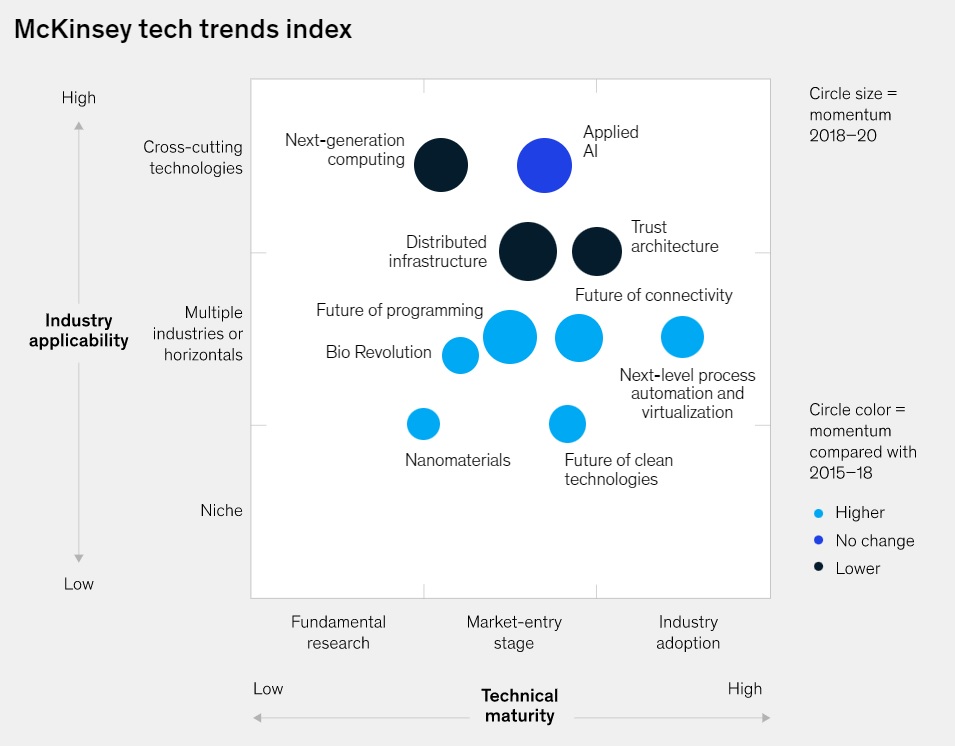
This report highlights 10 technology trends; 7 of which are general in scope and 3 specific to specific areas of activity.
In this decade we will experience more progress than in the last 100 years.
Peter Diamandis
According to visionary Peter Diamandis, founder of the XPrize Foundation and co-founder of Singularity University, this decade will see more progress in computing than in the past 100 years . Whether it’s classical or quantum computing, as it becomes faster and cheaper, many technologies that use it also become more capable. For example, communication networks, sensors, robotics, virtual and augmented reality, blockchain , and artificial intelligence (AI) are improving exponentially. But they are also intertwined and converge: for example, AI with robotics. And that’s getting even faster because the number of people with access to technology is increasing. There is also more capital available than ever before, which means more innovative ideas are funded, which in turn leads to more breakthroughs.
We summarize the trends that McKinsey points out:
Top 10 Technology Trends
Below, we share the list of the 10 technological trends. This list is drawn up according to the amount of venture capital invested, the number of patents applied for and the implications they have when it comes to innovation, allowing companies, markets, industries and entire sectors to be reinvented.
1. Next generation in process automation and virtualization
This trend is based on the combined power of robotics, artificial intelligence, the Industrial Internet of Things (IIoT), digital twins, and 3-D or 4-D printing (also known as additive manufacturing or AM) combining to streamline routine tasks, improve operational efficiency, and accelerate time to market.
This trend will change the future of work, where the skills needed for the professionals of the future will become more social, emotional, and technological as intelligent machines take on more physical, repetitive, and basic cognitive tasks.
2. The future of connectivity
This trend combines fifth-generation (5G) mobile broadband networks and the Internet of Things (IoT) to enable faster connectivity over longer distances, with exponentially faster downloads and latency (the time it takes to retrieve data) reduced to almost nothing. Without the 5G network being deployed, work is already being done on 6G.
Major changes will be brought about in the business landscape, from the digitalization of manufacturing (through wireless control of mobile tools, machines, and robots) to decentralized power delivery and remote patient monitoring.
3. Distributed infrastructure
It’s the marriage of cloud and edge computing (Cloud Computing + Edge Computing) to help enterprises bring computing power to the edge of their networks, enabling them to reach data-intensive devices, with much lower latency, in a greater number of locations that are even more remote, and to accelerate decision-making with advanced analytics data on demand. This trend will help companies increase their speed and agility, reduce complexity, save costs, and strengthen their cybersecurity defenses.
4. Next-generation computing
Quantum computing and neuromorphic computing, the latter with the development of specialized microchips called application-specific integrated circuits (ASICs), promise to help find answers to problems that have troubled science and society for years, unlocking unprecedented capabilities for businesses. It also promises to reduce the development time of chemical and pharmaceutical products with simulations, accelerate the development of autonomous vehicles with quantum artificial intelligence and transform cybersecurity.
5. Applied artificial intelligence
It involves implementing AI algorithms to train machines to recognize patterns and interpret and act on those patterns. In short, helping computers make sense of real-world data, including video or images, text, and audio.
This trend promises to improve customer satisfaction through new customer interfaces and interaction methods, as well as increase productivity and reduce operating expenses.
Applied AI will also have a disruptive effect on research and development through generative models and next-generation simulations.
6. The future of programming
This is what is called Software 2.0, in which programmers are helped by neural networks that use machine learning to develop software. It promises to accelerate use cases of enormous complexity such as in autonomous vehicles, where the only way to progress is through artificial intelligence models. It will also provide organizations with a much easier, iterative, and intuitive way to customize existing code and automate programming tasks.
7. Trust Architecture
It’s a set of technologies and approaches designed for a world of growing cyberattacks. These trusted architectures provide frameworks for verifying the reliability of devices as data flows across networks, APIs, and applications. Trust architectures include distributed ledger technologies (DLTs), including blockchain, and “zero trust security” approaches to prevent data breaches. In addition to reducing the risk of breaches, trusted architectures reduce the cost of complying with security regulations, reduce capital and operational expenses associated with cybersecurity, and enable more cost-effective transactions, for example, between buyers and sellers.
8. The Bio-revolution
It reflects the confluence of advances in life science combined with the accelerated development of computing, automation, and AI, which together are giving rise to a new wave of innovation called the Bio-revolution. It promises a significant impact on the economy and our lives and will affect industries ranging from healthcare and agriculture to consumer goods, energy and materials. Biomolecules, which include “omics” and molecular technologies, have become the most advanced and fastest-growing biological science, but biomachines, biocomputing, and biosystems are also important dimensions.
The rapid pace of life science will soon bring competitive disruption, and not just in healthcare. As biological innovations penetrate industries such as food, consumer health, and new materials, higher margins can be realized in exchange for greater personalization by consumers and patients. New markets may emerge, such as genetic-based nutrition recommendations, hyper-personalized medicine, and the development of new vaccines in record time.
9. New generation materials
Innovations in materials science are revolutionizing many industries. Next-generation materials such as graphene and 2-D materials, molybdenum disulfide nanoparticles, nanomaterials, and a range of smart, sensitive, and lightweight materials enable new functionality and improved performance in pharmaceuticals, energy, transportation, healthcare, semiconductors, and manufacturing. Because they have a lower environmental impact, next-generation materials will be critical to future sustainability. While many of these materials are still in the research stage, others are approaching their commercial potential. Molybdenum disulfide nanoparticles are already being used in flexible electronics, while graphene has helped drive a resurgence of 2-D semiconductors.
10. Future of clean technologies
This trend includes new technologies that address the growing need for clean energy generation, including systems for smart grid energy distribution, energy storage systems, carbon-neutral power generation, and fusion energy. The Foundation’s next Future Trends Forum will delve into this topic with international experts.
These new technologies will have a wide application:
- Energy, such as renewables (solar photovoltaic, solar thermal and wind), clean coal, carbon capture, smart grid and metering technologies, energy storage solutions, energy efficiency and waste-to-energy opportunities.
- Transportation, such as clean vehicles, electric vehicles (hybrids, plug-in hybrids, and batteries), fuel cells, and batteries.
- Buildings and infrastructure, such as automation, HVAC, windows, insulation, home energy management, appliances, and LED lighting
- Water, such as wastewater treatment and desalination/membranes.
If you want to know the technological trends that we analyze in our think tank, Future Trends Forum, we invite you to browse our connectome.